


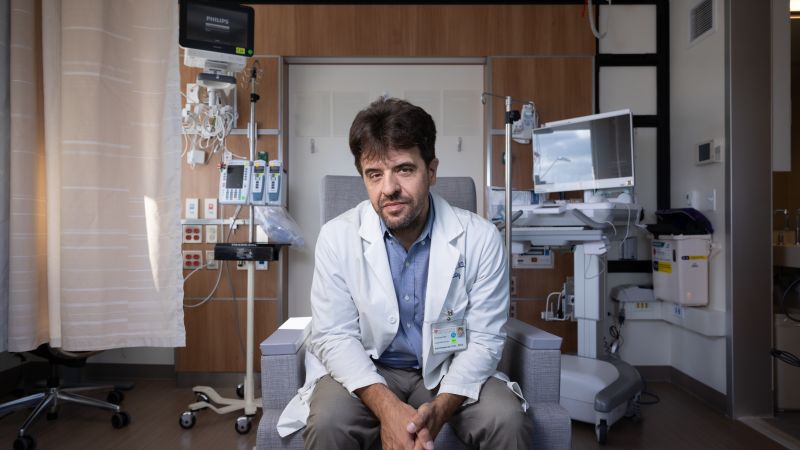
Karl Deisseroth, a renowned bioengineer, neuroscientist, and psychiatrist at Stanford University, has created the Human Neural Circuitry program in an effort to better understand and treat some of the most baffling mysteries of the mind.
“How do brain cells create an emotion or a feeling?”
That’s the question driving Dr. Karl Deisseroth, a renowned bioengineer, neuroscientist and psychiatrist at Stanford University whose <a href="https://healthylife7.com/we-drove-down-smoking-now-we-need-the-same-resolve-on-obesity-cancer-research-uk/” title=”We drove down smoking; now we need the same resolve on obesity – Cancer Research UK”>research has already reshaped much of our understanding about the human brain
The answer could provide insights into some of the most complex and severe mental health conditions, including schizoaffective disorder and borderline personality disorder
About 1 in every 200 people develops schizoaffective disorder during their life. The condition is marked by schizophrenia symptoms like delusions and hallucinations as well as depression and mania. In the US, some 14 million people have borderline personality disorder, which involves patterns of unstable, intense emotions, impulsive behaviors, self-mutilation and an unhealthy view of oneself
“This is the sort of experience that most people don’t ever see but need to know about and care about — and put the appropriate level of care and science and societal support behind,” Deisseroth said
Finding what causes these conditions is the mission of Deisseroth and his team as they combine cutting-edge neuroscience with a state-of-the-art laboratory in an inpatient hospital setting called the Human Neural Circuitry program
Deisseroth and his Stanford colleagues hope to better understand neuropsychiatric disorders — and how best to treat them. His ultimate goal is to decode “the inner world of human beings as it is experienced in health and disease.”
“That scientific discovery aspect is very exciting and motivating,” he told CNN. “Although I treat patients and do clinical research, I’m really a basic scientist at heart. That’s what drew me to neuroscience and the study of the brain: How can cells give rise to an emotion? How can they create one version of reality that may be different from another brain’s version of reality?
“We’re approaching this from a basic curiosity standpoint as well as treatment standpoint,” Deisseroth added
The program began three years ago in what Stanford hails as a unique collaboration of biomedical scientists, data scientists, neurosurgeons, neurologists and psychiatrists — with the main research being conducted inside Stanford Hospital on the same floor as the hospital’s epilepsy monitoring unit
During testing in one mode, patients wear a shower-cap-like array of electrodes for noninvasive recording of brain activity. Other times, patients have deep brain recording electrodes that are placed and removed by neurosurgeons. In both cases, real-time electrical activity from the brain is collected and transmitted
A volunteer wearing a cap full of sensors, which pick up tiny voltage changes from active neurons near the scalp, undergoes testing in the lab.
These are “very large data streams, spanning the brain and with sub-millisecond resolution,” Deisseroth said
The data streams can communicate with servers across the Stanford campus with a “round-trip time of less than half a millisecond, allowing closed-loop work for sensing and responding.”
The responses, he said, are tracked as “people carry out activities such as interacting socially, listening to stories, describing sensory responses and describing internal feelings — sometimes in the context of different medications — and all in a naturalistic, comfortable, safe and private setting
“The key innovation here is, we get results with millisecond precision,” Deisseroth said. “Exactly as problems are happening, we’re literally seeing what’s going on in the brain at the millisecond level — and that’s the crucial step.”
The tests go beyond schizoaffective disorder and borderline personality disorder. Investigators are also studying autism, cancer-induced depression, epilepsy, chronic pain, dissociative disorders, obsessive-compulsive disorder and other brain-related conditions
The research is conducted with the full consent of patients; almost every patient has expressed a deep curiosity about what is happening inside their brains, Deisseroth said
The Human Neural Circuitry program is already paying dividends. In a study published in the journal Science in May 2025, researchers found that humans and mice share persistent brain-activity patterns in response to a mildly adverse sensory experience (in this case, an eye puff test like what you go through at the eye doctor)
Deisseroth explains his research, saying, “We were interested in where the signals in the brain start, how they propagate, and how that relates to what the person is experiencing.”
“We were interested in where the signals in the brain start, how they propagate and how that relates to what the person is experiencing at that exact moment,” Deisseroth said
The investigators identified triggering activity inside the brain that provided “deep insight into the origination of these neural activity patterns that relate to negative emotions.”
“It was a wonderful first step,” he said. “We couldn’t have done this without the setup of the Human Neural Circuitry program.”
Three decades ago, Deisseroth’s life changed in an instant. He was a budding neurosurgeon late in his residency at Stanford Medicine. At 27, Deisseroth had “structured my whole career” around becoming a neurosurgeon, but life had other plans
During a required psychiatry phase of his residency, he was stationed in a locked psychiatric ward, taking notes at a nurse’s station when a patient undergoing a full-blown schizoaffective episode approached him, screaming
“I remember just sitting there in the chair looking up at him and just seeing his mix of fear and anger,” Deisseroth said. “He was yelling at me. He had a perception or delusion that I was scheming against him
“His anger and his rage and his fear — and seeing it play out just a few inches in front of me — it was just a staggering experience, and obviously it was shocking.”
With the Human Neural Circuitry program, Deisseroth says he hopes to decode “the inner world of human beings as it is experienced in health and disease.” He added, “That’s what drew me to neuroscience and the study of the brain: How can cells give rise to an emotion?”
Most people might’ve walked away from that experience and never returned. Deisseroth decided to change career paths and dedicate his life to understanding the brain and psychiatric disorders, because that type of suffering is “next level.”
“For me, it’s been a long path,” he said, “but I’m finally coming full circle to that patient in some ways.”
Deisseroth is already acclaimed for his breakthrough invention of optogenetics, a revolutionary technology that allows scientists to control specific brain cells using beams of light, what he often describes as a “universal remote that operates the body’s tiniest cells.”
The technique combines optics and genetics and has been used by thousands of researchers in labs around the world to better study the brain, cardiac tissue, stem cells and the development of organisms. It can also be used for things like triggering or blocking pain responses, while providing scientists with insight into what is happening during such events
His name consistently comes up for consideration of the Nobel Prize in medicine for the innovation
Dr. Anil Malhotra, the co-director of the Institute of Behavioral Science at the Feinstein Institutes for Medical Research at Northwell Health, called Diesseroth a pioneer who is “really bringing together basic science with clinical psychiatry.”
“I think most of the research world, not just in psychiatry, pays a lot of attention to this kind of approach, and in addition, they pay a lot of attention to Dr. Deisseroth, who again is probably on the short list for a Nobel Prize at some point in time,” Malhotra told CNN
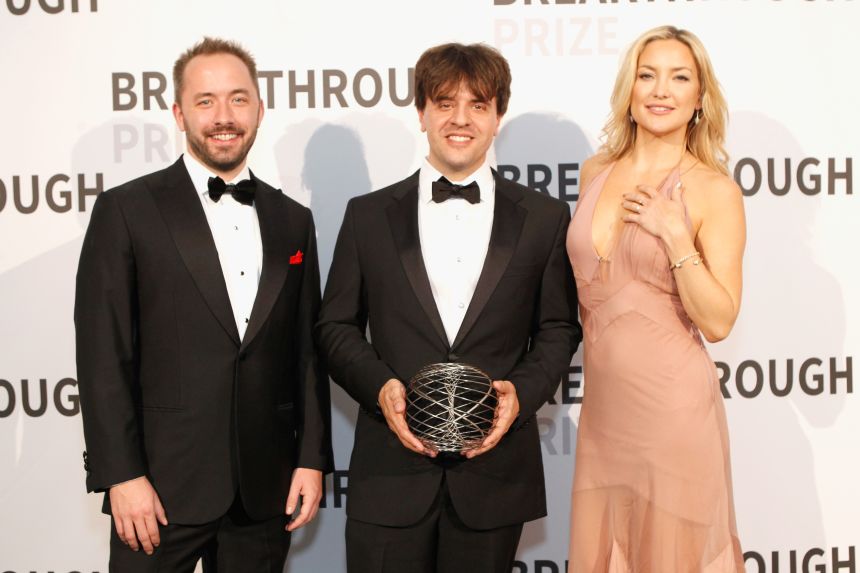
Dr. Karl Deisseroth, center, accepted the 2016 Breakthrough Prize in Life Sciences alongside Drew Houston, the founder and CEO of Dropbox, and actress Kate Hudson at the 2016 Breakthrough Prize Ceremony in November 2015 in Mountain View, California.
Deisseroth said he believes his current work is his most important. Even with all of the major medical advances in recent decades, he said, the human brain remains the least understood organ
“For every other organ, we at least have a pretty good mechanistic model for what’s going on. The heart is clearly pumping blood. We can model the heart as a pump,” he said. “With the brain, we don’t quite understand exactly at that level what it’s trying to do, so it’s much harder to fix.”
A volunteer is fitted with a cap that has small metal disc electrodes that will register signals through the scalp and skin.
But, he said, it’s not impossible — and that is why the Human Neural Circuitry program is so “exciting.” He ponders deep questions daily:
- What if treatments can be developed for specific neural circuit activity during a breakdown as it happens?
- What if a severe autistic storm can be put out almost as quickly as it starts?
- What if cancer-induced depression can become a thing of the past through research developed out of his Stanford lab?
“There’s no limit to the disorders that we can study under these conditions and come to a deep understanding of what’s actually going on all across the brain during these very complex and hitherto quite private symptoms,” Deisseroth said
He added, “The goal is to have, for the first time, treatments that relate to that neural circuitry dynamics as it happens in the moment.”
And he won’t stop until he achieves that goal
