


Download PDF
Abstract
Background: The popularity of GLP-1 receptor agonists (GLP-1 RAs) for weight loss has increased significantly in recent years, raising concerns about self-medication with these medications. Objective: To assess the proportion and identify factors associated with GLP-1 RA use without medical prescription among GLP-1 RA users in Brazil. Methods: This cross-sectional study was conducted through a self-administered online questionnaire including adults aged 18 years or older residing in Brazil who reported current or past use of GLP-1 RAs for weight loss. We reported the proportion of self-medication and explored associated factors using Poisson regression with robust variance, adjusting for potential confounders. Results: A total of 860 participants were included (mean age: 39.46 ± 10.61 years; 82.0% female; 47.1% with obesity). The proportion of self-medication with GLP-1 RA was 23.8% (95% CI: 21.1–26.8%). Predictors of self-medication included not having obesity (PR = 1.45; 95% CI: 1.13–1.89), not attending physical training centers (PR = 1.55; 95% CI: 1.23–1.96), and working in healthcare-related professions (PR = 1.45; 95% CI: 1.14–1.84). Conversely, being married (PR = 0.73; 95% CI: 0.57–0.94), having diabetes (PR = 0.35; 95% CI: 0.18–0.70), or having eating disorders (PR = 0.72; 95% CI, 0.34–0.97) were associated with lower self-medication rates. Conclusion: Almost one in four users reported using GLP-1 RAs without medical prescription. This practice was more frequent among individuals without obesity, those not attending physical training centers, and healthcare professionals.
Subjects
- Metabolic syndrome
- Obesity
Introduction
Overweight and obesity are highly prevalent worldwide [1]. As these conditions are associated with several health problems, concerns about weight management have been increasing progressively [2, 3]. Obesity management typically includes lifestyle measures, such as dietary changes and physical activity. However, some individuals require pharmacological or surgical interventions [1]
Among pharmacological treatments, GLP-1 receptor agonists (GLP-1 RAs) have emerged as therapeutic options offering significant weight loss. GLP-1 RAs mimic the action of endogenous GLP-1, enhancing satiety and delaying gastric emptying [2, 3]. Currently, this class of medications is approved for the treatment of obesity in individuals with a body mass index (BMI) ≥ 30.0 kg/m², or in those with a BMI between 27.0 and 29.9 kg/m² with weight-related comorbidities [4]
GLP-1 RAs have gained widespread popularity among the general population [5, 6]. As a result, an increasing number of individuals are seeking GLP-1 RAs in pursuit of weight loss [7, 8]. However, these attempts are often undertaken without appropriate safety measures [9]. The concerns regarding the safe and proper use of these medications are so significant that the Food and Drug Administration (FDA) issued a statement warning about the risks associated with unapproved versions of GLP-1 RAs [10, 11]. Also, a recent statement was issued regarding hospital admissions and deaths associated with the inappropriate use of GLP-1 RAs in the United Kingdom [12].
Brazil has strict rules for the commercialization of GLP-1 RAs for individual use [13]. However, the use of these medications without a medical prescription remains common [13]. Although regulations governing the commercialization of GLP-1 RAs existed, pharmacies were not required to retain medical prescriptions until 2025 [14]. This regulatory context may have facilitated access to these medications without formal prescription. Reports of self-medication with GLP-1 RAs for weight loss have also increased in recent years [15].
Self-medication is a potentially harmful practice associated with the risk of serious adverse events [16]. This practice can exacerbate body image disorders and may also be driven by them [17]. Considering the potential harms of self-medication at both the individual and population levels, this study aimed to characterize the profile of individuals engaging in self-medication with GLP-1 RAs. Additionally, it sought to identify predictors associated with this practice. Understanding these aspects may help support public measures aimed at reducing this behavior, a particularly relevant point given the lack of studies specifically addressing self-medication with GLP-1 receptor agonists.
Methods
Study design and data collection
This cross-sectional study evaluated the proportion and determinants of use of GLP-1 RAs without medical prescription in a web-based sample in Brazil. Data were collected through a self-administered online questionnaire developed and hosted on the REDCap platform (supplementary material). The survey targeted Brazilian adults with internet access who reported current or prior use of GLP-1 receptor agonists and was disseminated between November 2024 and April 2025
The questionnaire was disseminated through both digital and in-person outreach strategies. On digital platforms (WhatsApp, Instagram, TikTok, YouTube, and Facebook), a direct hyperlink to the self-administered REDCap survey was shared in posts, stories, and targeted advertisements. In addition, QR codes linked to the same survey were made available both online and in physical settings. For in-person dissemination, printed materials containing QR codes were displayed in public and clinical environments, allowing participants to access the questionnaire using their mobile devices. All responses were submitted directly through the REDCap platform.
To enhance nationwide reach and minimize selection bias, social media dissemination was supported by traffic control strategies, including paid advertisements and geographically targeted promotions. Information on sociodemographic characteristics, clinical history, and self-medication with GLP-1 RAs was obtained. All data were self-reported. Informed consent was obtained through online agreement from all eligible participants prior to any data collection
Study population
Participants were adults aged ≥18 years residing in Brazil who reported current or previous use of liraglutide or semaglutide for weight loss. At the time of data collection, liraglutide and semaglutide were the only GLP-1 receptor agonists approved in Brazil for the treatment of overweight and obesity. Participants were required to be able to complete the online survey. Exclusion criteria included refusal to provide informed consent or completion of less than 75% of the survey
Outcomes
The primary outcome was the proportion of participants reporting GLP-1 RA use without medical prescription. Secondary outcomes included the identification of sociodemographic, behavioral, and clinical factors associated with a higher likelihood of self-medication with GLP-1 RAs. For analysis purposes, participants were classified as having GLP-1 use without medical prescription if they reported any occurrence of self-medication, even if they had also reported episodes of prescribed use at different points in time.
Sample size
The minimum sample size estimation was performed using the OpenEpi Collection of Epidemiologic Calculators (v3.01) [17]. Assuming a 95% confidence level, a 5% margin of error, and an anticipated proportion of 50%, the required sample size was 383 participants. The 50% proportion was chosen to yield the most conservative estimate, given the absence of prior data on self-medication with GLP-1 RAs
Statistical analysis
Sociodemographic and clinical variables were described overall and stratified by GLP-1 RAs use without medical prescription, using descriptive statistics. Continuous variables were reported as means (standard deviations [SD]) and categorical variables as frequencies (percentages). The proportion of GLP-1 RA use without medical prescription was reported with 95% confidence intervals estimated using the Clopper–Pearson method. As predictors were analyzed separately through regression models, no formal statistical comparisons were performed between groups at this stage.
To explore associations between participant characteristics and the proportion of non-prescribed use, Poisson regression with robust variance was used to estimate crude and adjusted prevalence ratios (PRs) and their respective 95% confidence intervals (95% CIs). Sex, age, family income, obesity status, marital status, attendance at physical training centers, history of eating disorders, history of diabetes, and working in a health-related profession were explored as potential predictors of GLP-1 RAs use without medical prescription.
The adjusted model included all variables that were individually analyzed in the crude models. Reference groups were female participants, those of younger age, participants with obesity, those attending physical training centers, non-healthcare professionals, single participants, and those without diabetes or eating disorders. All analyses were conducted only after data collection was completed. Analyses were performed using SPSS® software (version 27.0; SPSS Inc., Chicago, IL), and a p-value < 0.05 was considered statistically significant. Associations were considered statistically significant when the 95% confidence interval did not include 1.0.
Ethical approval
The study was approved by the Institutional Ethics Committee of Pontifícia Universidade Católica do Rio Grande do Sul (PUCRS) (Certificate of Presentation of Ethical Appreciation number 80273024.2.0000.5336) and carried out in accordance with Good Clinical Practice guidelines and the principles of the Declaration of Helsinki. The Strengthening the Reporting of Observational Studies in Epidemiology (STROBE) guidelines were followed when reporting the study [18]. All authors signed the confidentiality document for data use. Informed consent was obtained from all participants.
Results
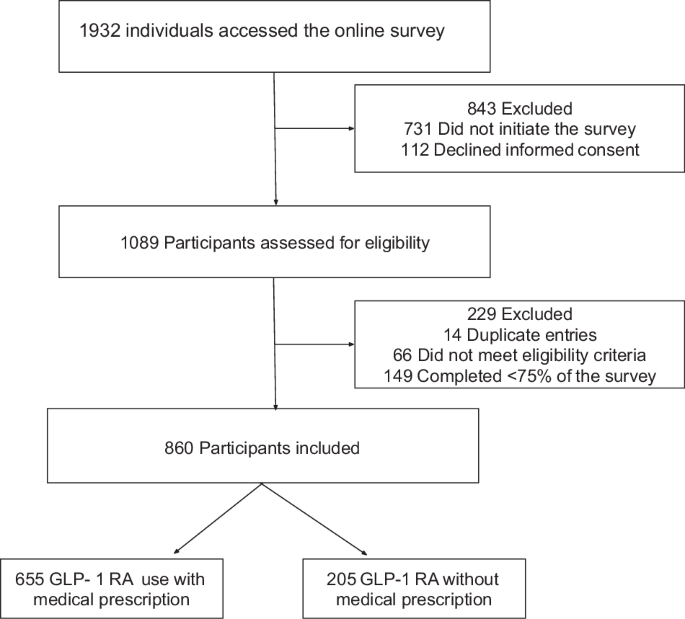
Between November 2024 and April 2025, 1201 individuals initiated the online survey, and 1089 provided electronic informed consent and were assessed for eligibility. Among these, 229 did not meet the eligibility criteria and were excluded, resulting in a total of 860 participants included in the study (Fig. 1). Overall, participants had a mean age of 39.46 ± 10.61 years and a mean body mass index (BMI) of 30.20 ± 5.67 kg/m², with 405 (47.1%) classified as having obesity. Most participants were female (n = 702, 82.0%) and held a university degree (n = 727, 84,5%). Most participants (n = 727, 84.5%) reported a history of semaglutide use, while 368 (42.8%) reported a history of liraglutide use. Few participants had hypertension, diabetes, or dyslipidemia; however, a high proportion reported a history of psychiatric disorders, mainly anxiety and depression (Table 1). Anxiety and depression were assessed by self-report in the questionnaire and were not based on structured diagnostic interviews or validated screening instruments.
Flow diagram of participant selection
The proportion of participants reporting GLP-1 RA use without medical prescription was 23.8% (Table 2). Among these, only 19 individuals (9.3%) had previously used GLP-1 RAs with a medical prescription, which suggests that most self-medication cases occurred without prior medically supervised use. The prevalence of self-medication was higher among participants without obesity (adjusted PR = 1.46; 94% CI, 1.13–1.89; p = 0.004), those not attending physical training centers (adjusted PR = 1.55; 95% CI, 1.23–1.96; p < 0.001), and those working in a healthcare profession (adjusted PR = 1.45; 94% CI, 1.14–1.84; p = 0.002). Conversely, it was lower among participants who were married (adjusted PR = 0.73; 95% CI, 0.57–0.94; p = 0.014) and among those with diabetes (adjusted PR = 0.35; 95% CI, 0.18–0.70; p = 0.003) or with eating disorders (adjusted PR = 0.72; 95% CI, 0.34–0.97; p = 0.032). No significant differences were observed for age and sex in either the crude or adjusted models. Among participants, 91.9% of those with obesity reported experiencing some form of social pressure to lose weight. Comparable proportion was observed among individuals with overweight (89.7%), and notably, 83.9% of participants with a BMI < 25 kg/m² also reported having experienced pressure to reduce their weight.
Family income was associated with a higher prevalence of self-medication in the crude analysis, with participants from the high-income group showing a higher prevalence compared to those from lower-income group (crude PR = 1.72; 95% CI, 1.13–2.60); however, this association was no longer significant after adjustment
Discussion
In this study, we assessed the proportion and determinants of self-medication with GLP-1 RAs among Brazilian users. Our findings indicate that nearly one in four participants reported using GLP-1 RAs for weight loss without a medical prescription. The proportion observed in our study may still be underestimated, as some participants may have been reluctant to report use without a medical prescription
Self-medication was more common among participants who did not attend physical training centers. A substantial proportion of individuals without obesity reported non-prescribed use of GLP-1 RAs. This pattern may reflect broader sociocultural pressures related to weight and body image. In contrast, married participants were less likely to report self-medication. These findings suggest that demographic and behavioral factors may be associated with non-prescribed use of GLP-1 RAs. However, the mechanisms underlying these associations cannot be determined from this cross-sectional study
Additionally, healthcare professionals reported higher rates of self-medication. This finding may be related to easier access to medications and greater familiarity with GLP-1 RA devices and their use. In contrast, lower rates of self-medication were observed among individuals with diabetes or eating disorders. This may reflect greater contact with healthcare services and more frequent medical follow-up among these individuals
Interestingly, only a small proportion of individuals who used GLP-1 RAs without a medical prescription had prior medically supervised use. This finding suggests that non-prescribed use is not simply a continuation of previous treatment under medical supervision. It also raises questions about how individuals learn about these medications and make decisions regarding their use. Further studies are needed to better understand these pathways and the factors associated with non-prescribed use. In this context, the absence of a medical prescription may also reflect the absence of formal medical supervision. Healthcare professionals can play an important role in assessing eligibility, discussing potential benefits and risks, and providing guidance on medication use.
A substantial proportion of participants reported lower household income, despite the high cost of GLP-1 receptor agonists in Brazil. This finding should be interpreted within a context in which pharmacological treatment for obesity is not available through the Unified Health System (SUS). Access to obesity treatment may therefore vary across socioeconomic groups, although this issue was not specifically evaluated in the present study
Although well-established criteria exist for the pharmacological treatment of obesity, anti-obesity medications remain proportionally underprescribed compared to therapies for other chronic diseases [19, 20]. This treatment gap may create a mismatch between individuals who meet clinical indications and access to prescribing professionals. Such a mismatch may contribute to self-medication behaviors
An additional point of concern was the high proportion of GLP-1 RA users classified as having normal weight, even within the group with medical prescription. Although the present study was not designed to explore clinical indications in depth, this distribution suggests use beyond established BMI thresholds and warrants further investigation. This pattern may be partly explained by the high prevalence of perceived social pressure to lose weight, which was also reported by individuals with lower BMI in our sample.
Our findings highlight the need for strategies to regulate access, raise awareness and ensure that the use of GLP-1 RAs occurs within appropriate clinical contexts. In response to growing concerns, Brazilian health authorities enacted regulations requiring a retained medical prescription for the purchase of these medications, which came into effect in July 2025 [14]. As the data in this study were collected prior to the implementation of this measure, its impact on usage patterns and medication access remains to be evaluated.
Limitations
This study has some limitations. First, it relied on a self-administered questionnaire, which could have led to misunderstandings in interpreting the questions. Additionally, as a cross-sectional study, participants answered based on memory, which may have introduced recall bias. A prospective cohort study could provide further insights into GLP-1 RAs self-medication with less recall bias; however, cohort studies still depend to some extent on participants’ record-keeping and are costly and time-consuming. In this context, the cross-sectional design offers a practical approach to studying population profiles and comparing subgroups. As a cross-sectional study, temporal relationships cannot be established, and the associations identified should not be interpreted as causal. Reverse causality is possible. For example, individuals without obesity may have engaged in non-prescribed use because they anticipated difficulty obtaining a prescription, rather than the absence of obesity directly leading to self-medication. Likewise, individuals with diabetes or eating disorders may have been less likely to self-medicate because they were already under closer medical supervision.
This study used an online convenience sample recruited through online dissemination, which limits generalizability. The sample was predominantly female and highly educated, characteristics that may reflect greater engagement with digital platforms and health-related content. Therefore, the findings should not be extrapolated to the general Brazilian population. Instead, they reflect a subgroup of individuals actively seeking GLP-1 RAs for weight loss, which represents the population of interest in this investigation. Online surveys also allow for broad geographic reach. However, since we did not conduct an in-person survey, individuals without internet access could not participate. Nonetheless, we believe that the population at risk of GLP-1 RAs exposure likely has internet access.
Anxiety and depression were assessed through self-report and were not measured using validated diagnostic instruments or confirmed medical diagnoses, which may have introduced misclassification. In contrast, history of eating disorder was included in the adjusted model because such diagnoses typically require formal clinical evaluation, potentially conferring greater specificity. The exclusion of self-reported anxiety and depression from the primary multivariable model may have resulted in residual confounding, and future studies using standardized psychiatric assessments are warranted.
The digital context in which this study was conducted warrants careful consideration. The study population was recruited through an online questionnaire and may therefore represent individuals who are more engaged in digital environments. As a result, participants in this study may have been more exposed to information, advertising, and opportunities to obtain GLP-1 receptor agonists than the general population [21, 22]. Therefore, the patterns of self-medication observed in this sample may not be fully generalizable to the broader Brazilian population [23].
Finally, as the questionnaire was distributed by healthcare professionals, this may have deterred some individuals who self-medicate from participating. Despite these limitations, we believe this study is highly relevant, as it is one of the few in the literature addressing this issue
Conclusion
This study underscores the considerable proportion of GLP-1 RA self-medication and highlights user profiles, contributing to the understanding of populations most susceptible to this practice. The higher proportion among individuals without obesity and those not engaged in physical activity suggests that GLP-1 RAs may be increasingly used outside their approved therapeutic indications. These findings reinforce the importance of medical supervision and public awareness regarding the safe and appropriate use of GLP-1 RAs. Future studies should evaluate the impact of recent prescription-retention policies in Brazil and explore the long-term consequences of unsupervised use. Ultimately, ensuring that GLP-1 RAs are accessed within proper clinical contexts is critical to safeguard patient safety and preserve availability for those with legitimate medical indications.
Data availability
The study data will be accessible for one year following the article’s publication upon a justified request, submittedaccess agreement
References
Yanovski SZ, Yanovski JA. Approach to obesity treatment in primary care: a review. JAMA Intern Med. 2024;184:818–29
Marso SP, Daniels GH, Brown-Frandsen K, Kristensen P, Mann JFE, Nauck MA, et al. Liraglutide and cardiovascular outcomes in type 2 diabetes. N Engl J Med. 2016;375:311–22
Marso SP, Bain SC, Consoli A, Eliaschewitz FG, Jódar E, Leiter LA, et al. Semaglutide and cardiovascular outcomes in patients with type 2 diabetes. N Engl J Med. 2016;375:331–44
Elmaleh-Sachs A, Schwartz JL, Bramante CT, Nicklas JM, Gudzune KA, Jay M, et al. Obesity management in adults: a review. JAMA. 2023;330:2000–15
Chiappini S, Vickers-Smith R, Harris D, Papanti GD, Corkery JM, Guirguis A, et al. Is there a risk for semaglutide misuse? Focus on the FDA adverse events reporting system (FAERS) pharmacovigilance dataset. Pharmaceuticals. 2023;16:994
Butuca A, Dobrea CM, Arseniu AM, Frum A, Chis AA, Rus LL, et al. An assessment of semaglutide safety based on real-world data: from popularity to spontaneous reporting in EudraVigilance database. Biomedicines. 2024;12:1124
Pires SP, Leal BA, Souza IP, Rangel KCF, Santos Filho LE. Use of semaglutide for aesthetic and weight loss purposes by non-diabetic individuals. Res Soc Dev. 2023;12:e26121243905
Guerdjikova AI, Ward A, Ontiveros M, McElroy SL. Semaglutide misuse in atypical anorexia nervosa: a case report. J Clin Psychopharmacol. 2024;44:179–80
Orsolini L, Francesconi G, Papanti D, Giorgetti A, Schifano F. Profiling online recreational/prescription drugs’ customers and overview of drug vending virtual marketplaces. Hum Psychopharmacol. 2014;29:301–10
US Food and Drug Administration. FDA warns consumers not to use counterfeit Ozempic (semaglutide) found in U.S. drug supply chain [Internet]. 2025 [cited 2025 Apr 26]. Available from: https://www.fda.gov/drugs/drug-safety-and-availability/fda-warns-consumers-not-use-counterfeit-ozempic-semaglutide-found-us-drug-supply-chain
US Food and Drug Administration. FDA’s concerns with unapproved GLP-1 drugs used for weight loss [Internet]. 2025 [cited 2025 Apr 27]. Available from: https://www.fda.gov/drugs/postmarket-drug-safety-information-patients-and-providers/fdas-concerns-unapproved-glp-1-drugs-used-weight-loss
BMJ. GLP-1 receptor agonists: safety concerns [Internet]. 2024 Feb 24 [cited 2025 Apr 27];388:r390. Available from: https://doi.org/10.1135/bmj.r390
Linhares IS, Cardoso OO, Andrade JX, Nascimento FFD, Rodrigues MTP, Mascarenhas MDM, et al. Prevalence and factors associated with body image dissatisfaction among school students: National School Health Survey, 2019. Epidemiol Serv Saude. 2024;33
Agência Nacional de Vigilância Sanitária (ANVISA). Medicamentos agonistas GLP-1 só poderão ser vendidos com retenção da receita [Internet]. 2025 [cited 2025 May 1]. Available from: https://www.gov.br/anvisa/pt-br/assuntos/noticias-anvisa/2024/canetas-emagrecedoras-so-poderao-ser-vendidas-com-retencao-de-receita
G1. Semaglutida para tratar obesidade é cada vez mais usada para fins estéticos; conheça os riscos da automedicação [Internet]. 2025 [cited 2025 Apr 26]. Available from: https://g1.globo.com/fantastico/noticia/2023/2/4/medicamento-semaglutida-para-tratar-obesidade-e-cada-vez-mais-usado-para-fins-esteticos-conheca-os-riscos-da-automedicacao.ghtml
Nguyen CT, Nguyen HT, Boyer L, Auquier P, Fond G, Do KN, et al. Prevalence and impacts of self-medication in a disadvantaged setting: the importance of multidimensional health interventions. Front Public Health. 2023;11:1176730
Dean AG, Sullivan KM, Soe MM. OpenEpi: openable from: www.OpenEpi.com
von Elm E, Altman DG, Egger M, Pocock SJ, Gøtzsche PC, Vandenbroucke JP. The STROBE statement: guidelines for reporting observational studies. J Clin Epidemiol. 2008;61:344–9
Elangovan A, Shah R, Smith ZL. Pharmacotherapy for obesity: trends using a population-level national database. Obes Surg. 2021;31:1101–9
Thomas CE, Mauer EA, Shukla AP, Rathi S, Aronne LJ. Low adoption of weight loss medications: a comparison of prescribing patterns of anti-obesity pharmacotherapies and SGLT2 inhibitors. Obesity. 2016;21:1955–61
Ashraf AR, Mackey TK, Schmidt J, Kulcsár G, Vida RG, Li J, et al. Safety and risk assessment of no-prescription online semaglutide purchases. JAMA Netw Open. 2024;8:e2428280
Mattingly TJ, Conti RM. Marketing and safety concerns for compounded GLP-1 receptor agonists. JAMA Health Forum. 2025;7:e245015
Instituto Brasileiro de Geografia e Estatística (IBGE). Gênero [Internet]. Rio de 401Janeiro:IBGE;[citado2026Jun7].Disponívelem: 402 https://www.ibge.gov.br/estatisticas/multidominio/genero.html
Funding
This work was supported by the Brazilian Federal Agency for Support and Evaluation of Graduate Education (CAPES), Finance Code 1. Additionally, TRC and LSM received PhD scholarships from CAPES. CAPES had no role in the design or conduct of the study; collection, management, analysis, or interpretation of the data; preparation, review, or approval of the manuscript; or decision to submit the manuscript for publication. The Article Processing Charge (APC) for the publication of this research was funded by the Coordenação de Aperfeiçoamento de Pessoal de Nível Superior – Brasil (CAPES) (ROR identifier: 00x0ma614).
Author information
Authors and Affiliations
Graduate program in Medicine and Health Sciences, Pontifícia Universidade Católica do Rio Grande do Sul, Porto Alegre, Brazil
Taíse Rosa de Carvalho, Lucas S. Matzenbacher & Gabriela Heiden Telo
School of Medicine, Pontifícia Universidade Católica do Rio Grande do Sul, Porto Alegre, Brazil
Taíse Rosa de Carvalho, Laura Gomes Boabaid de Barros, Luiza Machado Blank, Mariana Kude Perrone, Ana Gabriela Rodrigues Haussen & Gabriela Heiden Telo
Internal Medicine Division, São Lucas Hospital, Pontifícia Universidade Católica do Rio Grande do Sul, Porto Alegre, Brazil
Taíse Rosa de Carvalho
Center for Obesity and Metabolic Syndrome, São Lucas Hospital, Pontifícia Universidade Católica do Rio Grande do Sul, Porto Alegre, Brazil
Taíse Rosa de Carvalho & Jacqueline Rizzolli
Clinical Trials Unit, Hospital Moinhos de Vento, Moinhos de Vento College of Health Sciences, Porto Alegre, Brazil
Lucas S. Matzenbacher
Authors
- Taíse Rosa de CarvalhoView author publications
Search author on:PubMed Google Scholar
- Lucas S. MatzenbacherView author publications
Search author on:PubMed Google Scholar
- Laura Gomes Boabaid de BarrosView author publications
Search author on:PubMed Google Scholar
- Luiza Machado BlankView author publications
Search author on:PubMed Google Scholar
- Mariana Kude PerroneView author publications
Search author on:PubMed Google Scholar
- Ana Gabriela Rodrigues HaussenView author publications
Search author on:PubMed Google Scholar
- Jacqueline RizzolliView author publications
Search author on:PubMed Google Scholar
- Gabriela Heiden TeloView author publications
Search author on:PubMed Google Scholar
Contributions
TRC: Conceptualization, methodology, formal analysis, investigation, writing—original draft preparation; LSM: Methodology, formal analysis, investigation, writing—original draft preparation; LGBB, LMB, MKP, AGRH, HTU: Methodology and investigation; JR: Writing, review and editing; GHT: Conceptualization, methodology, supervision, writing—review and editing. All authors have reviewed the final version of the manuscript and agree with the publication of the results presented. TRC is the guarantor of this work and, as such, had full access to all the data in the study and takes responsibility for the integrity of the data and the accuracy of the data analysis.
Ethics declarations
Competing interests
The authors declare no competing interests
Additional information
Publisher’s note Springer Nature remains neutral with regard to jurisdictional claims in published maps and institutional affiliations
Supplementary information
Supplementary material (download PDF )
Rights and permissions
Open Access This article is licensed under a Creative Commons Attribution 4.0 International License, which permits use, sharing, adaptation, distribution and reproduction in any medium or format, as long as you give appropriate credit to the original author(s) and the source, provide a link to the Creative Commons licence, and indicate if changes were made. The images or other third party material in this article are included in the article’s Creative Commons licence, unless indicated otherwise in a credit line to the material. If material is not included in the article’s Creative Commons licence and your intended use is not permitted by statutory regulation or exceeds the permitted use, you will need to obtain permission directly from the copyright holder. To view a copy of this licence, visit http://creativecommons.org/licenses/by/4.0/.
About this article
Cite this article
de Carvalho, T.R., Matzenbacher, L.S., Barros, L.G.B.d. et al. Self-medication with GLP-1 receptor agonists among Brazilian Adults: findings from a web-based survey.
Int J Obes (2026). https://doi.org/10.1038/s41366-026-02186-0
Received:13 September 2025
Revised:19 July 2026
Accepted:31 July 2026
Published:20 August 2026
Version of record:20 August 2026
DOI
:https://doi.org/10.1038/s41366-026-02186-0
