


Abstract
Background
The Lancet Diabetes & Endocrinology Commission redefined obesity by considering both anthropometric and direct measures of adiposity, in addition to body mass index (BMI), and distinguishing preclinical from clinical obesity based on physical function and related conditions. However, the frequency and determinants of progression from preclinical to clinical obesity have never been studied
Methods
We included participants with no obesity, preclinical obesity, or clinical obesity from the All of Us dataset. Obesity was defined as meeting at least two of the following four criteria: (1) BMI ≥ 30 kg/m², (2) waist circumference ≥88 cm for females or ≥102 cm for males, (3) waist-to-hip ratio (WHR) > 0.85 for females or >0.90 for males, and (4) waist-to-height ratio (WHtR) > 0.50, or BMI ≥ 40 kg/m2. Baseline preclinical or clinical obesity was determined based on self-reported physical function and obesity-related conditions. Transition from preclinical to clinical obesity was defined based on the new onset of related conditions over follow-up. We estimated cumulative transition incidences from preclinical to clinical obesity and evaluated risk factors for transition using time to transition and Cox models after multivariable adjustment.
Results
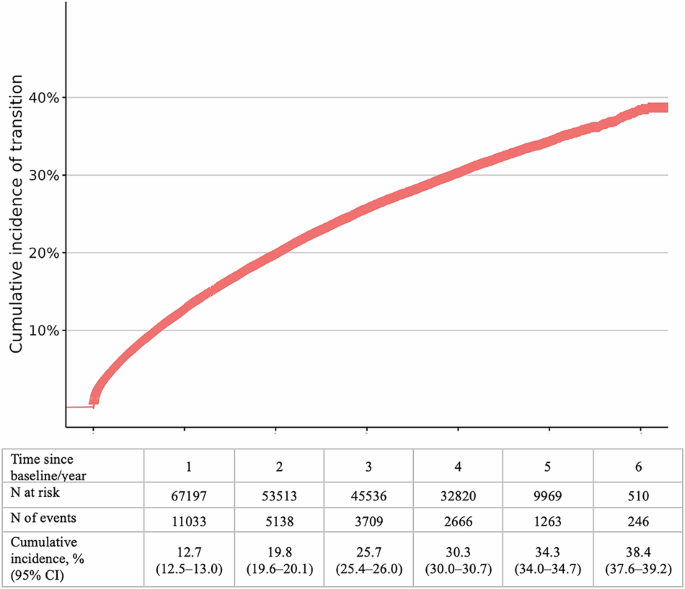
Among 319,815 participants, 28.9% had preclinical obesity and 40.0% had clinical obesity at baseline. Of the 92,396 individuals with preclinical obesity, 24,057 (26.0%) transitioned to clinical obesity over a median follow-up of 2.9 years. The cumulative incidence at 1, 3, and 5 years was 12.7%, 25.7%, and 34.3%, respectively. In the adjusted Cox model, older age, elevated hemoglobin A1C, higher BMI, higher WHR, higher WHtR, insurance coverage, and poorer self-reported overall health were strongly and independently associated with a greater likelihood of transition.
Conclusions and relevance
Progression from preclinical to clinical obesity is relatively common. Given the different treatment considerations proposed for preclinical and clinical obesity under the Lancet framework, improved identification of individuals at higher risk of progression may be important for future implementation of this classification system
This is a preview of subscription content, access
Access options
Access through your institution
- Purchase on SpringerLink
- Instant access to the full article PDF.
39,95 €
Prices may be subject to local taxes which are calculated during checkout
Subjects
- Endocrine system and metabolic diseases
- Risk factors
Data availability
Data are available through the All of Us Research Program Researcher Workbench to approved researchers under controlled access
References
Seidell JC, Halberstadt J. The global burden of obesity and the challenges of prevention. Ann Nutr Metab. 2015;66:7–12
Hammond RA, Levine R. The economic impact of obesity in the United States. Diabetes Metab Syndr Obes. 2010;3:285–95
Yao Z, Tchang BG, Albert M, Blumenthal RS, Nasir K, Blaha MJ. Associations between Class I, II, or III obesity and health outcomes. NEJM Evid. 2025;4:EVIDoa2400229
Yao Z, Tchang BG, Chae K, Albert M, Clark JM, Blaha MJ. Adverse effects of obesity on overall health, quality of life, and related physical health metrics: a cross-sectional and longitudinal study from the All of Us Research Program. J Intern Med. 2025;297:657–71
Nuttall FQ. Body mass index: obesity, BMI, and health: a critical review. Nutr Today. 2015;50:117
Romero-Corral A, Somers VK, Sierra-Johnson J, Thomas RJ, Collazo-Clavell ML, Korinek J, et al. Accuracy of body mass index in diagnosing obesity in the adult general population. Int J Obes. 2008;32:959–66
Okorodudu DO, Jumean MF, Montori VM, Romero-Corral A, Somers VK, Erwin PJ, et al. Diagnostic performance of body mass index to identify obesity as defined by body adiposity: a systematic review and meta-analysis. Int J Obes. 2010;34:791–9
Frankenfield DC, Rowe WA, Cooney RN, Smith JS, Becker D. Limits of body mass index to detect obesity and predict body composition. Nutrition. 2001;17:26–30
Ortega FB, Sui X, Lavie CJ, Blair SN. Body mass index, the most widely used but also widely criticized index: would a criterion standard measure of total body fat be a better predictor of cardiovascular disease mortality? Mayo Clin Proc. 2016;91:443–55
Rubino F, Cummings DE, Eckel RH, Cohen RV, Wilding JPH, Brown WA, et al. Definition and diagnostic criteria of clinical obesity. Lancet Diab Endocrinol. 2025;13:221–62
Yao Z, Dardari ZA, Razavi AC, Silver N, Jelwan Y, Erhabor J, et al. Prevalence of clinical obesity versus BMI-defined obesity among US adults: a cohort study. Lancet Diabetes Endocrinol. 2025. https://doi.org/10.1016/S2213-8587(25)00159-7
The All of Us Research Program InvestigatorsThe “All of Us” Research Program. N Engl J Med. 2019;381:668–76
Curated Data Repository (CDR) version 8 Release Notes. User Support. 2025; published online Feb 4. https://support.researchallofus.org/hc/en-us/articles/30294451486356-Curated-Data-Repository-CDR-version-8-Release-Notes (accessed June 22, 2025)
Krems C, Lührmann PM, Strassburg A, Hartmann B, Neuhäuser-Berthold M. Lower resting metabolic rate in the elderly may not be entirely due to changes in body composition. Eur J Clin Nutr. 2005;59:255–62
Atlantis E, Martin SA, Haren MT, Taylor AW, Wittert GA, Adelaide F, et al. Lifestyle factors associated with age-related differences in body composition: the Florey Adelaide Male Aging Study. Am J Clin Nutr. 2008;88:95–104
Schaap LA, Koster A, Visser M. Adiposity, muscle mass, and muscle strength in relation to functional decline in older persons. Epidemiol Rev. 2013;35:51–65
St-Onge M-P. Relationship between body composition changes and changes in physical function and metabolic risk factors in aging. Curr Opin Clin Nutr Metab Care. 2005;8:523–8
St-Onge M-P, Gallagher D. Body composition changes with aging: the cause or the result of alterations in metabolic rate and macronutrient oxidation? Nutrition. 2010;26:152–5
Wu S, Wang R, Zhao Y, Ma X, Wu M, Yan X, et al. The relationship between self-rated health and objective health status: a population-based study. BMC Public Health. 2013;13:320
Miilunpalo S, Vuori I, Oja P, Pasanen M, Urponen H. Self-rated health status as a health measure: The predictive value of self-reported health status on the use of physician services and on mortality in the working-age population. J Clin Epidemiol. 1997;50:517–28
Lohne-Seiler H, Hansen BH, Kolle E, Anderssen SA. Accelerometer-determined physical activity and self-reported health in a population of older adults (65–85 years): a cross-sectional study. BMC Public Health. 2014;14:284
Wuorela M, Lavonius S, Salminen M, Vahlberg T, Viitanen M, Viikari L. Self-rated health and objective health status as predictors of all-cause mortality among older people: a prospective study with a 5-, 10-, and 27-year follow-up. BMC Geriatr. 2020;20:120
McGee DL, Liao Y, Cao G, Cooper RS. Self-reported health status and mortality in a multiethnic US cohort. Am J Epidemiol. 1999;149:41–6
Benjamins MR, Hummer RA, Eberstein IW, Nam CB. Self-reported health and adult mortality risk: An analysis of cause-specific mortality. Soc Sci Med. 2004;59:1297–306
Caraballo C, Ndumele CD, Roy B, Lu Y, Riley C, Herrin J, et al. Trends in racial and ethnic disparities in barriers to timely medical care among adults in the US, 1999 to 2018. JAMA Health Forum. 2022;3:e223856
Jacobs PD, Abdus S. Changes in preventive service use by race and ethnicity after medicare eligibility in the United States. Prev Med. 2022;157:106996
Arnett MJ, Thorpe RJ, Gaskin DJ, Bowie JV, LaVeist TA. Race, medical mistrust, and segregation in primary care as usualntegrated communities study. J Urban Health. 2016;93:456–67
Keller M, Svensson SIA, Rohde-Zimmermann K, Kovacs P, Böttcher Y. Genetics and epigenetics in obesity: what do we know so far? Curr Obes Rep. 2023;12:482–501
Blüher M. Metabolically healthy obesity. Endocr Rev. 2020;41:bnaa004
Jastreboff AM, Aronne LJ, Ahmad NN, Wharton S, Connery L, Alves B, et al. Tirzepatide once weekly for the treatment of obesity. N Engl J Med. 2022;387:205–16
Author information
Authors and Affiliations
Johns Hopkins Ciccarone Center for Prevention of Cardiovascular Disease, Baltimore, MD, USA
Zhiqi Yao, Zeina A. Dardari, Sohail Zahid, Alexander C. Razavi, John Erhabor, Yara Jelwan, Semenawit Burka & Michael J. Blaha
Johns Hopkins Bloomberg School of Public Health, Baltimore, MD, USA
Nader Silver
Center for Heart Disease Prevention, Emory University School of Medicine, Atlanta, GA, USA
Alexander C. Razavi
Authors
- Zhiqi YaoView author publications
Search author on:PubMed Google Scholar
- Zeina A. DardariView author publications
Search author on:PubMed Google Scholar
- Sohail ZahidView author publications
Search author on:PubMed Google Scholar
- Nader SilverView author publications
Search author on:PubMed Google Scholar
- Alexander C. RazaviView author publications
Search author on:PubMed Google Scholar
- John ErhaborView author publications
Search author on:PubMed Google Scholar
- Yara JelwanView author publications
Search author on:PubMed Google Scholar
- Semenawit BurkaView author publications
Search author on:PubMed Google Scholar
- Michael J. BlahaView author publications
Search author on:PubMed Google Scholar
Contributions
ZY designed the study, curated and analyzed the data, interpreted the findings, prepared the figures, and drafted the manuscript. MJB conceived the study and provided supervision. ZAD, SZ, NS, ACR, JE, YJ, and SB reviewed and revised the manuscript
Ethics declarations
Competing interests
MJB has received research grants or contracts from the National Institutes of Health, Food and Drug Administration, American Heart Association, Novo Nordisk, and Bayer; consulting fees from Scene Health and Autonomy Bio; and honoraria for lectures and legal testimony from Novo Nordisk. He has also served on data safety monitoring boards or advisory boards for Novartis, Novo Nordisk, Bayer, Eli Lilly, AstraZeneca, Boehringer Ingelheim, NewAmsterdam, Agepha, Idorsia, Genentech, and Vectura. The remaining authors report no relevant disclosures.
Additional information
Publisher’s note Springer Nature remains neutral with regard to jurisdictional claims in published maps and institutional affiliations
Supplementary information
Supplementary tables and figures_ final (download DOCX )
Rights and permissions
Springer Nature or its licensor (e.g. a society or other partner) holds exclusive rights to this article under a publishing agreement with the author(s) or other rightsholder(s); author self-archiving of the accepted manuscript version of this article is solely governed by the terms of such publishing agreement and applicable law
About this article
Cite this article
Yao, Z., Dardari, Z.A., Zahid, S. et al. Transition from preclinical obesity to clinical obesity among US adults: incidences and risk factors.
Int J Obes (2026). https://doi.org/10.1038/s41366-026-02199-9
Received:12 December 2025
Revised:27 July 2026
Accepted:10 August 2026
Published:21 August 2026
Version of record:21 August 2026
DOI
:https://doi.org/10.1038/s41366-026-02199-9
