


Abstract
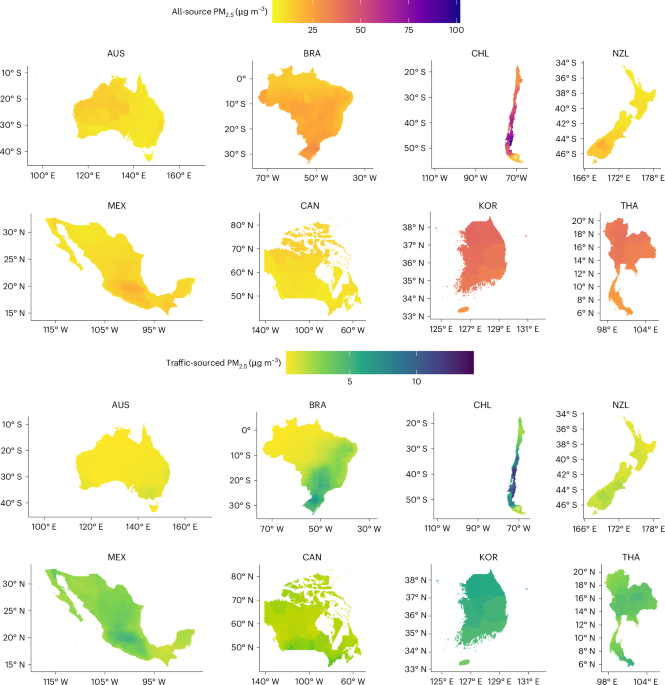
People with cancer may be susceptible to acute environmental stressors, including ambient fine particulate matter (PM2.5), but the contribution of traffic-related particles to short-term cancer mortality remains uncertain. We analysed daily cancer mortality records by cancer site from 2000 to 2019 across eight countries (Australia, Brazil, Canada, Chile, South Korea, Mexico, New Zealand and Thailand). A time-stratified case-crossover design was used to assess associations with all-source PM2.5 and traffic-sourced PM2.5 (TSPM2.5). The analysis included 9,223,612 cancer deaths. Every 10 μg m−3 increase in the 2-day moving average of all-source PM2.5 exposure (lag 0–1) was associated with a 0.77% increase in all-cancer mortality risk (95% confidence interval (CI) 0.64–0.89%). The corresponding increase in TSPM2.5 was associated with a 3.87% increase (95% CI 3.28–4.47%). Although TSPM2.5 represented only 14.72% of total PM2.5 concentrations, it accounted for 73.55% of PM2.5-attributable cancer deaths during the study period, equivalent to 1.21% (95% CI 1.03–1.39%) of total cancer mortality. Effect modification by age, sex or socioeconomic status was not statistically significant. Reducing TSPM2.5 exposure may help lower acute pollution-related mortality risks among people with cancer.
This is a preview of subscription content, access
Access options
Access through your institution
- Purchase on SpringerLink
- Instant access to the full article PDF.
39,95 €
Prices may be subject to local taxes which are calculated during checkout
Subjects
- Environmental impact
- Risk factors
Data availability
Publicly available data are found here: the global gridded GDP (https://doi.org/10.1038/sdata.2018.4) and the Gridded Population of the World (version 4, https://sedac.ciesin.columbia.edu/data/collection/gpw-v4); surface temperature and ambient dewpoint temperature from ERA5 (https://www.ecmwf.int/en/forecasts/datasets/reanalysis-datasets/era5). Data supporting the GEOS-Chem model development and TSPM2.5 simulation in this study can be found from MIX v1.1 Asian anthropogenic emissions (http://meicmodel.org.cn/?page_id=87&lang=en), Multi-resolution Emission Inventory for China (http://meicmodel.org.cn/?page_id=125&lang=en), European Monitoring and Evaluation Program (https://www.emep.int/), Diffuse and Inefficient Combustion Emissions Africa inventory (https://www2.acom.ucar.edu/modeling/dice-africa) and National Emission Inventory of America (https://www.epa.gov/air-emissions-inventories/national-emissions-inventory-nei). The authors do not have permission to directly share the health outcome data. Interested researchers should contact the corresponding author Y.G. on a case-by-case basis for further information about the restricted health outcome data and the relevant data access procedures. Source data are provided with this paper.
Code availability
Analysis codes are available from the corresponding authors on request and shared on https://github.com/Yukieuuuuu/Traffic_PM25_short_term_cancer_mortality
References
Liu, C. et al. Ambient particulate air pollution and daily mortality in 652 cities. N. Engl. J. Med381, 705–715 (2019)
Orellano, P., Reynoso, J., Quaranta, N., Bardach, A. & Ciapponi, A. Short-term exposure to particulate matter (PM(10) and PM(2.5)), nitrogen dioxide (NO(2)), and ozone (O(3)) and all-cause and cause-specific mortality: systematic review and meta-analysis. Environ. Int.142, 105876 (2020)
Yu, W. et al. Estimates of global mortality burden associated with short-term exposure to fine particulate matter (PM(2.5)). Lancet Planet. Health8, e146–e155 (2024)
Bray, F. et al. Global cancer statistics 2022: GLOBOCAN estimates of incidence and mortality worldwide for 36 cancers in 185 countries. CA Cancer J. Clin.74, 229–263 (2024)
Chen, J. & Hoek, G. Long-term exposure to PM and all-cause and cause-specific mortality: a systematic review and meta-analysis. Environ. Int.143, 105974 (2020)
Loomis, D. et al. The carcinogenicity of outdoor air pollution. Lancet Oncol.14, 1262–1263 (2013)
Yu, P. et al. Cohort studies of long-term exposure to outdoor particulate matter and risks of cancer: a systematic review and meta-analysis. Innovation (Camb.)2, 100143 (2021)
CAS
Google ScholarPinto, B. M. & Trunzo, J. J. Health behaviors during and after a cancer diagnosis. Cancer104, 2614–2623 (2005)
Krittanawong, C. et al. PM2.5 and cardiovascular diseases: state-of-the-art review. Int. J. Cardiol. Cardiovasc. Risk Prev.19, 200217 (2023)
Prousi, G. S. et al. Vascular inflammation, cancer, and cardiovascular diseases. Curr. Oncol. Rep.25, 955–963 (2023)
Iqbal, M. J. et al. Interplay of oxidative stress, cellular communication and signaling pathways in cancer. Cell Commun. Signal.22, 7 (2024)
Wang, N. et al. Short-term association between ambient air pollution and lung cancer mortality. Environ. Res.179, 108748 (2019)
Xue, X., Chen, J., Sun, B., Zhou, B. & Li, X. Temporal trends in respiratory mortality and short-term effects of air pollutants in Shenyang, China. Environ. Sci. Pollut. Res. Int.25, 11468–11479 (2018)
Ma, C. et al. Short-term association of air pollution with lung cancer mortality in Osaka, Japan. Environ. Res.224, 115503 (2023)
Yu, P. et al. Cancer mortality risk from short-term PM(2.5) exposure and temporal variations in Brazil. J. Hazard. Mater.473, 134606 (2024)
Masselot, P. et al. Differential mortality risks associated with PM2.5 components: a multi-country, multi-city study. Epidemiology33, 167–175 (2022)
HEI Panel on the Health Effects of Traffic-Related Air Pollution Traffic-Related Air Pollution: A Critical Review of the Literature on Emissions, Exposure, and Health Effects (Health Effects Institute, 2010)
Morawska, L., Ristovski, Z., Jayaratne, E. R., Keogh, D. U. & Ling, X. Ambient nano and ultrafine particles from motor vehicle emissions: characteristics, ambient processing and implications on human exposure. Atmos. Environ.42, 8113–8138 (2008)
Fussell, J. C. et al. A review of road traffic-derived non-exhaust particles: emissions, physicochemical characteristics, health risks, and mitigation measures. Environ. Sci. Technol.56, 6813–6835 (2022)
Ostro, B. et al. The effects of particulate matterpain. Environ. Health Perspect.119, 1781–1787 (2011)
Kim, S. Y. et al. The short-term association of selected components of fine particulate matter and mortality in the Denver Aerosol study. Environ. Health14, 49 (2015)
Cheng, Z. et al. Air pollution and cancer daily mortality in Hangzhou, China: an ecological research. BMJ Open14, e084804 (2024)
Rolston, K. V. Infections in cancer patients with solid tumors: a review. Infect. Dis. Ther.6, 69–83 (2017)
Zhao, Y. et al. Cardiorespiratory responses to fine particles during ambient PM(2.5) pollution waves: findings from a randomized crossover trial in young healthy adults. Environ. Int.139, 105590 (2020)
Lin, Y. et al. Pro-oxidative and proinflammatory effects after traveling from Los Angeles to Beijing: a biomarker-based natural experiment. Circulation140, 1995–2004 (2019)
Shi, J. et al. Association between fine particulate matter chemical constituents and airway inflammation: a panel study among healthy adults in China. Environ. Res.150, 264–268 (2016)
Chen, R. et al. Fine particulate air pollution and the expression of microRNAs and circulating cytokines relevant to inflammation, coagulation, and vasoconstriction. Environ. Health Perspect.126, 017007 (2018)
Schuijs, M. J. et al. ILC2-driven innate immune checkpoint mechanism antagonizes NK cell antimetastatic function in the lung. Nat. Immunol.21, 998–1009 (2020)
Stoll, J. R. et al. Association of interleukin-6 and tumor necrosis factor-α with mortality in hospitalized patients with cancer. J. Am. Acad. Dermatol.84, 273–282 (2021)
Atkinson, R. W. et al. Short-term exposure to traffic-related air pollution and daily mortality in London, UK. J. Expo. Sci. Environ. Epidemiol.26, 125–132 (2016)
Zhu, Y. et al. Short-term exposure to traffic-related air pollution and STEMI events: insights into STEMI onset and related cardiac impairment. Sci. Total Environ.827, 154210 (2022)
Bai, L. et al. Exposure to traffic-related air pollution and acute bronchitis in children: season and age as modifiers. J. Epidemiol. Community Health72, 426–433 (2018)
Cosselman, K. E. et al. Acute exposure to traffic-related air pollution alters antioxidant status in healthy adults. Environ. Res.191, 110027 (2020)
Dummer, T. J. B. et al. Traffic-related air pollution and risk of lung, breast, and urinary tract cancer in Halifax, Nova Scotia. J. Occup. Environ. Med.65, e485–e490 (2023)
Chen, G., Wan, X., Yang, G. & Zou, X. Traffic-related air pollution and lung cancer: a meta-analysis. Thorac. Cancer6, 307–318 (2015)
IARC Working Group on the Evaluation of Carcinogenic Risks to Humans Diesel and Gasoline Engine Exhausts and Some Nitroarenes (IARC, 2014)
de Jesus, A. L. et al. Ultrafine particles and PM(2.5) in the air of cities around the world: are they representative of each other? Environ. Int.129, 118–135 (2019)
Tsai, D. H., Wu, Y. H. & Chan, C. C. Comparisons of commuter’s exposure to particulate matters while using different transportation modes. Sci. Total Environ.405, 71–77 (2008)
Electric two and three-wheelers. UN Environment Programmehttps://www.unep.org/topics/transport/electric-mobility/electric-two-and-three-wheelers (2026)
Liu, Y. et al. Comparative analysis of non-exhaust airborne particles from electric and internal combustion engine vehicles. J. Hazard. Mater.420, 126626 (2021)
Christou, A., Giechaskiel, B., Olofsson, U. & Grigoratos, T. Review of health effects of automotive brake and tyre wear particles. Toxics13, 301 (2025)
Snider, G. et al. Variation in global chemical composition of PM2.5: emerging results from SPARTAN. Atmos. Chem. Phys.16, 9629–9653 (2016)
Yu, P. et al. Spatiotemporal variations and inequalities in global traffic-
Kamangar, F., Dores, G. M. & Anderson, W. F. Patterns of cancer incidence, mortality, and prevalence across five continents: defining priorities to reduce cancer disparities in different geographic regions of the world. J. Clin. Oncol.41, 5209–5224 (2023)
Zhang, Y. et al. Global variations in lung cancer incidence by histological subtype in 2020: a population-based study. Lancet Oncol.24, 1206–1218 (2023)
Zhang, L. et al. CanScreen5, a global repository for breast, cervical and colorectal cancer screening programs. Nat. Med.29, 1135–1145 (2023)
Soerjomataram, I., Lam, F., Bardot, A., Bray, F. & Ervik, M. SURVCAN-3 online tool: international cancer survival benchmarking. IARChttps://gco.iarc.fr/survival/survcan (2023)
Nascimento, F. P. & Gouveia, N. Ambient air pollution and mortality: the role of socioeconomic conditions. Environ. Epidemiol.8, e297 (2024)
Gutiérrez-Avila, I. et al. Short-term exposure to PM2.5 and 1.5 million deaths: a time-stratified case-crossover analysis in the Mexico City metropolitan area. Environ. Health22, 70 (2023)
Li, S. et al. An umbrella review of socioeconomic status and cancer. Nat. Commun.15, 9993 (2024)
Afshar, N., English, D. R. & Milne, R. L. Factors explaining socio-economic inequalities in cancer survival: a systematic review. Cancer Control28, 10732748211011956 (2021)
Lundqvist, A., Andersson, E., Ahlberg, I., Nilbert, M. & Gerdtham, U. Socioeconomic inequalities in breast cancer incidence and mortality in Europe—a systematic review and meta-analysis. Eur. J. Public Health26, 804–813 (2016)
Gryparis, A., Paciorek, C. J., Zeka, A., Schwartz, J. & Coull, B. A. Measurement error caused by spatial misalignment in environmental epidemiology. Biostatistics10, 258–274 (2009)
Hoek, G., Vienneau, D. & de Hoogh, K. Does residential address-based exposure assessment for outdoor air pollution lead to bias in epidemiological studies? Environ. Health23, 75 (2024)
Nguyen, H. et al. Accuracy of coded cause of death data: a study based on primary liver cancer. Tasman Med. J.4, 12–20 (2022)
Morais, R. M. D. & Costa, A. L. Uma avaliação do Sistema de Informações sobre Mortalidade. Saúde em Debate41, 101–117 (2017)
Hebbern, C. et al. Future temperature-related excess mortality under climate change and population aging scenarios in Canada. Can. J. Public Health114, 726–736 (2023)
Microdata Integrated System (MDIS). Statistics Koreahttps://mdis.kostat.go.kr/mypage/extract/viewMyExtractDetail.do?curMenuNo=UI_POR_P1068&procPcdtId=PROC0000000000190368 (2026)
Mortalidad. Instituto Nacional de Estadística y Geografíahttps://en.www.inegi.org.mx/programas/edr/#open_data (2026)
Mortality collection data dictionary. New Zealand Ministry of Healthhttps://www.health.govt.nz/publication/mortality-collection-data-dictionary (2026)
Kliengchuay, W. et al. The association of meteorological parameters and AirQ+ health risk assessment of PM2. 5 in Ratchaburi province, Thailand. Sci. Rep.12, 12971 (2022)
Open Data: deaths by cause. Department of Health Statistics and Information (DEIS), Ministry of Health of Chilehttps://deis.minsal.cl/#datosabiertos (2026)
Xu, R. et al. Global population exposure to landscape fire air pollution from 2000 to 2019. Nature621, 521–529 (2023)
ERA5 hourly data on single levels from 1979 to present. ECMWFhttps://cds.climate.copernicus.eu/cdsapp#!/dataset/reanalysis-era5-single-levels?tab=overview (2026)
Center for International Earth Science Information Network Global Gridded Relative Deprivation Index (GRDI), Version 1. SEDAChttps://doi.org/10.7927/3XXE-AP97 (2022)
Yu, P. et al. Cancer mortality risk from short-term PM2.5 exposure and temporal variations in Brazil. J. Hazard. Mater.473, 134606 (2024)
Xu, R. et al. The association between heat exposure and hospitalization for undernutrition in Brazil during 2000–2015: a nationwide case-crossover study. PLoS Med.16, e1002950 (2019)
Guo, Y. Hourly associations between heat and ambulance calls. Environ. Pollut.220, 1424–1428 (2017)
Biswas, R. et al. Tinnitus prevalence in Europe: a multi-country cross-sectional population study. Lancet Reg. Health Eur.12, 100250 (2022)
Funding
This study was supported by the Australian Research Council (grant no. DP210102076), the Australian National Health and Medical Research Council (grant no. APP2000581) and the National Research Council of Thailand E-Asia Joint Research Program: climate change impact on natural and human systems (grant no. N33A670560). S.L. was supported by an Emerging Leader Fellowship (grant no. GNT2009866) of the Australian National Health and Medical Research Council and Y.G. by Leader Fellowship (grant no. GNT2008813) of the Australian National Health and Medical Research Council. The funders had no role in data collection, analysis, interpretation, writing of the manuscript or the decision to submit.
Author information
Authors and Affiliations
Guangdong Key Laboratory of Environmental Pollution and Health, College of Environment and Climate, Jinan University, Guangzhou, China
Pei Yu
Climate, Air Quality Research Unit, School of Public Health and Preventive Medicine, Monash University, Melbourne, Victoria, Australia
Pei Yu, Wenzhong Huang, Zhengyu Yang, Michael J. Abramson, Tingting Ye, Wenhua Yu, Yanming Liu, Ke Ju, Yiwen Zhang, Yao Wu, Bo Wen, Yuming Guo & Shanshan Li
Chongqing Emergency Medical Center, Chongqing University Central Hospital, School of Medicine, Chongqing University, Chongqing, China
Rongbin Xu
School of Public Health and Preventive Medicine, Faculty of Medicine, Nursing and Health Sciences, Monash University, Melbourne, Victoria, Australia
Rongbin Xu
Key Laboratory of Environmental Medicine and Engineering of Ministry of Education, and School of Public Health, Southeast University, Nanjing, China
Wenzhong Huang
Department of Urban Planning and Design, the Social Infrastructure for Equity and Wellbeing (SIEW) Lab, and the Hong Kong Base of the State Key Laboratory of Subtropical Building and Urban Science, The University of Hong Kong, Hong Kong SAR, China
Zhengyu Yang
International Laboratory for Air Quality and Health, Queensland University of Technology, Brisbane, Queensland, Australia
Lidia Morawska
Menzies Institute for Medical Research, University of Tasmania, Hobart, Tasmania, Australia
Fay H. Johnston
Sydney School of Public Health, The University of Sydney, Sydney, New South Wales, Australia
Luke Knibbs
Public Health Research Analytics and Methods for Evidence, Public Health Unit, Sydney Local Health District, Camperdown, New South Wales, Australia
Luke Knibbs
Burnet Institute, Melbourne, Victoria, Australia
Guy B. Marks
School of Population and Global Health, The University of Western Australia, Crawley, Western Australia, Australia
Jane Heyworth
Seoul National University, Seoul, South Korea
Ho Kim
Department of Social and Environmental Medicine, Faculty of Tropical Medicine, Mahidol University, Bangkok, Thailand
Kraichat Tantrakarnapa & Wissanupong Kliengchuay
School of Medicine, University of the Andes (Chile), Las Condes, Chile
Patricia Matus
Department of Public Health, University of Otago, Wellington, New Zealand
Simon Hales
School of Epidemiology and Public Health, University of Ottawa, Ottawa, Ontario, Canada
Eric Lavigne
Environmental Health Science and Research Bureau, Health Canada, Ottawa, Ontario, Canada
Eric Lavigne
Department of Pathology, School of Medicine, University of São Paulo, São Paulo, Brazil
Paulo H. N. Saldiva & Micheline S. Z. S. Coelho
School of Statistics and Data Science, Southeast University, Nanjing, China
Yanming Liu
Authors
- Pei YuView author publications
Search author on:PubMed Google Scholar
- Rongbin XuView author publications
Search author on:PubMed Google Scholar
- Wenzhong HuangView author publications
Search author on:PubMed Google Scholar
- Zhengyu YangView author publications
Search author on:PubMed Google Scholar
- Lidia MorawskaView author publications
Search author on:PubMed Google Scholar
- Fay H. JohnstonView author publications
Search author on:PubMed Google Scholar
- Michael J. AbramsonView author publications
Search author on:PubMed Google Scholar
- Luke KnibbsView author publications
Search author on:PubMed Google Scholar
- Guy B. MarksView author publications
Search author on:PubMed Google Scholar
- Jane HeyworthView author publications
Search author on:PubMed Google Scholar
- Ho KimView author publications
Search author on:PubMed Google Scholar
- Kraichat TantrakarnapaView author publications
Search author on:PubMed Google Scholar
- Wissanupong KliengchuayView author publications
Search author on:PubMed Google Scholar
- Patricia MatusView author publications
Search author on:PubMed Google Scholar
- Simon HalesView author publications
Search author on:PubMed Google Scholar
- Eric LavigneView author publications
Search author on:PubMed Google Scholar
- Paulo H. N. SaldivaView author publications
Search author on:PubMed Google Scholar
- Micheline S. Z. S. CoelhoView author publications
Search author on:PubMed Google Scholar
- Tingting YeView author publications
Search author on:PubMed Google Scholar
- Wenhua YuView author publications
Search author on:PubMed Google Scholar
- Yanming LiuView author publications
Search author on:PubMed Google Scholar
- Ke JuView author publications
Search author on:PubMed Google Scholar
- Yiwen ZhangView author publications
Search author on:PubMed Google Scholar
- Yao WuView author publications
Search author on:PubMed Google Scholar
- Bo WenView author publications
Search author on:PubMed Google Scholar
- Yuming GuoView author publications
Search author on:PubMed Google Scholar
- Shanshan LiView author publications
Search author on:PubMed Google Scholar
Contributions
S.L. and Y.G. designed and supervised the study and are cosenior authors. P.Y. conducted the statistical analysis and took the lead in drafting the paper and interpreting the results. P.Y. and R.X. estimated the all-source and TSPM2.5 exposure data. P.Y., R.X., W.H., Z.Y., T.Y., W.Y., Y.L., K.J., Y.Z., Y.W. and B.W. cleaned, processed or analysed the data. L.M., F.H.J., M.J.A., L.K., G.B.M., J.H., H.K., K.T., W.K., P.M., S.H., E.L., P.H.N.S. and M.S.Z.S.C. provided or supported access to the mortality data and contributed to results interpretation. All authors, including P.Y., R.X., W.H., Z.Y., L.M., F.H.J., M.J.A., L.K., G.B.M., J.H., H.K., K.T., W.K., P.M., S.H., E.L., P.H.N.S., M.S.Z.S.C., T.Y., W.Y., Y.L., K.J., Y.Z., Y.W., B.W., Y.G. and S.L., revised and edited the paper and approved the submitted version. The corresponding authors attest that all listed authors meet authorship criteria and that no others meeting the criteria have been omitted.
Ethics declarations
Competing interests
M.J.A. holds investigator-initiated grants from Pfizer, Boehringer-Ingelheim, GSK and Sanofi for unrelated research. He has undertaken an unrelated consultancy for Sanofi. The other authors declare no competing interests
Peer review
Peer review information
Nature Sustainability thanks Claudia Dalmastri, M. Omar Nawaz, Brian Oliver, Debatosh B. Partha and the other, anonymous, reviewer(s) for their contribution to the peer review of this work
Additional information
Publisher’s note Springer Nature remains neutral with regard to jurisdictional claims in published maps and institutional affiliations
Supplementary information
Supplementary Information (download PDF )
Supplementary Figs. 1–10 and Tables 1–19
Reporting Summary (download PDF )
Source data
Source Data Fig. 1 (download CSV )
Statistical
Source Data Fig. 2 (download CSV )
Statistical
Source Data Fig. 3 (download CSV )
Statistical
Source Data Fig. 4 (download CSV )
Statistical
Rights and permissions
Springer Nature or its licensor (e.g. a society or other partner) holds exclusive rights to this article under a publishing agreement with the author(s) or other rightsholder(s); author self-archiving of the accepted manuscript version of this article is solely governed by the terms of such publishing agreement and applicable law
About this article
Cite this article
Yu, P., Xu, R., Huang, W. et al. Contributions of traffic to daily PM2.5 exposure and links to cancer mortality.
Nat Sustain (2026). https://doi.org/10.1038/s41893-026-01925-5
Received:22 January 2025
Accepted:31 July 2026
Published:21 August 2026
Version of record:21 August 2026
DOI
:https://doi.org/10.1038/s41893-026-01925-5
