


Download PDF
Abstract
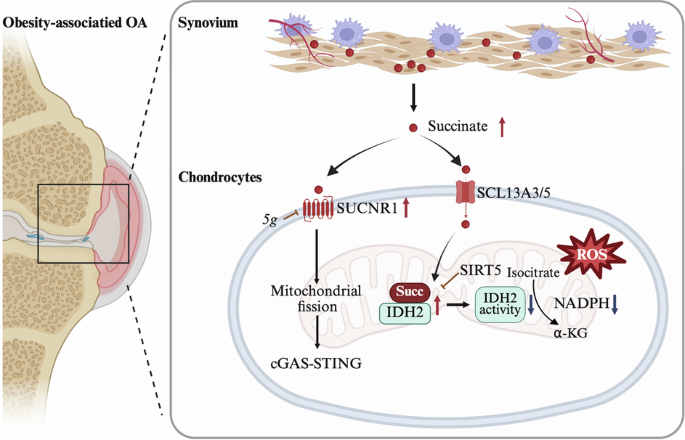
Osteoarthritis (OA) is the most prevalent degenerative joint disease and is closely related to obesity. The molecular mechanisms underlying obesity-induced metabolic alterations that lead to cartilage degeneration have not been fully elucidated. Succinate, a key intermediate in the Krebs cycle, exhibits signaling functions that extend beyond its traditional metabolic role. This study demonstrates that succinate is significantly accumulated in the knee joint of obesity-associated OA. Succinate exacerbates obesity-associated cartilage degeneration through a combination of extracellular and intracellular pathways, which converge on mitochondrial dysfunction. Mechanistically, extracellular succinate activates G protein-coupled receptor succinate receptor-1 (SUCNR1), triggering mitochondrial fission and activation of the cGAS-STING pathway. Intracellular succinate reduces NADPH levels and promotes mitochondrial reactive oxygen species (mtROS) accumulation, in association with increased IDH2 succinylation. Additionally, sirtuin 5 (SIRT5) acts as an IDH2 desuccinylase and exerts a protective effect against intracellular succinate-induced cartilage degeneration. To target both intracellular and extracellular succinate, the phenylboronic acid-modified gelatin hydrogel is designed to load the SUCNR1 inhibitor 5 g and the SIRT5 agonist puerarin. This injectable ROS-responsive system targeting succinate exhibits remarkable therapeutic efficacy in vivo. These findings suggest that targeting succinate provides a novel therapeutic strategy for obesity-associated OA.
Created with BioRender.com
Subjects
- Extracellular signalling molecules
- Metabolic disorders
- Post-translational modifications
Acknowledgements
We are grateful for the support and assistance provided by the Institute of Medical Innovation and Research of Peking University Third Hospital and the Department of Laboratory Animal Science of Peking University Health Science Center. We thank BioRender for assistance with the graphical abstract
Funding
This work was supported by the National Natural Science Foundation of China (#12572365, #12172011), the National Key Research and Development Program of China (#2024YFB3814700), and the Beijing Natural Science Foundation (#7252159)
Author notes
These authors contributed equally: Haofeng Hong, Longting Chen, Yiming Zhong
Authors and Affiliations
Department of Orthopedics, Peking University Third Hospital, Beijing, China
Haofeng Hong, Longting Chen, Yiming Zhong, Zihuan Yang, Zhuoxin Li, Chunli Song, Weishi Li, Wanqiong Yuan, Hua Tian & Huijie Leng
Beijing Key Laboratory of Advanced Bioadaptable Orthopedic Implants, Beijing, China
Haofeng Hong, Longting Chen, Yiming Zhong, Zihuan Yang, Zhuoxin Li, Chunli Song, Weishi Li, Wanqiong Yuan, Hua Tian & Huijie Leng
Engineering Research Center of Bone and Joint Precision Medicine, Ministry of Education, Beijing, China
Haofeng Hong, Longting Chen, Yiming Zhong, Zihuan Yang, Zhuoxin Li, Chunli Song, Weishi Li, Wanqiong Yuan, Hua Tian & Huijie Leng
Authors
- Haofeng HongView author publications
Search author on:PubMed Google Scholar
- Longting ChenView author publications
Search author on:PubMed Google Scholar
- Yiming ZhongView author publications
Search author on:PubMed Google Scholar
- Zihuan YangView author publications
Search author on:PubMed Google Scholar
- Zhuoxin LiView author publications
Search author on:PubMed Google Scholar
- Chunli SongView author publications
Search author on:PubMed Google Scholar
- Weishi LiView author publications
Search author on:PubMed Google Scholar
- Wanqiong YuanView author publications
Search author on:PubMed Google Scholar
- Hua TianView author publications
Search author on:PubMed Google Scholar
- Huijie LengView author publications
Search author on:PubMed Google Scholar
Ethics declarations
Competing interests
The authors declare no competing interests
Additional information
Publisher’s note Springer Nature remains neutral with regard to jurisdictional claims in published maps and institutional affiliations
Supplementary information
Supplementary Figures (download PDF )
Supplementary Tables (download XLSX )
Full and uncropped western blots (download PDF )
Rights and permissions
Open Access This article is licensed under a Creative Commons Attribution 4.0 International License, which permits use, sharing, adaptation, distribution and reproduction in any medium or format, as long as you give appropriate credit to the original author(s) and the source, provide a link to the Creative Commons licence, and indicate if changes were made. The images or other third party material in this article are included in the article’s Creative Commons licence, unless indicated otherwise in a credit line to the material. If material is not included in the article’s Creative Commons licence and your intended use is not permitted by statutory regulation or exceeds the permitted use, you will need to obtain permission directly from the copyright holder. To view a copy of this licence, visit http://creativecommons.org/licenses/by/4.0/.
About this article
Cite this article
Hong, H., Chen, L., Zhong, Y. et al. Succinate exacerbates obesity-associated osteoarthritis: mitochondrial dysfunction mediated by SUCNR1 activation and succinylation modification.
Cell Death Discov. (2026). https://doi.org/10.1038/s41420-026-03318-1
Received:06 May 2026
Revised:31 July 2026
Accepted:19 August 2026
Published:22 August 2026
DOI
:https://doi.org/10.1038/s41420-026-03318-1
