


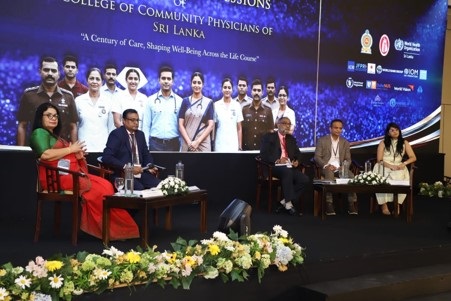
Pandemic preparedness and resilient health systems are inseparable. This message featured prominently during Symposium 5, “Resilient Health Systems for Future Well-being”, at the Public Health Summit held in Colombo, Sri Lanka, from 22 to 24 July. The WHO South-East Asia Regional Office (WHO SEARO) participated in the symposium, contributing to discussions on how countries can prepare for future health emergencies while sustaining essential health services, contributing to health security, and advancing universal health coverage.
Photo: Public Health Summit, where the main theme was 100 years of organised community health services in Sri Lanka. The summit was supported by the WHO Country Office for Sri Lanka (Photo credit: WHO Country Office for Sri Lanka).
The SEARO presentation at the symposium, titled “Pandemic Preparedness for Resilient Health Systems”, highlighted how lessons learned from the COVID-19 pandemic and ongoing global health initiatives are shaping stronger, more resilient health systems capable of protecting populations during future crises
Photo : WHO South-East Asia Regional Office’s Health Emergencies Programme highlighted that pandemic preparedness strengthens resilient health systems, advances health security, reinforces primary health care, and supports progress towards universal health coverage. (Photo credit: WHO Country Office for Sri Lanka).
A resilient health system is one that can prevent, prepare for, detect, adapt to, respond to, and recover from public health threats while maintaining access to quality essential health services. Such systems are able to absorb shocks and continue advancing progress towards universal health coverage. Resilience is strengthened through robusthealth emergency preparedness, response and resilience (HEPR)capacities, strong primary health care, effective delivery of essential public health functions, and sustained community engagement and empowerment.
Drawing on experiences from the COVID-19 pandemic, SEARO presented examples of resilience in action from around the world. Thailand demonstrated the value of a well-organised health system in supporting a coordinated emergency response. The Republic of Korea showed how sustained investment in health systems contributes to resilience during public health emergencies. India’s experience during the Delta wave highlighted the importance of surge preparedness and rapidly scalable capacity. Meanwhile, innovative approaches in Ghana, including the use of drone technology for specimen transport, helped maintain essential services, while Bhutan’s De-Suung volunteer programme supported the health workforce during periods of heightened demand.
The presentation also examined how the COVID-19 pandemic exposed weaknesses in global preparedness and response systems, leading to recommendations from theIndependent Panel for Pandemic Preparedness and Response(IPPPR). These recommendations have informed global efforts to strengthen governance, financing, accountability, and equitable access to medical countermeasures. They have also contributed to major developments, including theWHO Pandemic Agreementandamendments to the International Health Regulations (2005).
SEARO also noted thatthe adoption of the landmark WHO Pandemic Agreement by the World Health Assemblyin May 2025 represents a significant step towards stronger international cooperation in pandemic prevention, preparedness and response. Together with the amended International Health Regulations (2005), the Agreement supports a more comprehensive architecture for health emergency preparedness, response and resilience
Central to this architecture are three interconnected components: governance, financing, and systems. The systems component comprises five key subsystems: emergency coordination, collaborative surveillance, community protection, safe and scalable clinical care, and equitable access to medical countermeasures. These capacities help countries prepare for, detect, and respond to health emergencies while protecting essential health services and supporting recovery
The symposium provided an opportunity to highlight the importance of translating global commitments into national action. Strengthening surveillance systems, investing in the health workforce, enhancing community engagement, improving emergency coordination, and ensuring equitable access to medical countermeasures are all critical elements of resilient health systems
In conclusion, SEARO emphasised that pandemic preparedness should be viewed not as a cost but as a long-term investment. Investments in pandemic preparedness generate health, social and economic benefits while reducing the impact of future crises. Building resilient health systems is therefore essential not only for health security but also for sustaining progress towards universal health coverage and improving population well-being
Photo: The symposium provided an opportunity to highlight the importance of translating global commitments into national actions to ensure health security and population well-being.(Photo credit: WHO Country Office for Sri Lanka).
As countries in the WHO South-East Asia Region continue to strengthen their pandemic preparedness capacities, the lessons from COVID-19 and the evolvingglobal HEPR architectureprovide a clear pathway towards stronger, safer and more resilient health systems in the Region for the future.
