


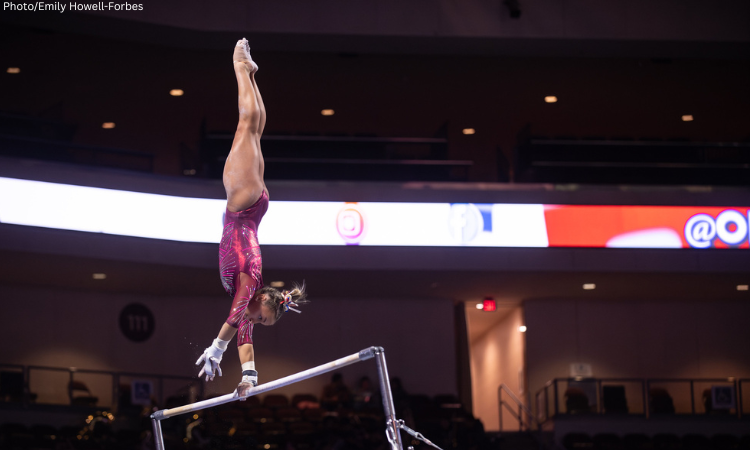
College gymnastics has become formulaic, with lineups full of the same Yurchenko-style vaults, back handspring layout step-outs on beam, front double fulls on floor, and Maloney to Pak salto combinations on bars.
Consistency is one of the predominant factors for coaches and athletes when they settle on a final competition routine, but virtuosity shouldn’t become synonymous with risk. The code of points is rich with skills that have been underused in college, so here are 10 that could freshen up the competition floor
Backward Rolls
One of the compositional requirements on beam is having level changes, where the athlete must perform low and high beam choreography. The simple solution to satisfy this is by mounting low on the beam and standing up, making the intro of a beam routine more of a formality instead of a performance. Backward rolls would demonstrate strength and control while also providing a moment of intrigue and uniqueness to an otherwise simple transition. They could be woven into choreography or at the beginning of an acrobatic series, highlighting the move’s versatility.
Sideways Acrobatics and Dance Skills
Another required display on the beam is sideways choreography, which is often an afterthought for athletes in between their difficult acrobatic and dance skills. In connection, sideways skills can rack up the bonus tenths needed for athletes to reach a 10.0 start value. Forward and backward movements are much more commonplace in college, making sideways skills more difficult, yet tantalizing. In elite gymnastics, Zhou Yaqin of the People’s Republic of China demonstrated mastery of these skills by utilizing them on her way to an Olympic silver medal, and they could definitely be part of winning routines in the NCAA as well.
Hop Fulls
A popular skill from the 90s, the hop full is a unique release move that can only be successfully performed by quick-twitch athletes who can complete the 360-degree turn above the bar. Rated an E in the collegiate code of points, this skill has more difficulty than a Tkatchev, Deltchev, or straddled Jaeger. However, its usage is incomparable to those three very common releases. Hop fulls would be worth adding to a gymnast’s repertoire, since they can be connected to almost any other release or high-to-low transition, raking in greater connection bonus than just a toe-on.
Moerz
Every collegiate floor routine has a dance passage connecting two leaps, with only one needing to reach 180 degrees. The tail end of that statement is where gymnasts could be taking more advantage of a skill like the Moerz, a pike-full jump to lying support on the ground. Many leaps in the NCAA have dubious rotation, and despite not being devalued, still open gymnasts up to execution deductions. The Moerz has a definitive body shape that must be achieved, but it also creates a good transition into on-the-floor choreography and could be easier to get fully rotated.
Whips in Combination
Whips are a bit more common in the NCAA than some of the previous skills, but they are still woefully underused. Combination passes in college have grown increasingly common as ways to pick up bonus tenths; however, whips are underutilized in this category. They’re able to be used in direct or indirect combinations and demonstrate an athlete’s power to be able to punch with her legs only and not her arms.
Full-Twisting Double Pike
Two-pass routines and double saltos without twists have asserted themselves as trends for college gymnastics on the floor, but if any athlete wanted to put the NCAA on notice, they should consider adding this skill next season. Full-twisting double pikes are a spectacular skill when done with the proper form and control they require. Rated the same as the tucked full-in, it’s much rarer to see a piked variation, simultaneously grabbing the judges’ and audience’s attention.
Hechts
Standing on the low bar is a very common way for athletes to prepare for their dismount after a release or transition combination. However, gymnasts are capable of adding difficulty to this part of their routine, and the most likely way is by encouraging the addition of Hecht transitions. A Hecht would help maintain the cohesive flow from element to element, as once embodied by LSU’s Sarah Finnegan, who won two NCAA titles on the uneven bars with this skill
Omelianchik
Front aerials and tosses, side aerials, and side somersaults are all D-rated in the NCAA code of points, making them reliable acrobatic skills to add for bonus tenths in any beam routine. An Omelianchik is a back handspring with a three-quarter turn and has the same ratification as the aforementioned skills despite being performed much less often. For gymnasts who are more confident in acrobatics and want to promote originality in their routine, this would be a strong contender
Inverted or Mixed Grip Work
Mixed grip work is defined by flexibility and precision, and the uneven bars have become synonymous with Maloney and Pak salto transitions. Oklahoma’s Audrey Davis wowed audiences for years by performing her Higgins grip into a floaty piked Jaeger. Encouraging athletes to do different grips in college could lead to more interesting transitions like Ezhovas, release moves like Markelovs, or maybe even E-rated pirouettes
Tsukahara Full
Vault is the least diverse apparatus in college, with variations of Yurchenko entries dominating competitive lineups across the country. At the conclusion of the regular season, only seven athletes ranked in the top 30 based on NQS had vaults that weren’t a Yurchenko entry. One of those vaults was Georgia’s Nyla Aquino and her Tsukahara full. This vault simultaneously showcased Aquino’s explosive power and tenacity on landings, entertaining the audience with something out of the norm, but just as excellent.
READ THIS NEXT: 10 Unique Vaults that Broke the Mold in 2026
