



Environment and sustainability
Why healthy, sustainable diets remain out of reach for most of the world
ASU researchers contribute to comprehensive review outlining key strategies to transform worldwide food systems to better align health, sustainability and equity

More than 3 billion people simply cannot afford a healthy diet, and many low- and middle-income countries face a “double burden” of undernutrition and rising obesity. iStock image
Despite decades of scientific consensus on what constitutes a healthy and sustainable diet, for most of the world, not a single country has successfully implemented a national food system that benefits most of its citizens
A sweeping new review published recently in the prestigious journal Science reveals why: Food choices are shaped less by our individual willpower and more by powerful, often invisible forces embedded within global food systems
The study, led by an international team of researchers, synthesizes evidence across nutrition, economics, environmental science and public policy to identify the systemic barriers preventing large-scale dietary change — and offers a promising new road map for overcoming them

“Most people assume diet is a matter of personal choice,” said Carola Grebitus, a W. P. Carey School of Business professor in the Morrison School of Agribusiness at Arizona State University’s Polytechnic campus. “But in reality, those choices are heavily constrained and influenced by food environments shaped by industry, policy and supply chains.”
The new paper stemmed from a workshop that convened faculty from several institutions to assess and offer solutions to our current diet crisis
“In the article, we steer clear from a lot of ‘could, should, would’ statements in the extant literature to consider the question of how we can ensure a transition toward sustainable, healthy and equitable (SHE) diets for countries at all levels of income,” said co-author Marc Bellemare of the University of Minnesota in his blog
A global dietary crisis
Around the world, diets are shifting in ways that harm both human and planetary health
Rising incomes, urbanization and the widespread availability of ultra-processed foods are driving increased consumption of sugar, salt, refined carbohydrates and animal products — while intake of fruits, vegetables, legumes and whole grains remains insufficient
These patterns are contributing to a surge in chronic diseases such as obesity, diabetes and heart disease while also accelerating vast environmental degradation through greenhouse gas emissions, deforestation and biodiversity loss
At the same time, inequality remains stark. More than 3 billion people simply cannot afford a healthy diet, and many low- and middle-income countries face a “double burden” of undernutrition and rising obesity
“As a result, no country today has fully achieved diets that are simultaneously healthy, sustainable and equitable,” Grebitus said
The hidden power of food systems
A central insight of the study is that dietary behaviors are shaped by a complex “food environment” — a web of factors including price, taste, convenience, marketing and cultural norms
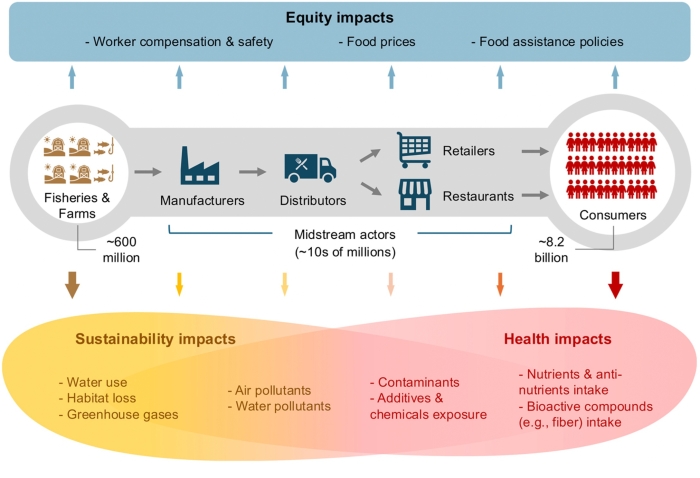
Crucially, the researchers highlight the outsized influence of “midstream” actors: food manufacturers, distributors, retailers and restaurants. Though far fewer in number than farmers or consumers, these actors exert disproportionate control over what food is available, affordable and appealing
“We take seriously the idea that midstream actors in the food value chain (e.g., processors, distributors, wholesalers, retailers) have an important role to play in … SHE diets,” said Bellemare, “and we have a cool infographic to go along with that idea.”
“These companies determine product formulation, portion sizes, pricing strategies and even how foods are displayed,” said Grebitus, an expert in food marketing. “That means they play a pivotal role in shaping both demand and supply.”
This helps explain why interventions focused solely on individual behavior — such as nutrition education or labeling — often have limited impact. They are frequently overwhelmed by broader systemic forces
Why healthy choices are hard
The review identifies several key drivers of unhealthy dietary patterns:
- Taste and sensory appeal: Humans are naturally drawn to sugar, salt and fat — preferences that food companies optimize through processing.
- Affordability: Nutrient-rich foods often cost more per calorie than processed alternatives, pushing consumers toward cheaper, less healthy options.
- Convenience: As incomes rise and lifestyles accelerate, demand for ready-to-eat and restaurant meals increases, often at the expense of diet quality.
- Marketing and culture: Advertising, product placement and social norms reinforce preferences for less healthy foods.
“These factors interact in powerful ways,” Grebitus said. “You can’t address one in isolation and expect meaningful change.”
7 strategies for systemic change
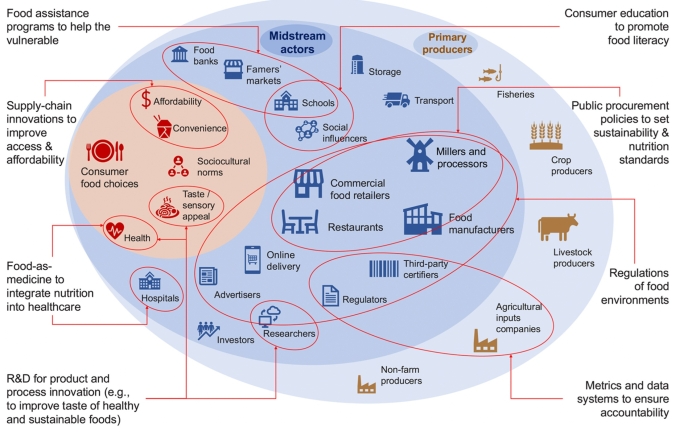
To overcome these challenges, the researchers outlined seven key areas for intervention — emphasizing that no single solution will suffice:
- Research and development:Investing in innovation can make healthy foods more affordable, appealing and more sustainable.
- Affordability and access:Policies such as food assistance programs, subsidies for nutritious foods and infrastructure improvements can help close the gap between healthy and unhealthy options.
- Food as medicine:Integrating nutrition into health care — through programs like medically tailored meals — can prevent disease and reduce health care costs.
- Regulation of food environments:Government policies can shape markets by limiting harmful practices, improving labeling and encouraging healthier product reformulation.
- Public procurement:Governments can use their purchasing power to set standards for healthy and sustainable food in schools, hospitals and other institutions.
- Metrics and accountability:Better data systems and reporting can track progress and hold companies accountable for health and environmental impacts.
- Education and social norms:Long-term change requires building food literacy and reshaping cultural expectations around diet.
Focus: Food as medicine
Among the factors could be a change in mindset to thinking of the food we eat as medicine. The review underscored that about 90% of the $4.3 trillion annual U.S. health care cost is due to chronic diseases, for which diet is a prominent risk factor
“Integrating dietary interventions into health care systems is a promising strategy,” Grebitus said
This food-as-medicine movement encompasses multiple models, some of which involve nutrition incentives. Simulations suggest that to combat heart disease — a top 10 worldwide cause of death — a U.S. Medicare and Medicaid 30% subsidy on fruit and vegetable purchases could prevent 1.93 million cardiovascular disease events and save $39.7 billion in formal health care costs
“Even greater savings and disease prevention would occur if whole grains, nuts and seeds, seafood and plant oils were also subsidized,” Grebitus said. “Health insurers and medical practitioners could prescribe dietary changes, with reimbursement models aligned accordingly. Community health workers can also play a role in delivering dietary guidance and distributing nutrient-rich foods.”
Aligning incentives across the system
A recurring theme in the study is the need to align incentives across all factors in the food system — from farmers and corporations to governments and consumers
“For transformation to occur, doing what is good for health and the environment must also make economic sense,” said corresponding author Christopher B. Barrett of Cornell University
This may involve combinations of policies, such as taxing unhealthy products while subsidizing nutritious ones, or using public procurement to create markets for sustainable foods
Why this research matters
Research is the invisible hand that powers America’s progress. It unlocks discoveries and creates opportunity. It develops new technologies and new ways of doing things
Learn more about ASU discoveries that are contributing to changing the world and making America the world’s leading economic power at researchmatters.asu.edu
The role of innovation — and emerging disruptors
The authors also highlight emerging forces that could reshape dietary behavior in unexpected ways
For example, new weight-loss drugs that regulate appetite may influence food demand at a biological level, potentially altering consumption patterns independently of traditional economic or cultural drivers
Digital food platforms, including online delivery services used by billions of people worldwide, also present new opportunities to influence choices at scale through targeted nudges and recommendations
“These technologies could either reinforce unhealthy trends or become powerful tools for positive change,” Grebitus said
A call for coordinated action
Ultimately, the study emphasizes that meaningful progress will require coordinated efforts across sectors and scales
“No single intervention is sufficient,” Barrett said. “We need integrated strategies that simultaneously address production, supply chains, policy and consumer behavior.”
Such efforts may face political and economic resistance, particularly from entrenched industry interests. But the stakes are high: Transforming global diets is essential not only for improving health outcomes but also for addressing climate change, protecting ecosystems and reducing inequality
Looking ahead
The authors call for more rigorous evaluation of interventions, particularly their long-term impacts, and for greater attention to how innovations in technology and medicine intersect with food systems
They also stress the importance of tailoring solutions to local contexts, recognizing that dietary challenges — and opportunities — vary widely across regions
“Achieving healthy, sustainable and equitable diets is one of the defining challenges of our time,” Grebitus said. “But with the right combination of policies, innovations and partnerships, it is within reach.”
The article “Strategies for Achieving Healthy, Sustainable, and Equitable Dietary Transitions” included co-authors Yi Yang, Dave Tilman, Jess Fanzo, Carola Grebitus, Kelly Haws, Mario Herrero, Susan Jebb, David Just, Marc Bellemare, Allen Levine, David Julian McClements, Ole Mouritsen, Rachel Pechey and Chris Barrett
FacultyHealthy LivingSDG 03 Good Health and Well-BeingSDG 09 Industry, Innovation and InfrastructureSDG 10 Reduced InequalitiesSDG 11 Sustainable Cities and CommunitiesSDG 12 Responsible Consumption and ProductionSDG 15 Life on LandCorporationsPolytechnic campusStaffCommunityEnvironment and sustainabilityPolicymakersMorrison School of AgribusinessSustainabilityFood and DiningResearchW. P. Carey School of Business
Faculty, Healthy Living, Research matters, SDG 03 Good Health and Well-Being, SDG 09 Industry, Innovation and Infrastructure, SDG 10 Reduced Inequalities, SDG 11 Sustainable Cities and Communities, SDG 12 Responsible Consumption and Production, SDG 15 Life on Land, Corporations, Polytechnic campus, Staff, Community, Environment and sustainability, Policymakers, Morrison School of Agribusiness, Sustainability, Food and Dining, Research, W. P. Carey School of Business
More Environment and sustainability

As flood disasters become more frequent and expensive, policymakers are debating whether states should take on more responsibility for flood insurance instead of relying on the federal government.But…
Read this story
Climate changeEnvironmentResearch

Birding, or bird-watching, is no longer just for retirees.People of all ages are into birds these days. In the U.S., more than 1 in 3 Americans over the age of 16 are birders.At least 95% of…
Read this story
ConservationHealthy LivingBiologyEcologyEnvironmentResearch

For decades, wildlife traffickers have illegally captured and sold hundreds of thousands of wild parrots native to Mexico. Despite changes to international wildlife laws, the conservation status of…
Read this story
ConservationEnvironmentScienceSustainabilityTechnologyResearch
