The first study in a new mechanistic clinical trials program will test Pemgarda and hydroxychloroquine alone and in combination
- A new U.S. clinical trials program called PROBE-PASC was announced on Friday at a Long COVID conference in Amsterdam. The program received initial funding of $8 million from a Department of Defense (DOD) grant.
- This DOD grant, through the Congressionally Directed Medical Research Programs (CDMRP), supports biomedical research for specific diseases and topics that Congress has designated as priorities. Past grants have supported research into cancer, tick-borne illnesses, traumatic brain injuries, and more.
- The first clinical trial in the series will test the monoclonal antibody Pemgarda, along with the immune-modulating drug hydroxychloroquine. The study will include arms with both drugs by themselves and the two in combination.
- The funding shows the DOD’s interest in Long COVID, which research has shown affects the military. A 2023 CDMRP grant supported the clinical trial of the novel drug bezisterim for Long COVID.
The U.S. Department of Defense (DOD) is funding a new clinical trials program for Long COVID with an initial grant of $8 million. Called PROBE-PASC, the program will focus on mechanistic trials that will study the disease’s underlying biology in tandem with testing promising treatments
Michael Peluso announced the new program at last week’s International Society for Long COVID and Post-Acute Infection Syndromes (ISLC-PAIS) Conference in Amsterdam, along with its first trial: a study that will test the monoclonal antibody Pemgarda along with the immune-modulating drug hydroxychloroquine, including arms with both drugs by themselves and the two in combination. Peluso, an infectious disease researcher at the University of California, San Francisco (UCSF), is one of the lead investigators for that initial trial.
This mechanistic trial and others in the PROBE-PASC program will explore specific questions about Long COVID’s causes at the same time as they test potential drugs. In a slide for his talk at the ISLC-PAIS conference, Peluso described the new program as “experimental medicine” that will ask, “Does interrupting this pathway change the biology [of Long COVID]?” Answering such questions will inform larger clinical trials that demonstrate drugs’ effectiveness
Funding for PROBE-PASC comes through the Congressionally Directed Medical Research Programs (CDMRP), in which the DOD supports biomedical research for specific diseases and topics that Congress has designated as priorities. Congress has previously designated myalgic encephalomyelitis (ME) as a priority following past advocacy from ME groups; BioVie’s Long COVID trial of the novel drug bezisterim for neurological symptoms received a CDMRP grant from fiscal year 2023 funding. After a new advocacy push led by the group Long COVID Campaign, Congress added Long COVID as a CDMRP priority in fiscal year 2025.
CDMRP funding “is typically quite competitive but is meant to fund research that is a high priority,” Peluso told The Sick Times in an email. “We are really grateful that Long COVID was listed as a topic area and that our grant proposal was selected during the last cycle.”
“This new clinical trials network shows what patient advocates, U.S. researchers, and [D.C] Hill leaders can achieve together,” Meighan Stone, executive director of the Long COVID Campaign, said in a statement. The Long COVID Campaign had pushed for the CDMRP funding behind this grant and participated in the Defense Health Research Consortium, an association of organizations that advocates for the programs. Stone thanked several senators whom she said supported the recent grant, including Todd Young (R-IN), Roger Marshall (R-KS), Bill Cassidy (R-LA), Tim Kaine (D-VA), Bernie Sanders (I-VT), Ed Markey (D-MA), and Tammy Duckworth (D-IL).
Long COVID Campaign has also been pushing for the disease to be included again in CDMRP in the fiscal year 2027 budget, alongside other advocacy for Long COVID and related diseases in the budget appropriations process
The new funding represents a win for advocates at a time when funding for Long COVID and many other chronic diseases has been threatened, Stone told The Sick Times. In Trump’s second term, the federal Department of Health and Human Services (HHS) has dismissed the former Office of Long COVID Research and Practice and a Long COVID advisory committee. HHS has also threatened other Long COVID research funding, and the administration has cut Medicaid and social services for people with disabilities.
[CDMRP funding] is typically quite competitive but is meant to fund research that is a high priority … We are really grateful that Long COVID was listed as a topic area and that our grant proposal was selected during the last cycle
Michael Peluso, UCSF, lead investigator for PROBE-PASC
New grant shows DOD interest in supporting Long COVID research
Compared to past funding asks for Long COVID research and support, such as the $10 billion Long COVID Moonshot Act proposed by Sen. Bernie Sanders in 2024, $8 million to launch PROBE-PASC is modest
Karyn Bishof, president and founder of the COVID-19 Longhauler Advocacy Project (C19LAP), applauded the new grant and noted that C19LAP has also advocated for CDMRP funding. “At the same time, this investment cannot stand alone,” she said in a statement, adding that C19LAP has called for $8 billion in Long COVID research funding a year across agencies. “PROBE-PASC should represent part of a much larger national research effort — not the limit of our investment.”
CDMRP’s overall budget in recent years has generally been between $1 billion and $1.5 billion. But within the CDMRP, the new grant comes from a specific area called the Peer Reviewed Medical Research Program (PRMRP), which supports distinct Congressional priorities that change each year. “Congress provided $150 million for the entire FY2025 PRMRP, with Long COVID competing alongside 55 other eligible research topics,” Stone told The Sick Times in an email
And the funding was “highly competitive,” she added: “PRMRP received 227 Clinical Trial Award applications and recommended just five for funding, a 2.2% success rate. PROBE-PASC’s selection shows that Long COVID deserves investment alongside longstanding research priorities like cancer, dementia, and ALS.”
Typical CDMRP programs seek to address health issues that impact the U.S. military, and have funded research on cancer, traumatic brain injuries, tick-borne illnesses, and more. “These programs have a strong record of translating research into treatments,” Stone said. For example, CDMRP supported the Prostate Cancer Clinical Trials Consortium, which has included over 250 clinical trials and contributed to several new treatments receiving Food and Drug Administration approval, she said
Recent research has shown that Long COVID “is a real threat to military preparedness,” Peluso said during his conference talk. One 2024 study, published in The Lancet Regional Health: Americas, found that about one-fourth of a cohort of 900 active-duty Marines experienced Long COVID symptoms after SARS-CoV-2 infections. COVID-19’s long-term effects on the military is the subject of an upcoming National Academies of Sciences, Engineering, and Medicine report
PROBE-PASC should represent part of a much larger national research effort — not the limit of our investment
Karyn Bishof, COVID-19 Longhauler Advocacy Project
Support independent Long COVID journalism
A mechanistic clinical trial, taking lessons from HIV research
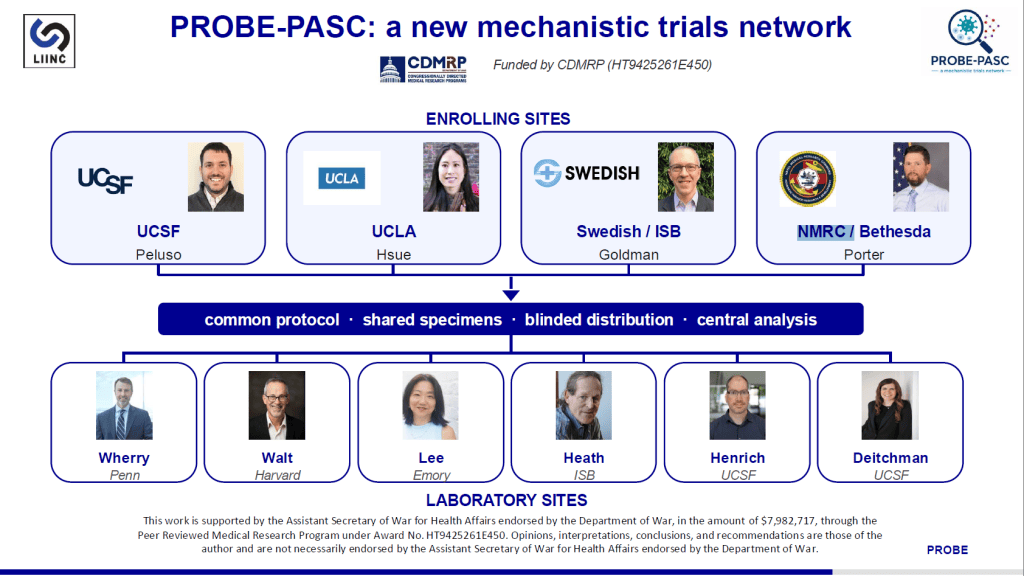
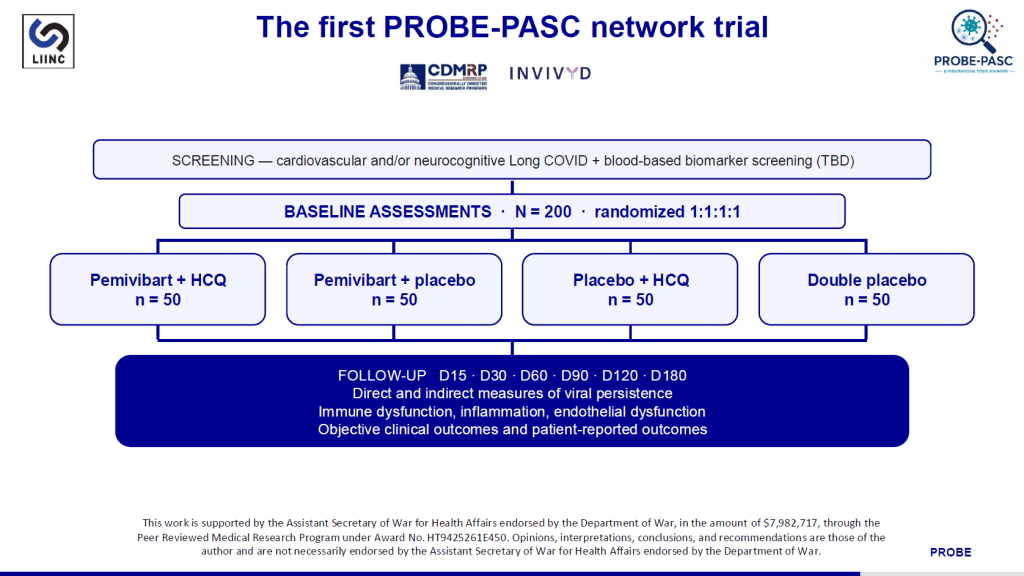
The first PROBE-PASC trial, testing Pemgarda and hydroxychloroquine, will include 200 participants across four sites: UCSF, the University of California, Los Angeles, Swedish Medical Center in Washington state, and the Naval Medical Research Command in Bethesda, Maryland. Those participants will be split across four arms, with 50 participants each, taking both drugs together, Pemgarda and a placebo, hydroxychloroquine and a placebo, or two placebos
Scientists have long been interested in trialing Pemgarda, a monoclonal antibody treatment designed to prevent SARS-CoV-2 infection among immunocompromised people, to see whether it may help with Long COVID symptoms by fighting lingering reservoirs of the virus. Invivyd, the company that produces Pemgarda, is “generously donating the antibody for the study,” Peluso said
Hydroxychloroquine is a treatment for autoimmune diseases and malaria that Trump promoted as a potential COVID-19 treatment in 2020, leading to shortages of the drug for people who were prescribed it for its approved uses. Research found the drug was not actually effective for treating acute COVID-19, but some papers have suggested it may help address immune system dysfunction in Long COVID. PROBE-PASC selected it for their first trial because it “provides beneficial immune modulation in other conditions associated with inflammation or autoimmunity,” may help with endothelial dysfunction (which is found in Long COVID), and is not linked to increased blood clotting, Peluso explained.
Research partners at other universities will test samples from trial participants to follow how the treatments address viral persistence and the immune system. Peluso and his colleagues at UCSF are also leading a program called VIPER (Viral Immunopathogenesis and Persistence Repeat Donor Cohort) that will examine candidates for Long COVID biomarkers. Biomarker candidates from VIPER may be used for PROBE-PASC samples as well, Peluso said
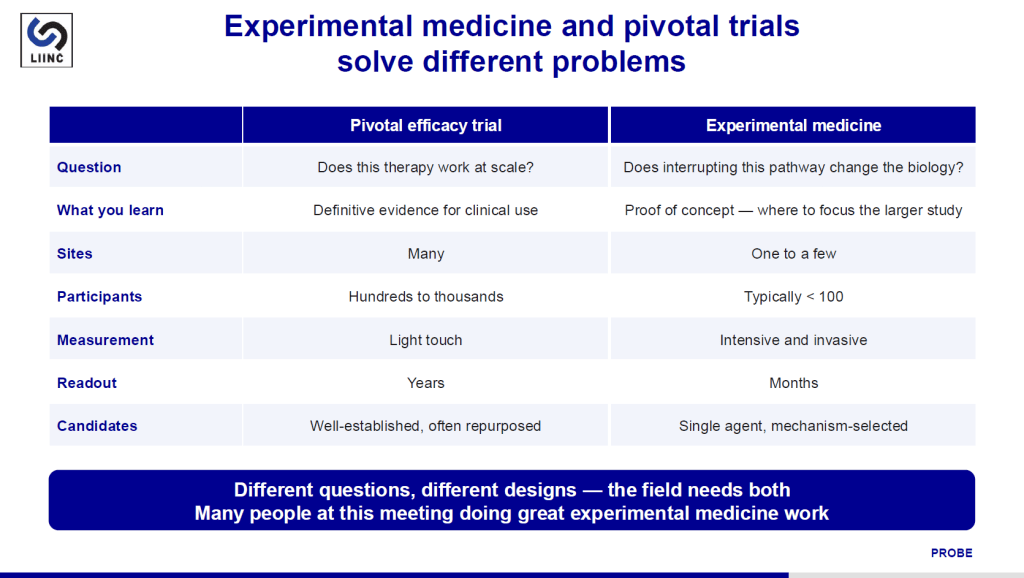
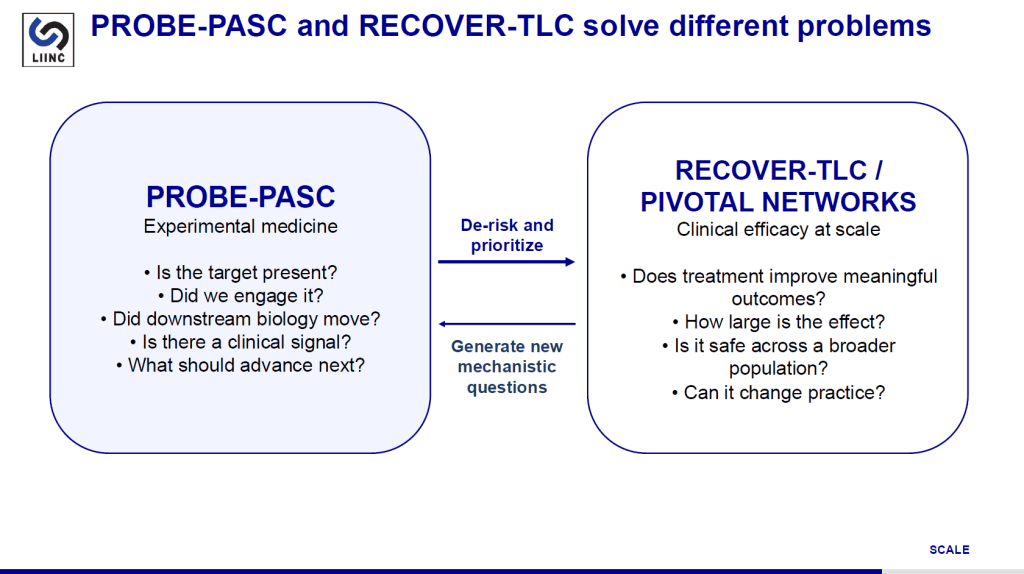
In his presentation, Peluso said that the PROBE-PASC program will complement the National Institutes of Health’s Long COVID trials initiative, RECOVER-Treating Long COVID, by focusing more on specific biological targets and doing deep analysis with smaller numbers of participants. The RECOVER-TLC trials are larger in their scale, more focused on establishing a treatment’s safety and effectiveness for many people
“We’ve seen firsthand the challenges in advocating for large efficacy trials because of limited pilot feasibility and mechanistic data,” Peluso told The Sick Times. “Our vision for this [PROBE-PASC] program is to fill that gap with high-quality mechanistic research at a larger scale than is typically possible in single-center studies.” While the current grant funds only one study in this new program, Peluso is optimistic that it can expand to further trials
Like VIPER, PROBE-PASC takes lessons from HIV research, Peluso said. “We’ve learned from our work in HIV that there is substantial benefit to having the clinical sites and laboratories working together from the very beginning … The idea is to have a core group of mechanism-focused laboratories ready and able to work with PROBE-PASC samples to understand the biology as part of the main project, rather than as something that comes later.”
Stone called the $8 million grant “a start, not a finish,” explaining that Long COVID Campaign will continue advocating for more funding through PRMRP. “Establishing the network is so valuable because future federal awards or other public and private funders can support additional therapies without building a new clinical trials network from scratch,” she said.
Right now, people with Long COVID and their allies can contact their Senators and call for Long COVID to be a priority again in fiscal year 2027, Stone said. “Community calls, emails and meetings helped make Long COVID eligible for PRMRP funding in FY2025. … We need that same community voice now to tell Congress: fund the tests, trials and treatments people with Long COVID urgently need.”
Community calls, emails and meetings helped make Long COVID eligible for PRMRP funding in FY2025. … We need that same community voice now to tell Congress: fund the tests, trials and treatments people with Long COVID urgently need
Meighan Stone, Long COVID Campaign
David Tuller contributed reporting from the ISLC-PAIS conference
Betsy Ladyzhets is a co-founder and the managing editor of The Sick Times. She will continue covering federal government efforts on Long COVID and IACCs. Send her tips at betsy@thesicktimes.org or betsyladyzhets.25 on Signal
All articles by The Sick Times are available for other outlets to republish free of charge. We request that you credit us and link back to our website
More policy & advocacy stories
- Department of Defense funds $8 million grant for Long COVID trialsSeptember 1, 2026

Congress’s 2027 budget could include new funding for Long COVID and MEAugust 18, 2026
How to protect your community from ICE when you have Long COVIDJuly 7, 2026
Wastewater testing is vital for public health. It needs sustained funding to continue beyond fall 2026.June 30, 2026
I worked in homeless services for years. It didn’t help me find accessible housing when I got Long COVID.June 26, 2026
The U.K.’s plan for ME has failed us. Members of parliament must step up.June 19, 2026