


Attachments
- Download Report(PDF | 2.14 MB)
• Hospital reconstruction accelerating: Syria signed an agreement with InterHealth Canada to rehabilitate and modernize 14 major public hospitals nationwide. The program covers buildings, medical equipment and hospital operating systems and is planned over approximately two years
• Eastern Syria receiving new investment: More than $10 million was allocated to health services in Raqqa, including rehabilitation of Raqqa National Hospital. In Deir-ez-Zoir a new cardiac catheterization, prosthetics, emergency, pediatric and neonatal services opened, while construction of a specialized oncology hospital was launched
• Additional facilities reopened or expanded across several governorates. Five health facilities opened in rural Idlib, including two dialysis centers; Homs opened a pediatric cardiology unit and upgraded dialysis services; Tadmor National Hospital received a $1 million grant and opened dialysis capacity; Douma National Hospital also reopened following rehabilitation supported by Japan and WHO
• Measles, polio, Hepatitis A and other communicable diseases (AWD, cutaneous leishmaniasis, scabies, etc.) remain active public-health concerns, especially where vaccination, safe water and routine health services are suboptimal
• Nutrition has become a stronger national priority. The MoH and UNICEF are moving nutrition programming from fragmented humanitarian projects toward a nationally led system. The Ministry says nutrition services operate through 929 primary health centers, and a new national nutrition survey and updated strategy are being prepared. UNICEF’s August assessment estimates 587,000 children need treatment for wasting, including around 96,000 with severe wasting. New international funding targets child health and malnutrition. On 24 August, South Korea and the UN launched a $18.95 million humanitarian/early-recovery package. UNICEF’s $7.95 million component will support health, nutrition and education for at least 400,000 vulnerable children and women, while WFP plans treatment for moderate acute malnutrition for 28,000 children under five and pregnant or breastfeeding women and girls.
• MoH is expanding specialist campaigns and diaspora participation. Syrian expatriate physicians have now reportedly carried out around 2,000 operations through more than 20 specialist medical campaigns, alongside local staff training. The MoH Telegram channel also announced “Recovery Bridges – SAMS 15” for September with SAMS and Global Medical Foundation Australia, covering multiple medical and surgical specialties across eastern, central, Damascus-area and Aleppo facilities
• Syrian diaspora doctors expanding specialist care: Syrian authorities reported that expatriate medical teams have conducted roughly 2,000 surgeries through more than 20 specialized campaigns, while also training local health workers and introducing newer medical technologies
• World Bank $75 million health project moves into implementation – the official World Bank procurement plan on 10 August
• Health financing reform is moving forward. Authorities want a redesigned public-sector health insurance system completed before the end of 2026, including a larger provider network, digital administration and stronger oversight. This is important because out-of-pocket spending remains one of the main barriers to care
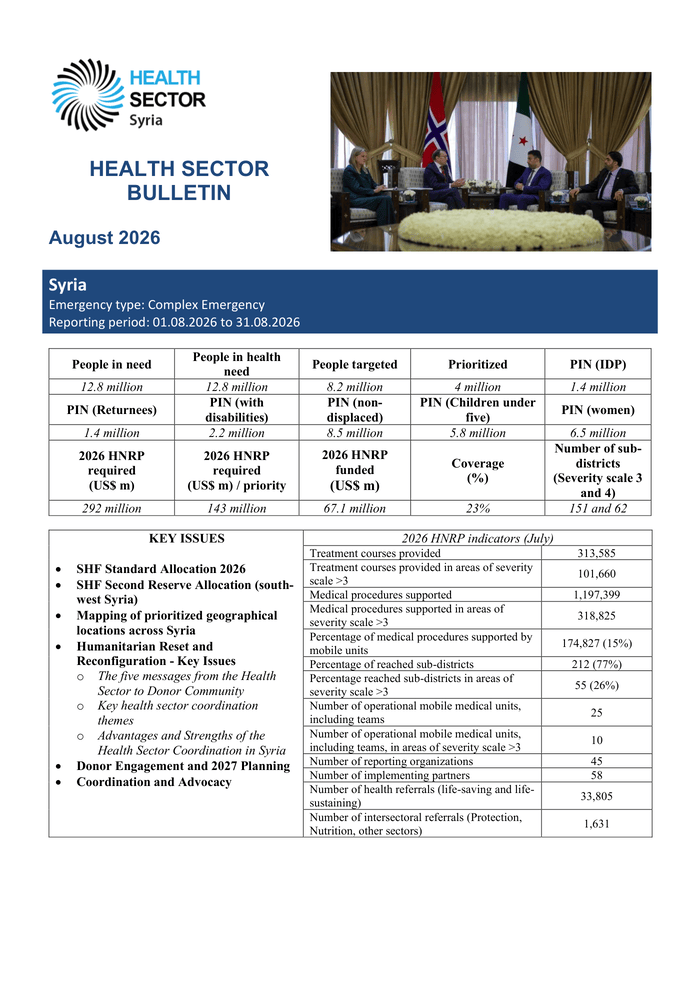
• The Health Minister met Norwegian Foreign Minister on 24 August (health-sector priorities, potential new projects, health investment and expanding successful experience with digital automation)
• The Health Minister met Germany’s chargé d’affaires in Damascus to discuss cooperation, coordination and future health-sector partnership
• The Health Minister met Norwegian Foreign Minister to discuss health-sector priorities, possible new projects, investment and the expansion of digital health-service automation
• The World Humanitarian Day, the Global Health Cluster, joins all humanitarians in honouring health workers who continue to provide life-saving care in the most dangerous conditions and the families who live with these risks and losses alongside them. The statement reflects on what is lost when health workers are attacked: lives, expertise, trust, relationships and vital care that communities depend on. It also calls for stronger protection of health workers and health care, respect for International Humanitarian Law, and accountability when those protections are violated. The full statement: https://healthcluster.who.int/newsroom/news/item/19-08-2026someone-is-waiting-for-them-to-come-home.
