


By Chuck Dinerstein, MD, MBA — Sep 02, 2026
Medicare Advantage can look like a great deal—until you get sick. A new study of why increasingly ill patients leave MA for Traditional Medicare reveals an economic paradox with implications far beyond Medicare Advantage, including the promise that Medicare for All can somehow escape healthcare’s unavoidable trade-offs.
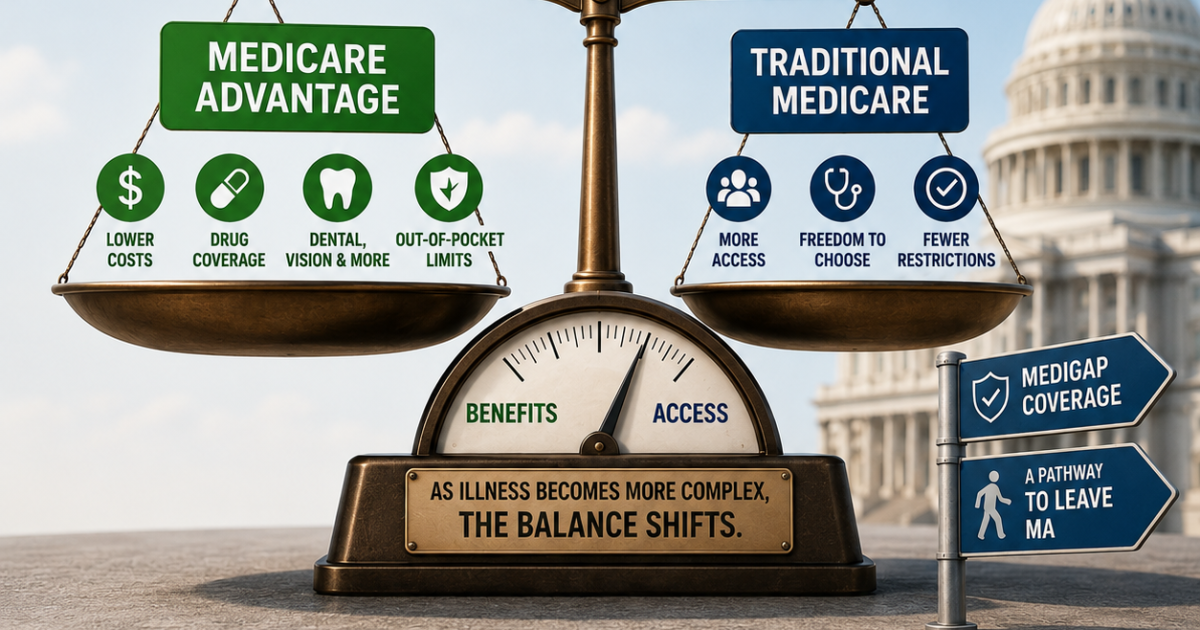
Image by ACSH using AI
Medicare Advantage (MA) accounts for an increasing share of overall Medicare coverage. The privatized program now serves 54% of eligible beneficiaries, and why not? MA provides out-of-pocket maximums and integrated prescription drug coverage, which traditional Medicare does not, along with additional benefits such as dental and vision coverage. Of course, there is no free ride, and the “cost” of those extras shows up in MA’s use restrictions, the administrative friction of prior authorization, and limited networks of hospitals and providers, which may limit access. Additionally, MA is more expensive to keep afloat, but taxpayers, not beneficiaries, bear those extra costs.
It should not be surprising that as we turn 65 and become eligible, many choose MA: lower cost, more benefits, a win-win for the beneficiary. Of course, a plan well suited to today’s healthy retiree may look very different to tomorrow’s chronically ill patient. A new studyreported in JAMA’s Health Forum finds that changes in health needs can lead beneficiaries to switch to traditional Medicare. However, like the “roach motel,” some find leaving MA difficult, mainly because secondary coverage (Medigap policies) for MA’s extras isn’t necessarily guaranteed once you become ill and switch plans.
When Good Coverage Meets Bad Health
The study included an analytic sample of roughly 1 million MA beneficiaries who, at the start of the study in 2016, had no medical issues, and followed them through 2019. Roughly 200,000 developed medical conditions during this period; the remaining 800,000 did not and served as the control comparison. Of those who developed medical problems, 80% developed one condition, 14% developed two conditions, and the remainder developed 3 or 4 new complex conditions
Among the key findings:
- Disenrollment increased after the onset of complex illness. Before new diagnoses appeared, disenrollment patterns were similar; afterward, beneficiaries who developed complex conditions were more likely to leave their current MA plans. Those who developed only one new complex condition were somewhat more likely to try another MA plan.
- A clear dose-response relationship emerged: the more new complex conditions, the higher the likelihood of leaving the MA plan.
- Disenrollment primarily reflected movement from MA to Traditional Medicare, particularly among beneficiaries developing multiple complex conditions.
- The type of illness mattered. Alzheimer’s disease and related dementias, diseases that require extensive care and medication, were associated with the largest increase in disenrollment; other conditions, such as heart attacks with fewer downstream costs, produced smaller movements away from their original MA plans.
- Access to Medigap appeared to facilitate leaving MA. Medigap policies, which add little to MA plans, did not materially affect switching between MA plans. However, beneficiaries in states with guaranteed-issue and community-rating protections to cover the gap left when leaving MA’s benefits were more likely to move to Traditional Medicare after developing complex illness, with the effect greatest among the most medically complex.
As illness becomes more complex, the tradeoff between benefits and access that drives choice shifts, and beneficiaries appear increasingly likely to leave MA and its benefits for traditional Medicare and its access. This is especially true when aakes the exit easier
The Economics Behind the Exit
The study helps inform the ongoing conversation about healthcare that ramps up around elections, especially when we understand two economic lenses. First, adverse selection occurs when people sort themselves into insurance arrangements based partly on information about their own risk
Adverse selection and the beneficiary. Medicare Advantage may be most attractive when beneficiaries are relatively healthy, and supplemental benefits and out-of-pocket limits can outweigh restricted networks and prior authorization. But illness changes the calculation. As medical complexity increased, beneficiaries became progressively more likely to leave MA for Traditional Medicare. Once sick, beneficiaries know more about their future need for care and may value fewer restrictions more. This is consistent with dynamic adverse selection. Medigap protections make that choice easier; without them, some beneficiaries may remain in MA because leaving has become financially difficult rather than because MA remains their preferred option.
Adverse selection and MA plans.Turn the lens around, and the same movement looks different. As higher-cost beneficiaries leave for Traditional Medicare, MA retains a relatively healthier, less costly population—favorable selection for MA and adverse selection into Traditional Medicare. The study does not show that MA plans deliberately push sick beneficiaries away. But utilization controls that matter little to healthy members become increasingly consequential to those needing the most care. The same mechanisms can therefore reduce spending among those who stay while making MA less attractive to those likely to cost the most.
Moral hazard. Insurance changes behavior because neither patients nor insurers necessarily bear the full consequences of their decisions. Traditional Medicare combined with Medigap lowers the marginal cost of additional care and may encourage greater utilization. MA creates the opposite incentive: because plans are capitated, they benefit from controlling utilization through networks, prior authorization, and care management. Those tools can discourage low-value care, but they can also make costly, necessary care harder to obtain. This study cannot tell us which is occurring.
The paradox. Traditional Medicare risks moral hazard by making care easier to consume; MA attempts to constrain that utilization through managed-care restrictions. Yet those restrictions matter most when beneficiaries become sick, giving those with the greatest healthcare needs the strongest reason to leave. The study’s pattern is telling: increasing complexity produced little movement between MA plans; most movement went toward Traditional Medicare
Understanding these choices is critical to understanding MA, traditional Medicare, and the aspirational Medicare for All
Medicare for All Doesn’t Make the Trade-offs Disappear
Both MA and traditional Medicare try to solve a fundamental healthcare problem: who decides how much care to consume, who provides it, and who pays for it. Traditional Medicare leaves more of those decisions to patients and physicians, accepting greater exposure to utilization and moral hazard. Medicare Advantage transfers more of that responsibility to insurers, accepting networks, prior authorization, and other restrictions in exchange for greater control over spending
The paradox is that what makes MA economically attractive when beneficiaries are healthy may make it less attractive when they become sick enough to need insurance most. Medicare for All would not eliminate that tension. Broadening coverage can answer who is insured, but it cannot eliminate scarcity, moral hazard, or the need to control utilization. The harder questions remain: How much healthcare can we consume, who decides what is worth paying for, and ultimately, who gets to say no?
g New Complex ConditionsJAMA Health Forum DOI: 10.1001/jamahealthforum.2026.2843
Tags:
Category
Policy & Ethics
Chuck Dinerstein, MD, MBA
Director of Medicine
Dr. Charles Dinerstein, M.D., MBA, FACS is Director of Medicine at the American Council on Science and Health. He has over 25 years of experience as a vascular surgeon
Recent articles by this author:
Medicare Disadvantage: What It Tells Us About Medicare for All
Going Keto: What Happens Beyond the Plate
From Cigarettes to Patches: Rethinking Nicotine Cardiovascular Risk
How do you keep doctors down on the farm?
Myopia: Screens, Sunlight and the Rise of Nearsightedness
All articles by this author
