


A new Q2 2026 report highlights critical workplace mental health trends, revealing forty-six percent of US workers don’t understand their retirement benefits, while 30 percent feel unsafe disclosing mental health issues to managers
- The Index reveals a stark link between employee financial wellbeing and overall productivity, as one in seven US workers says money stress is negatively affecting their workplace productivity
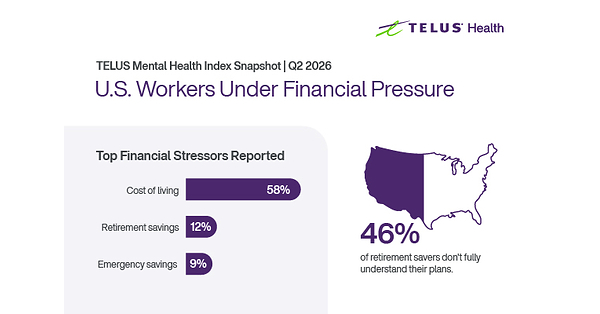
- Cost of living is the top financial stressor for 58 percent of workers, dwarfing those concerned about retirement savings (12 percent) and emergency savings (9 percent)
- Nearly half (46 percent) of US workers don’t fully understand the retirement plan they pay into
- Almost two-thirds (64 percent) of US workers are anxious about money, and one in nine never stops worrying about their finances
CHICAGO, Sept. 2, 2026 /PRNewswire/ — Today, TELUS Health released its TELUS Mental Health Index (“the Index”) reporting that the cost of living is the single largest financial stressor for 58 percent of US workers, dwarfing concerns over retirement savings (12 percent) and building emergency funds (9 percent). Adding to these financial anxieties, a benefits literacy gap finds nearly half (46 percent) of US workers admit they do not fully understand the retirement plan they pay into each month.
Continue Reading
According to the Index, the growing pressures of day-to-day expenses has created a constant state of distraction for millions of employees, with one in nine reporting they never stop worrying about money. Almost two-thirds (64 percent) of US workers report money-related stress and more than one in seven admit that financial strain is negatively impacting their productivity on the job. Financial strain continues to compound, as twenty-three percent of US employees lack emergency savings to cover basic needs, and workers lacking emergency savings are three times more likely to report workplace productivity declines.
“For the large majority of US workers, survival has eclipsed long-term planning. Fifteen percent of workers report that personal financial stress is directly hurting their work productivity, while three percent have missed work entirely due to financial strain,” says Paula Allen, Global Leader of Research and Insights, TELUS Health. “These financial anxieties coupled with a lack of support resources creates operational costs for employers, highlighting how employee financial health and workplace psychological safety are directly linked across the US labor market.”
Younger workers, parents, and caregivers are most at risk
The Index reveals distinct generational and organizational vulnerabilities across age groups, family structures, and industry sectors
- Age:Workers under age 40 are three times more likely than those over 50 to report a decrease in work productivity due to financial stress.
- Family:Working parents are twice as likely and managers are 60 percent more likely to experience productivity losses stemming from financial strain compared to their counterparts.
- The ‘Sandwich Generation’:Twenty-seven percent of workers provide care or financial aid to adult children, aging parents, or extended family. Among these caregivers, 34 percent report a negative impact on their finances and 27 percent report a hit to their mental health.
The retirement and saving benefits knowledge gap
Employee financial wellbeing and operational productivity are inseparable. Forty-six percent of workers contributing to a workplace retirement or savings program do not have a strong understanding of how it works, and those who do not understand it at all score 22.5 points lower on the Index than those who understand it well (54.2 vs. 76.7). Almost half of US employees (49 percent) actively want employer-provided resources, communications, or support for retirement, pensions, or savings plans making it the most requested financial topic in the Index.
The impact of mental health stigma on employee disclosure and care
In addition to financial stress, workplace stigma continues to hinder care. Only 49 percent of workers feel comfortable disclosing a mental health issue to their manager; and those who avoid disclosure score 11.5 points lower on the Index. Similarly, while substance use impacts work performance for over 40 percent of struggling employees, top barriers to seeking help include embarrassment (23 percent), cost (22 percent), confidentiality concerns (20 percent), and fear of workplace repercussions (18 percent).
About the TELUS Mental Health Index research methodology
The TELUS Mental Health Index data was collected through an online survey between June 5 and June 18, 2026, among 5,000 employed adults residing in the United States who were employed within the preceding six months. The sample is balanced to reflect the age, gender, industry, and geographic distribution of the US population. Benchmark scores out of 100 represent optimal (80–100), strained (50–79), and distressed (0–49) mental health ranges
Frequently Asked Questions
Q: How does financial stress affect employee mental health?
Workers who report always feeling anxious about money score 43.0 on the TELUS Mental Health Index—placing them in the distressed range, 27.1 points below the national average of 70.1 and 47.3 points below peers who never feel money-anxious. Overall, financially insecure workers score 25.9 points lower than their financially secure counterparts (52.3 vs. 78.2)
Q: Does financial stress affect work productivity?
Fifteen percent of US workers report that personal financial stress has directly impaired their work productivity over the past three months, with affected employees scoring 25.7 points lower on the Index compared to unaffected peers (50.6 vs. 76.3). In addition, ten percent report difficulty concentrating at work and three percent have missed work entirely due to financial stress
Q: What are employees most stressed about financially in 2026?
Fifty-eight percent of US workers identify the cost of living as the leading driver of their financial anxiety, nearly five times the proportion citing a lack of retirement savings (12 percent) or emergency savings (9 percent). However, financial stressors vary by age as workers over 50 are two and a half times more likely than those under 40 to cite retirement savings as their primary concern
Q: Why are emergency savings critical for workplace productivity?
Twenty-three percent of US employees lack emergency savings to cover basic needs. The Index found that workers without an emergency fund are three times more likely to report declines in workplace productivity, as the lack of a financial safety net increases chronic stress and distraction
Q: Do employees understand their retirement benefits?
Forty-six percent of US workers contributing to workplace retirement or savings programs lack a strong understanding of how they work. The three percent of contributors who report not understanding their program at all score 22.5 points lower on the Index than those who understand their plan very well (54.2 vs. 76.7)
Q: What financial benefits do employees want from employers?
Almost half (49 percent) of US workers want employer-provided reavings plans. Specific topics requested include: retirement/long-term savings (29 percent), investing (21 percent), workplace pension/savings plans (20 percent), tax planning (17 percent), emergency savings (16 percent), insurance/financial protection (15 percent), debt management (13 percent), and budgeting (10 percent)
Q: How many employees care for aging parents or adult children?
Twenty-seven percent of the US workforce provides financial support or caregiving to adult children (14 percent), aging parents (9 percent), or other adult family members (4 percent). Among these caregivers, 34 percent report a negative impact on their personal finances, 27 percent report a negative impact on their mental health, and 13 percent report decreased work productivity
Q: Are employees comfortable discussing mental health with their manager?
Only 49 percent of US workers feel comfortable telling their manager if they have a mental health issue, while 30 percent would not feel comfortable and 22 percent are unsure. Workers who would not feel comfortable disclosing a mental health issue score 11.5 points lower on the Index compared to those who would (63.1 vs. 74.6)
Q: What stops employees from getting help for substance use?
Top barriers preventing US workers from seeking help for substance use include stigma or embarrassment (23 percent), cost or financial barriers (22 percent), confidentiality concerns (20 percent), and fear of having to tell someone at work (18 percent). Additionally, 24 percent of workers prefer to handle substance use issues on their own
Q: What is the state of workplace mental health in the US in 2026?
The Index score stands at 70.1 in the US for Q2 2026, with 23 percent of the workforce at high mental health risk, 42 percent at moderate risk, and 35 percent at low risk. Anxiety (63.5) and isolation (66.4) remain the lowest sub-scores in the report, continuing a six-year trend as the primary drivers of workforce psychological risk
About TELUS Health
TELUS Health empowers people to live healthier lives and helps organizations create more productive, wellbeing-focused workplaces through global leadership in healthcare technology. Operating in more than 200 countries and territories, we support approximately 159 million people at every point of their physical, mental, and financial wellbeing journey
Our integrated approach connects the entire healthcare ecosystem: comprehensive workforce wellbeing programs, compassionate and personalized preventive care, and the technology infrastructure that healthcare practitioners and payors rely on daily. This creates seamless care pathways delivering regionalized and gender-responsive support, where and when people need it most
Through our data-driven insights and proprietary research we are reshaping healthcare with earlier intervention and culturally-attuned approaches so individuals and organizations can thrive. Follow us as we advance our mission to become the world’s most trusted wellbeing company: telushealth.com
Media Contact:Kaya Arai TELUS Health PR [email protected]
SOURCE TELUS Health

