


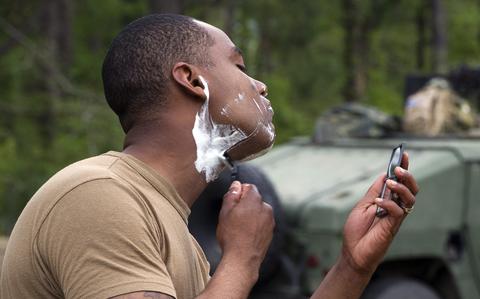
A sailor shaves during an exercise in 2012 at Camp Shelby, Miss. Sailors with shaving-related conditions will get one year of medical treatment to meet the Navy’s clean-shaven face standard or they will be removed from the service. (Ernesto Hernandez Fonte/U.S. Navy)
Sailors with shaving-related conditions will get one year of medical treatment to meet the Navy’s clean-shaven face standard or they will be removed from the service, according to new guidance
The Navy will no longer issue permanent shaving waivers to sailors who suffer from skin conditions caused by shaving, including pseudofolliculitis barbae, according to a Navy memorandum published this week. The updated policy brings the service into line with guidance issued last year by Defense Secretary Pete Hegseth banning most shaving accommodations for service members
The Navy’s July directive instructs all sailors with skin irritation or other conditions caused by shaving — including those with current medical shaving waivers — to report the issue to their supervisors and seek medical evaluation. If recommended for treatment, their commanding officer may issue a temporary shaving waiver, allowing them to maintain a beard up to ¼ inch in length
Commanders may grant temporary waivers for up to 90 days, according to the guidance. Those waivers must “align with prescribed treatment.” Commanders may only grant a 90-day shaving waiver four times before they must recommend a sailor for administrative separation
Sailors who cannot meet shaving standards after one year of treatment shall be deemed to have “an unmanageable permanent condition” and recommended for “separation due to failure to comply with grooming standards,” according to the memo
“The operational success of the U.S. Navy demands the readiness of all sailors. Mission accomplishment hinges on stringent compliance with standards and ensuring implementing policies are clear, unambiguous, and compliant with law and regulation,” the memo reads. “Grooming standards add to sailor and mission safety and ensure the safe and proper utilization of protective equipment in all naval environments and operational conditions.”
The policy says the Navy will not grant temporary medical shaving waivers to recruits or others entering or reentering the service
Pseudofolliculitis barbae, commonly known as razor bumps, is a condition that can cause a person to experience painful inflammation after shaving. The condition disproportionately affects Black men, some 60% of whom may experience it, according to the American Osteopathic College of Dermatology
Hegseth has lamented the increase in recent years of bearded troops, who he has said do not meet military standards. His Sept. 2025 memorandum also instructed the military services to reevaluate religious beard waivers
The Navy last month ordered sailors with religious-based accommodations, including for facial hair, to reapply for a grooming standard exemption and outlined its more stringent evaluation process
The July memo allows sailors to continue to wear mustaches. It also allows certain special operators to don beards in certain operational environments when they are deemed “mission essential.” Those forces — including Navy SEALs — however must “be clean shaven” when deployed in areas with a threat of a chemical, biological, radiation or nuclear attack, the memo said
Featured on Instagram

Corey Dickstein
Corey Dickstein
Corey Dickstein covers the military in the U.S. southeast. He joined the Stars and Stripes staff in 2015 and covered the Pentagon for more than five years. He previously covered the military for the Savannah Morning News in Georgia. Dickstein holds a journalism degree from Georgia College & State University and has been recognized with several national and regional awards for his reporting and photography. He is based in Atlanta.
