



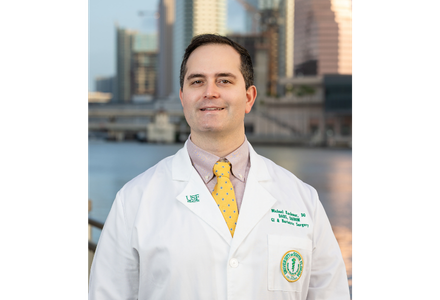
Dr. Michael Kachmar
High rates of obesity are associated with an increased risk of developing a number
of chronic health conditions, including heart disease, diabetes, stroke, high blood
pressure and various types of cancer.
Given its connection to diseases requiring surgical treatment, American patients with
the most severe forms of obesity would be expected to make up a growing share of surgical
care. But a new national study led by a USF Health surgeon found the opposite
Published in the journal Obesity, the study found that patients with the highest levels of obesity, as measured by
body mass index, or BMI, underwent the fewest surgical operations each year. In essence,
the higher a person’s BMI, the less likely they were to receive surgical care
The findings raise potential concerns because patients with higher BMI have increasing
medical and surgical needs, yet their representation among surgical cases declined
over time. Such underrepresentation is especially notable in light of the research
team’s prior work showing that the U.S. population with extreme obesity has grown disproportionately over the past two decades
Michael Kachmar, DO, assistant professor of surgery in the USF Health Morsani College of Medicine and a bariatric and metabolic surgeon at Tampa General Hospital, served as the study’s
first author
“What stands out to me as a surgeon is both the direction of the trend and what may
be happening before a patient even reaches the operating room,” Dr. Kachmar said.
“This population has a substantial obesity-related disease burden, and prior work
shows it is growing rapidly. So, when patients with the highest BMI become less represented
among surgical cases over time, it raises an important question: are we identifying
and addressing the barriers these patients may face along the pathway to care, from
referral and imaging to anesthesia evaluation, hospital resources, insurance requirements
and preoperative optimization?”
Investigators from USF Health, Pennington Biomedical Research Center and LSU Health
New Orleans analyzed more than 11.6 million multispecialty surgical cases from the
American College of Surgeons National Surgical Quality Improvement Program between
2005 and 2022. The analysis included procedures across multiple surgical specialties
and evaluated trends by BMI.
The research team found that as BMI increased, patients were progressively less represented
in surgical care over time. The trend was most pronounced among patients with the
highest BMI levels, including those with severe obesity
The findings are significant because obesity is closely associated with many conditions
that may require surgery, including hernias, gallbladder disease, osteoarthritis and
cancer. If patients with severe obesity are receiving fewer procedures over time,
it raises important questions about where obstacles may be occurring in the surgical
care pathway
The study does not identify a single cause for the trend. However, researchers note
that there could be several factors, including greater surgical complexity, higher
perioperative risk, limited access to specialized equipment or infrastructure, delayed
evaluation and differences in eligibility for some elective procedures
Researchers say the findings point to the need for health systems to better understand
how patients with severe obesity move through surgical treatment. Kachmar suggests
researchers and health providers should work to identify and address the underlying
factors that prevent patients from accessing the medical and surgical care they need,
including referral patterns, preoperative evaluation, hospital infrastructure, insurance
coverage, patient counseling and other points in the care pathway.
“There are absolutely clinical reasons why some patients with very high BMI may be
deferred or optimized before surgery,” Dr. Kachmar said. “But the numbers are stark.
This population is growing rapidly, and we should not be seeing the kind of decline
in surgical representation that we observed. That tells us we need to look much more
closely at where these patients are being delayed, redirected or lost along the pathway
to surgical care.”
