


Credit: Oriane Zerah for the IRC
13 JUL 2026
Afghanistan’s child malnutrition emergency is expanding because collapsing support, drought, displacement, and weakened health services are reinforcing one another. The crisis is now best understood not only as a humanitarian emergency, but also as a Human Rights failure and a test of State Policy capacity, because the right to food and basic health protection is being eroded while millions remain without reliable assistance
Afghanistan child malnutrition emergency grows as support collapses
The scale of the emergency is severe and still rising. UN reporting said 3.7 million children in Afghanistan are suffering from acute malnutrition, while WFP said 4.9 million mothers and children are expected to be malnourished in 2026. Reuters added that 200,000 more children are expected to face acute malnutrition this year, bringing the total treatment burden to 3.7 million children
This crisis is not limited to one region or one season. WFP has said 17.4 million people are projected to be severely food insecure, and Save the Children said just over 9 million children will face crisis or emergency hunger before March 2026. UNICEF’s malnutrition data also shows the structural depth of the problem, with 10% of children under five malnourished and 45% stunted
Drought, displacement, and weak services drive the crisis
The immediate pressure comes from the collapse of support at the same time as need is increasing. UN reporting said Afghanistan’s humanitarian appeal is only 14% funded, while WFP said it urgently needs $350 million for the next six months to keep life-saving operations running. WFP also warned that funding cuts have forced it to reach only one in four children who need treatment, showing how quickly reduced financing turns into reduced survival
Drought and water stress are deepening the damage. UN reporting described villages where around half the population has left because there was no water to irrigate crops, while families were surviving on scraps like potato peelings. The IPC also linked the crisis to drought, returns from Iran, earthquakes, poor dietary diversity, and seasonal disease burdens, which means the nutrition collapse is tied to broader environmental and displacement pressures
Human Rights concerns intensify as malnutrition worsens
This is a Human Rights crisis because access to food, health, and safe water is being undermined in ways that disproportionately hurt children and mothers. A rights-basedly realize the right to food and protect people against hunger and starvation even during emergencies. In Afghanistan, that obligation is being tested by the scale of unmet need, the closure of services, and the inability of many families to reach care in time
The rights problem is also visible in service collapse. MSF said 445 health facilities and 203 mobile health and nutrition teams have been suspended or closed after major funding cuts. That means children who need early screening, supplements, and referral care are increasingly being missed until they become critically ill, turning a preventable health issue into a life-threatening rights violation
State Policy failures deepen Afghanistan’s nutrition crisis
The crisis is also a test of State Policy, because nutrition problems of this scale cannot be solved by emergency aid alone. Afghanistan’s public health institutions have long had nutrition responsibilities, but the current emergency shows that policies on water access, local health delivery, and community outreach are not strong enough to absorb repeated shocks. When treatment centers close and mobile teams disappear, policy failure becomes visible at the bedside, not just in planning documents.
The state’s response capacity is further constrained by shrinking humanitarian space. UN reporting said repeated floods, earthquakes, fuel-price pressure, border restrictions, and disrupted supply routes are making operations harder. MSF added that health access has deteriorated after cuts to international financing, meaning the policy environment is no longer able to protect the most vulnerable at scale
Families face impossible choices as food access breaks down
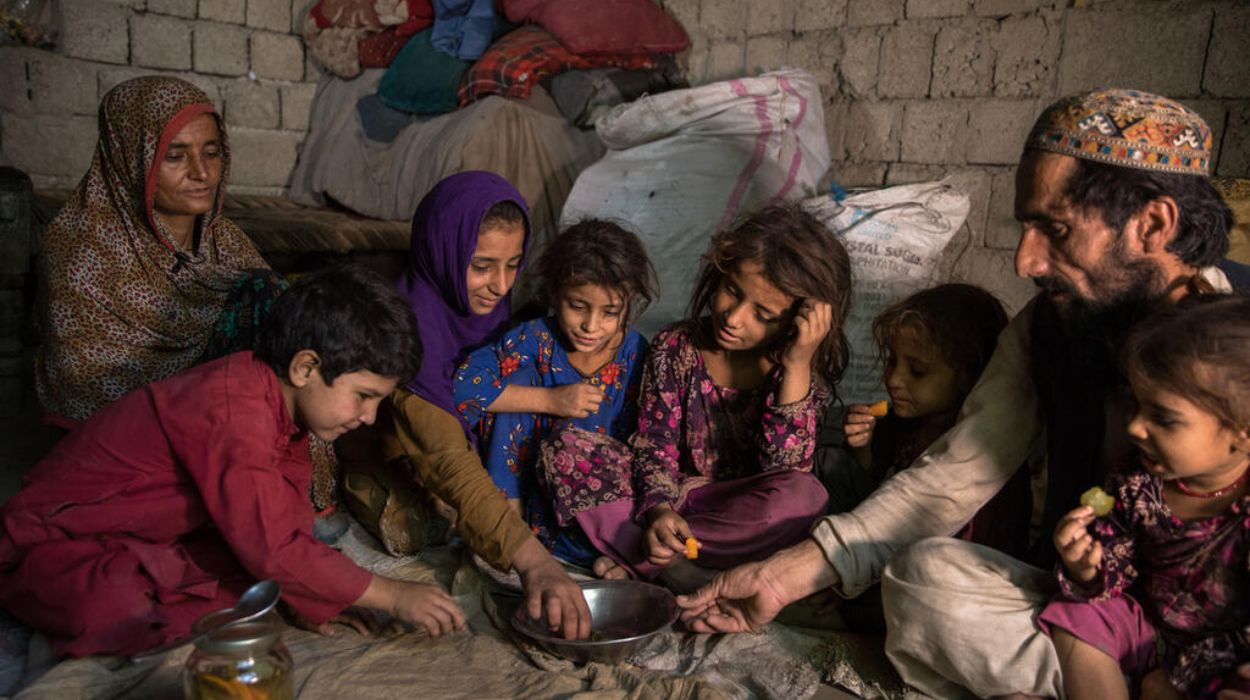
At household level, the crisis is forcing impossible choices. UN News described families eating
“potato peelings and other scraps,”
which reflects how far diets have deteriorated under sustained food stress. In the same reporting, remote communities were described as becoming impossible to sustain because water shortages and loss of livelihood made staying in place less
The burden falls especially hard on women and young children. UN reporting noted that restrictions on women’s participation are affecting the availability of female health workers, which makes maternal and child nutrition services harder to provide. WFP also said women and children account for 80% of food-assistance recipients, so when funding falls, the people with the highest nutrition risk are the first to lose support
Medical evidence shows the crisis is accelerating
The frontline medical evidence confirms the crisis is worsening. MSF said admissions of severely malnourished children in Helmand and Kandahar were more than 30% higher between January and April 2026 than during the same period in the previous three years. In Helmand’s Boost Provincial Hospital, there were more than 1,500 admissions of severely malnourished children with medical complications during those months, more than double the same period in 2022
In Kandahar, MSF recorded over 570 admissions, with more than 300 patients referred onward. These figures show that the emergency is no longer only about shortages of food. Children are arriving too late for simple treatment, which means malnutrition is now interacting with infection, diarrhea, respiratory illness, and broader weakness caused by poor diets and weak immunity
Returnees and border pressures intensify the emergency
Another major pressure point is the return of large numbers of Afghans from neighboring countries. Reuters reported that more than 2.1 million returnees have come back from Iran since late 2023, creating fresh demand for food, shelter, and services in communities already struggling. WFP also said some assistance was suspended near border areas because of clashes and disrupted corridors, which made it harder to move therapeutic supplies where they are needed
This matters because returnee pressure does not create a separate crisis; it multiplies the existing one. Families arriving in host communities often have no assets, while those host communities are already dealing with drought and unemployment. The result is greater competition for food, higher prices, and a larger share of children at risk of malnutrition
What the warnings mean for Afghanistan’s future
The warning from humanitarian agencies is clear: without urgent funding, the crisis will keep widening. WFP said the shortage is so severe that it can only provide a fraction of what is needed, while UN reporting said extraordinary efforts will still fall short unless donor support and humanitarian clearances improve quickly. Save the Children similarly warned that financing cuts will reduce access to food assistance and supplementary feeding for tens of thousands of children and mothers
The broader implication is that Afghanistan’s malnutrition emergency is now a governance and rights crisis as much as a humanitarian one. The combination of funding collapse, weak service delivery, drought, displacement, and restricted access means child malnutrition is being normalized as a permanent emergency rather than treated as a solvable policy failure
