


Senator Lindsey Graham died on Saturday, July 11th, at 71. The medical examiner’s preliminary finding was an aortic dissection, a tear in the wall of the aorta, the large artery that carries blood out of the heart. The final death certificate is still pending. Most of the coverage called it “sudden.” Aortic disease is usually silent until it tears or bursts
What can go wrong in the aorta
The aorta is the body’s largest artery, running from the heart down through the chest and abdomen. Three different things can go wrong with it. They’re related but not the same, and they get confused all the time
An aneurysm is a bulge. A weak spot in the aortic wall stretches and balloons outward. It happens slowly, over years, and usually causes no symptoms, which is why most aneurysms are found by accident on a scan done for something else. An aneurysm is defined by size. The wider it grows, the thinner and more fragile the wall gets, and the higher the odds that it will eventually fail
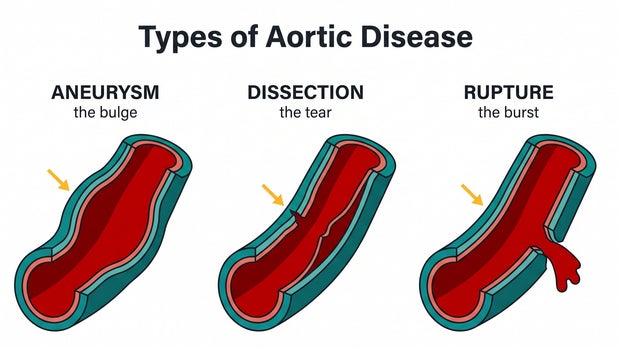
A dissection is a tear. Blood breaks through the inner lining and forces its way into the wall itself, splitting the layers apart and carving a false channel. This one is sudden and is a true emergency, usually announced by abrupt, tearing chest or back pain. It doesn’t require an aneurysm first. A dissection can strike an aorta that was never enlarged, which is part of why it gets missed
A rupture is a burst. The wall gives way completely, and blood pulses out where it shouldn’t, into the chest or the sac around the heart. It’s the usually fatal ending that either an aneurysm or a dissection can lead to, and it can kill in minutes
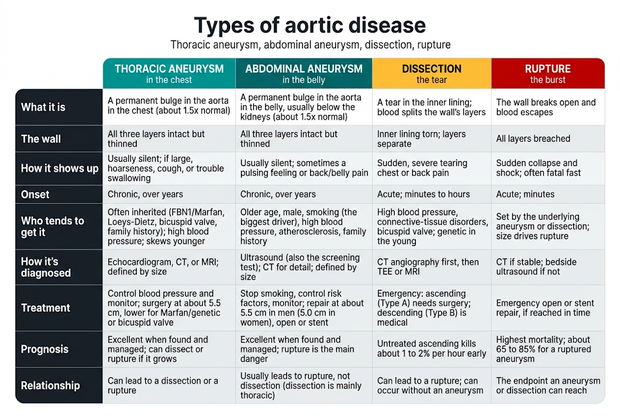
Bulge, tear, burst. One can set off another, but they aren’t the same. Dissection skews older, driven by high blood pressure and hardened arteries. An aneurysm in a younger person is more likely to be inherited, caused by a weakness in the connective tissue itself
That difference is what separated Graham from my husband. Graham’s aorta, at 71, tore, a dissection along a wall stiffened by decades of what the medical examiner called arteriosclerotic cardiovascular disease. My husband Grant Wahl’s bulged and burst, at an age when this disease usually means something inherited
Graham’s kind is the common one, driven by age, blood pressure, and hardened arteries. For most people, it isn’t a reason to go hunting for an aneurysm. It’s a reason to treat your blood pressure and for emergency rooms to keep a tear in the aorta on their radar, because it still gets mistaken for a heart attack. There is one proven screening test in this whole area: a one-time ultrasound for men 65 to 75 who have ever smoked, which looks for abdominal aneurysms. Beyond that group, almost no one reading this needs a scan tomorrow.
The version that killed my husband is the other one, and it doesn’t play by those rules. It runs in families, it strikes decades earlier, and it usually gives no warning until the artery fails. A routine checkup won’t find it, and no population screening program looks for it. Most families learn they carry it the way mine did, after someone dies. None of this is a reason for everyone to panic. But if aortic disease runs in your family, it can be caught early, with imaging and sometimes genetic testing, long before it turns dangerous.
The aneurysm nobody saw
In December 2022, my husband, the soccer journalist Grant Wahl, collapsed in the press box while covering a World Cup quarterfinal in Qatar. He died that night. He was 49
The aneurysm was in the first stretch of aorta just above his heart, 6.0 cm across, and when it ruptured it filled the sac around his heart with blood. The autopsy found the wall had been thinning from the inside for a long time, its elastic fibers fragmenting. There was almost no hardening of his arteries at all. His was a bulge that burst in a man under 50, without the decades of arterial wear that killed the senator
Why I asked for an autopsy
I’m a physician, epidemiologist, and medical journalist. I investigate. I think in terms of mechanisms and evidence, and I don’t accept “he died suddenly” as a stopping point. So I asked the New York City medical examiner for a full autopsy. I wanted to know what had happened, and I wanted an explanation. Had I missed something? Could anything have been done to prevent it or treat it? Could whatever killed him be used to protect the rest of Grant’s family, or help other families? I needed to make sense of it. Grief leaves you turning every ordinary day over, looking for the sign you didn’t catch, and the autopsy gave me answers instead of that loop. It gave me closure. It was therapeutic.
It gave me facts I needed for an uglier reason, too. Within days of Grant’s death, people invested in vaccine disinformation claimed the COVID shot had killed him. The autopsy was unambiguous: he tested negative for the virus, and the report stated that his prior vaccination “neither caused nor contributed” to the rupture. I’ve written about that elsewhere, and I’ll leave it there
What the autopsy found in his DNA
The New York City medical examiner’s office runs the only molecular genetics laboratory housed inside a medical examiner’s office in the country. It tests the DNA of people who die suddenly, reviewing about 500 cases a year and finding a genetic cause in roughly 100 of them. In Grant’s heart tissue, the lab found a variant in FBN1, the gene behind Marfan syndrome
Grant did not have Marfan. He was tall, but he didn’t have the syndrome. What he had was a single change in a gene that helps build the connective tissue holding the aortic wall together, in a spot the labs classify as a “variant of uncertain significance.” We don’t know for certain that this variant caused his aneurysm. It’s the most likely explanation, and inherited connective tissue problems are well-established risk factors for ascending aortic aneurysms in people under 60
Sorting out which of these variants actually cause disease is real, unfinished work. Dr. Dianna Milewicz’s group at UTHealth Houston has spent years mapping the genes behind thoracic aortic disease. Other teams are chasing the opposite question: why some people carry a Marfan mutation and never get sick, hunting “modifier” genes that seem to shield the aorta. Grant’s variant sits inside that uncertainty
Turning a death into prevention
None of that uncertainty changed what came next. Once the lab identified the variant, Grant’s blood relatives could be tested for that exact change. My brother-in-law Eric, Grant’s brother, carries it. His uncle, a niece and a nephew, and other family members have been tested, too. Eric had echocardiograms as well as MRI and CT scans. His aorta is structurally normal. He now gets regular imaging, and if his aorta ever starts to enlarge, his doctors will see it coming, with years to act
That’s what the autopsy did. It gave the people who share Grant’s DNA something they could act on
The same disease killed the actor John Ritter. In 2003, at 54, he died of an aortic dissection that was mistaken for a heart attack. His widow, Amy Yasbeck, started the John Ritter Foundation for Aortic Health, which funds Milewicz’s research program and has enrolled more than 1,500 families. Eric now advocates with them. Twenty-three years after Ritter’s death, aortic dissection is still routinely missed in emergency rooms because it mimics a heart attack and most clinicians aren’t thinking about it.
But it’s not just for patients to advocate for themselves. Clinicians should consider a tear in the aorta before sending someone home, and geneticists can test families after a sudden death. The New York City medical examiner recently launched a program called GIFTS that offers free genetic testing to the living relatives of people who died of inherited conditions, the first time a medical examiner’s office has tested living patients. The lab’s director, Dr. Yingying Tang, told me the program was shaped by families like mine.
Should you get checked?
Two questions I get asked a lot:
What should prompt you to get screened? A first-degree relative, a parent, sibling, or child, with a thoracic aortic aneurysm or dissection, or a sudden unexplained death in the family, especially before 60. Physical features of a connective tissue disorder: being very tall with long limbs, a chest that caves in or juts out, severe nearsightedness, or a dislocated lens. The current cardiology guidelines recommend imaging the aorta in the first-degree relatives of anyone with thoracic aortic disease.
One more, and it has nothing to do with family history: men 65 to 75 who have ever smoked should get a one-time abdominal ultrasound to check for an abdominal aortic aneurysm. If that’s you, ask your doctor for it
Who should get genetic testing? People with a thoracic aortic aneurysm or dissection who also have features of a connective tissue disease, a family history of aortic disease, or disease before 60. When a disease-causing variant turns up, the rest of the family can be tested for that exact variant. That’s how you find the Eric’s, the ones carrying the risk whose aortas are still normal
And if an aneurysm is found? A known aneurysm is a manageable condition: blood pressure control, regular imaging, and surgery once it reaches a size threshold, around 5.5 cm for the ascending aorta and lower for people with genetic forms. Grant’s was 6.0 cm, well into repair territory. Nobody knew it was there
I couldn’t have known. He had no symptoms, and nothing in his life would have pointed a doctor to his aorta. But a lot of families can know. If aortic disease has touched your blood relatives, ask your doctor about imaging and ask whether genetic testing makes sense for you
This article was originally published in Dr. Céline Gounder’s “Underlying Conditions”newsletter on Substack.Read more and subscribe here
