



- Short Reads
August 25, 2026
Americans want transparency when AI is used in their healthcare
ByEileen YamGiancarlo PasquiniEmma Kikuchi
Whether for reading X-rays or taking notes on patient-doctor conversations, artificial intelligence is reshaping healthcare
A new Pew Research Center survey asked U.S. adults about their views on AI at the doctor’s office. A common thread in their responses is that they’re uncertain about whether it’s used in their healthcare, and they want to be informed if it is. Here are more key takeaways from the survey
About this research
This Pew Research Center analysis explores Americans’ views on the use of AI in healthcare
Why did we do this?
Pew Research Center does research to help the public, media and decision-makers understand important topics. This research builds on two of our key topics: artificial intelligence and medicine and health
Learn more about Pew Research Center and our other research on science and society
How did we do this?
For this analysis, we surveyed 3,488 U.S. adults from June 22 to 28, 2026. Everyone who took part in this survey is a member of the Center’s American Trends Panel. The survey represents the views of the full U.S. adult population
Here are the survey questions used for this analysis, the detailed responses and the survey methodology
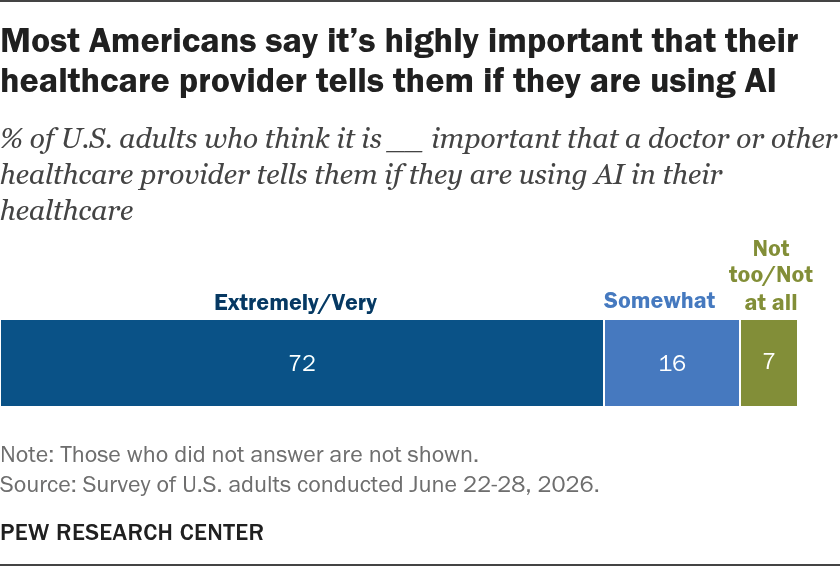
Americans want doctors to tell them if AI is being used in their healthcare
% of U.S. adults who think it is __ important that a doctor or other healthcare provider tells them if they are using AI in their healthcare
Note: Those who did not answer are not shown.
Source: Survey of U.S. adults conducted June 22-28, 2026.
PEW RESEARCH CENTER
Most Americans say it’s highly important that their healthcare provider tells them if they are using AI
% of U.S. adults who think it is __ important that a doctor or other healthcare provider tells them if they are using AI in their healthcare
| Extremely/Very | Somewhat | Not too/Not at all | |
|---|---|---|---|
| U.S. adults | 72 | 16 | 7 |
Note: Those who did not answer are not shown.
Source: Survey of U.S. adults conducted June 22-28, 2026.
PEW RESEARCH CENTER
About seven-in-ten U.S. adults (72%) say it’s extremely or very important that a doctor or other healthcare provider tells them if they’re using AI in their healthcare. And majorities across age, gender, education, and racial and ethnic groups say this. (Read the appendix for a detailed breakdown.)
This comes as discussion is rapidly evolving about medical professionals’ legal and ethical obligations to get patients’ consent before using AI tools
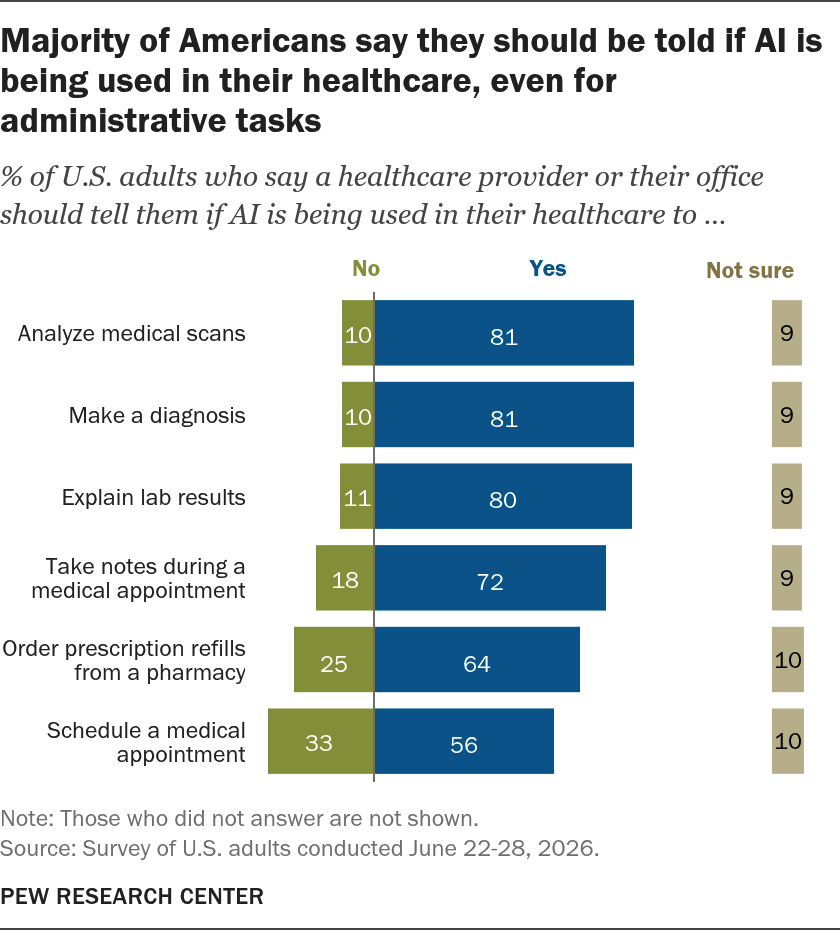
Many Americans say doctors should tell them if AI is being used, even for administrative tasks
Eight-in-ten or more want a provider or their office to tell them if AI is used for things that can directly affect care or medical decisions, like analyzing medical scans, diagnosing conditions and explaining lab results
% of U.S. adults who say a healthcare provider or their office should tell them if AI is being used in their healthcare to …
Note: Those who did not answer are not shown.
Source: Survey of U.S. adults conducted June 22-28, 2026.
PEW RESEARCH CENTER
Majority of Americans say they should be told if AI is being used in their healthcare, even for administrative tasks
% of U.S. adults who say a healthcare provider or their office should tell them if AI is being used in their healthcare to …
| No | Yes | Not sure | |
|---|---|---|---|
| Analyze medical scans | 10 | 81 | 9 |
| Make a diagnosis | 10 | 81 | 9 |
| Explain lab results | 11 | 80 | 9 |
| Take notes during a medical appointment | 18 | 72 | 9 |
| Order prescription refills from a pharmacy | 25 | 64 | 10 |
| Schedule a medical appointment | 33 | 56 | 10 |
Note: Those who did not answer are not shown.
Source: Survey of U.S. adults conducted June 22-28, 2026.
PEW RESEARCH CENTER
When it comes to AI being used to take notes in the background during an appointment, 72% of Americans say they should be told
Smaller shares – but still more than half – feel this way about behind-the-scenes administrative activities. These include scheduling medical appointments (56%) and getting prescription refills (64%). Scheduling is the task that the largest share feels they do not need to be told about (33%)
For each of the tasks we asked about, another 9% to 10% say they’re not sure whether they need to be informed about AI use
White adults were more likely than Black or Hispanic adults to say they want to be told if AI is used for the three tasks we asked about that directly shape medical decisions. (Read the appendix to explore more differences by race and ethnicity.)
A majority of Americans want more say over whether AI is used in their healthcare
Many Americans don’t think they have a say whether AI is used in their healthcare, and would like more
% of U.S. adults who say that in general, they think they have __ (of a) say over whether a doctor or other healthcare provider uses AI in their healthcare
% of U.S. adults who say they __ over whether AI is used in their healthcare
Note: Those who did not answer are not shown.
Source: Survey of U.S. adults conducted June 22-28, 2026.
PEW RESEARCH CENTER
Many Americans don’t think they have a say whether AI is used in their healthcare, and would like more
| Not too much/None | Some | A great deal/Quite a bit | Not sure | |
|---|---|---|---|---|
| % of U.S. adults who say they have ___ (of a) say whether a healthcare provider uses AI in their healthcare… | 53 | 16 | 17 | 14 |
| World like more say | Are comfortable with how much say they have | Not sure | ||
| % of U.S. adults who say they __ over whether AI is used in their healthcare | 63 | 21 | 16 |
Note: Those who did not answer are not shown.
Source: Survey of U.S. adults conducted June 22-28, 2026.
PEW RESEARCH CENTER
Americans tend to feel like they don’t have a lot of control over AI use in their healthcare. The largest share (53%) say they have not too much or no say about whether a provider uses AI in their care. Another 33% feel they have at least some say
White adults (60%) are more likely than Hispanic (40%), Black (43%) and Asian adults (42%) to say they have little to no say. (Read the appendix to explore more differences by race and ethnicity.)
In addition, Americans are three times as likely to say that they want more input on whether AI is used in their healthcare as they are to say they’re comfortable with how much input they have (63% vs. 21%). Another 16% aren’t sure
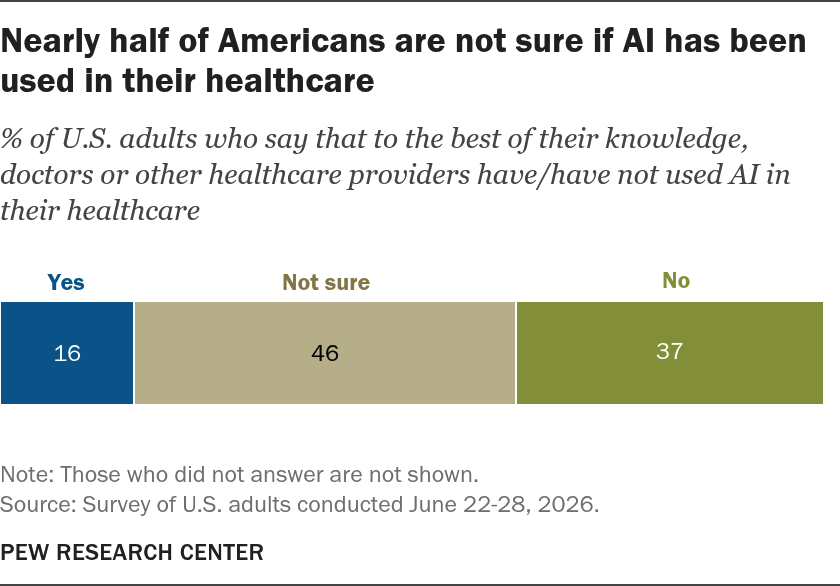
Many Americans are unsure whether and how AI is being used in their healthcare
% of U.S. adults who say that to the best of their knowledge, doctors or other healthcare providers have/have not used AI in their healthcare
Note: Those who did not answer are not shown.
Source: Survey of U.S. adults conducted June 22-28, 2026.
PEW RESEARCH CENTER
Nearly half of Americans are not sure if AI has been used in their healthcare
% of U.S. adults who say that to the best of their knowledge, doctors or other healthcare providers have/have not used AI in their healthcare
| Yes | Not sure | No | |
|---|---|---|---|
| U.S. adults | 16 | 46 | 37 |
Note: Those who did not answer are not shown.
Source: Survey of U.S. adults conducted June 22-28, 2026.
PEW RESEARCH CENTER
A small share (16%) say their doctors or other healthcare providers have ever used AI in their healthcare. Much larger shares say it hasn’t been used (37%) or they’re not sure (46%). This comes as AI use in hospitals and doctor’s offices is increasingly common
Adults with higher education levels are more likely to say their providers have used AI. For example, 25% of those with a postgraduate degree say this, compared with 11% of those with a high school diploma or less education. Yet across education levels, Americans are similarly likely to say they’re not sure (ranging from 46% among those with a high school diploma or less to 48% of those with a postgraduate degree). (Read the appendix for more details.)
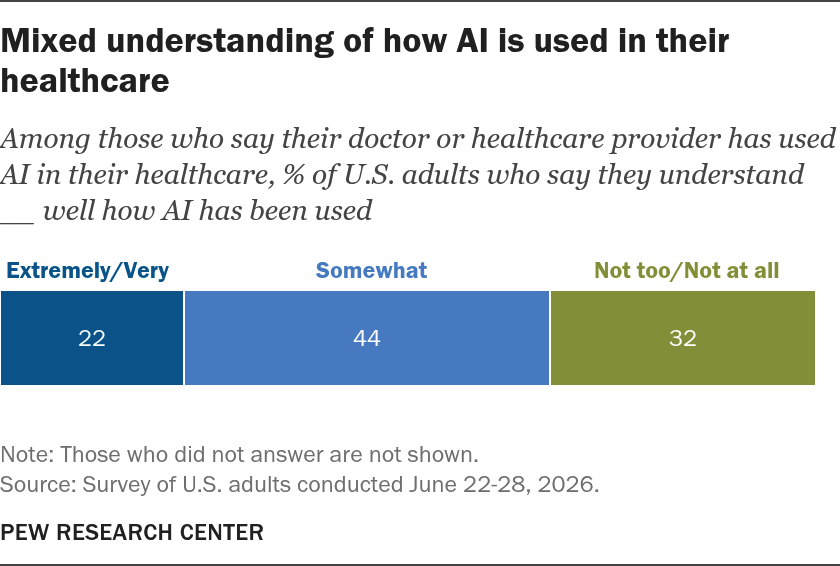
Among those who say their doctor or healthcare provider has used AI in their healthcare, % of U.S. adults who say they understand __ well how AI has been used
Note: Those who did not answer are not shown.
Source: Survey of U.S. adults conducted June 22-28, 2026.
PEW RESEARCH CENTER
Mixed understanding of how AI is used in their healthcare
Among those who say their doctor or healthcare provider has used AI in their healthcare, % of U.S. adults who say they understand __ well how AI has been used
| Extremely/Very | Somewhat | Not too/Not at all | |
|---|---|---|---|
| U.S. adults | 22 | 44 | 32 |
Note: Those who did not answer are not shown.
Source: Survey of U.S. adults conducted June 22-28, 2026.
PEW RESEARCH CENTER
Among those who say their providers have used AI in their care, the largest share say they understand somewhat well how it’s been used (44%). But they are more likely to say they understand it not too or not at all well (32%) than extremely or very well (22%)
Note: Here are the survey questions used for this analysis, the detailed responses and the survey methodology
Appendix
Most Americans across demographic groups say it is highly important their healthcare provider tells them if they are using AI
% of U.S. adults who think it is __ important that a doctor or other healthcare provider tells them if they are using AI in their healthcare
| Extremely/Very | Somewhat | Not too/Not at all | |
|---|---|---|---|
| U.S. adults | 72 | 16 | 7 |
| Men | 68 | 18 | 8 |
| Women | 74 | 14 | 5 |
| White | 75 | 15 | 6 |
| Hispanic | 66 | 16 | 9 |
| Black | 67 | 17 | 6 |
| Asian* | 62 | 23 | 8 |
| Ages 18-29 | 68 | 14 | 10 |
| 30-49 | 69 | 16 | 7 |
| 50-64 | 73 | 18 | 5 |
| 65+ | 76 | 14 | 5 |
| Postgrad | 70 | 17 | 8 |
| College grad | 75 | 16 | 6 |
| Some college | 75 | 15 | 5 |
| HS or less | 67 | 16 | 8 |
* Estimates for Asian adults are representative of English speakers only.Note: Respondents who said “Not sure” or did not answer are not shown. White, Black and Asian adults include those who report being only one race and are not Hispanic; Hispanics are of any race.
Source: Survey of U.S. adults conducted June 22-28, 2026.
PEW RESEARCH CENTER
White adults are more likely than Black or Hispanic adults to say they want to be told if AI is used for diagnoses, medical scans or explaining lab results
% of U.S. adults who say a healthcare provider or their office should tell them if AI is being used in their healthcare to …
| Yes | No | Not sure | |
|---|---|---|---|
| Schedule a medical appointment | |||
| White | 57 | 33 | 9 |
| Hispanic | 60 | 25 | 14 |
| Black | 46 | 37 | 14 |
| Asian* | 53 | 41 | 6 |
| Take notes during a medical appointment | |||
| White | 75 | 17 | 7 |
| Hispanic | 69 | 18 | 13 |
| Black | 62 | 21 | 15 |
| Asian* | 67 | 24 | 9 |
| Make a diagnosis | |||
| White | 86 | 7 | 7 |
| Hispanic | 72 | 14 | 13 |
| Black | 64 | 18 | 15 |
| Asian* | 83 | 10 | 6 |
| Analyze medical scans | |||
| White | 85 | 8 | 7 |
| Hispanic | 78 | 10 | 12 |
| Black | 65 | 16 | 16 |
| Asian* | 84 | 8 | 8 |
| Order prescription refills | |||
| White | 65 | 26 | 8 |
| Hispanic | 64 | 21 | 15 |
| Black | 58 | 22 | 18 |
| Asian* | 63 | 31 | 7 |
| Explain lab results | |||
| White | 84 | 9 | 7 |
| Hispanic | 75 | 13 | 12 |
| Black | 65 | 18 | 15 |
| Asian* | 77 | 17 | 7 |
* Estimates for Asian adults are representative of English speakers only.Note: Respondents who did not answer are not shown. White, Black and Asian adults include those who report being only one race and are not Hispanic. Hispanic adults are of any race.
Source: Survey of U.S. adults conducted June 22-28, 2026.
PEW RESEARCH CENTER
White adults are more likely than other racial and ethnic groups to say they have little to no say whether AI is used in their healthcare
% of U.S. adults who say that in general, they think they have __ (of a) say over whether a doctor or other healthcare provider uses AI in their healthcare
| A great deal/Quite a bit | Some | Not too much/None | Not sure | |
|---|---|---|---|---|
| White | 12 | 15 | 60 | 12 |
| Hispanic | 27 | 16 | 40 | 17 |
| Black | 23 | 16 | 43 | 17 |
| Asian* | 20 | 24 | 42 | 13 |
* Estimates for Asian adults are representative of English speakers onlyNote: Respondents who did not answer are not shown. White, Black and Asian adults include those who report being only one race and are not Hispanic; Hispanics are of any race.
Source: Survey of U.S. adults conducted June 22-28, 2026.
PEW RESEARCH CENTER
Topics

Eileen Yamis director of science and society research at Pew Research Center

Giancarlo Pasquiniis a former research associate focusing on science and society research at Pew Research Center

Emma Kikuchiis a research analyst focusing on science and society research at Pew Research Center
