


Download PDF
Abstract
Background
Very preterm (VP) birth has been associated with higher rates of anxiety and mood disorders, but the emergence and persistence from childhood to adulthood is unknown. This study examined prevalence rates and early risk factors of these disorders in VP and term-born individuals
Methods
In a prospective sample of VP (<30 weeks’ gestation or birthweight <1250 g, n = 191) and term-born individuals (n = 69), anxiety and mood disorders were assessed using structured interviews at 7, 13 years and 20 years. Perinatal, neonatal and social environmental information was collected at birth and 2 years
Results
Rates of anxiety and mood disorders increased from childhood to adulthood, but only subtle differences were observed between VP and term-born groups. Among VP individuals, higher social risk at 2 years increased the odds of anxiety or mood disorder (OR 2.51, 95% CI: 1.18, 5.35)
Conclusions
Prevalence of anxiety and mood disorders increased from childhood to young adulthood for both birth groups, with the largest between-group difference observed for anxiety disorder at 13 years. Higher social risk was the main risk factor for VP individuals. Early identification and support for families with higher social risk may reduce mental health difficulties in VP individuals
Impact
There is evidence that very preterm (VP) birth is associated with higher rates of anxiety and mood disorders, but how these conditions emerge and persist from childhood to adulthood is unknown
Rates for anxiety and mood disorders increase from childhood to adulthood, but the developmental trajectory for VP individuals is similar to that of term-born peers. Social risk factors consistently influence mental health outcomes across development
Early assessment and targeted support for VP individuals and families facing socio-economic disadvantage may promote positive long-term mental health outcomes
Introduction
Individuals born very preterm (VP; <32 weeks’ gestational age) or very low birth weight (VLBW; <1500 g birthweight) are reported to be at increased risk for mental health problems compared with term-born peers, including anxiety and mood disorders.1 Current evidence suggests that differences in rates of mental health disorders exist at different time points throughout childhood and into adulthood,2,3 but few studies have examined this longitudinally in the same cohort
While some neurodevelopmental disorders have their onset in childhood (e.g. attention-deficit/hyperactivity, autism spectrum disorder), other mental health problems (e.g. anxiety and mood disorders) become more prevalent in adolescence or adulthood.4,5 In population-based studies, mental health problems affect about 10–20% of children and adolescents,6,7 while lifetime prevalence rates range from 4-31% for anxiety disorders and 3–21% for mood disorders.8,9 However, the evidence is mixed on the extent to which rates of anxiety and mood disorders differ between VP and term-born individuals in childhood through to early adulthood. While VP/VLBW children and adolescents are more likely to experience anxiety or mood disorders compared with term-born peers, this difference in prevalence seems to diminish in adulthood.1,2,10,11,12 However, not all longitudinal studies report similar conclusions.5,13,14,15
One study reported an increase in mood and anxiety disorders in VP but not in term-born children between the ages of 7–13 years.13 A slightly older cohort study reported increased rates of anxiety disorders in VLBW but not in term-born participants when assessed at age 14 and 19 years, while prevalence of mood disorders increased in both groups.14 In a study of young adults, a slight increase in anxiety and mood disorders was observed in both extremely preterm or extremely low birth weight (EP/ELBW) and term-born groups when assessed at ages 18 and 25 years.5 The Bavarian Longitudinal Study reported stable rates of mood and anxiety disorders between 6 and 8 years of age for VP/VLBW and term control groups, but observed a marked increase for both groups at the next assessment at 26 years of age.15 Thus, most studies report rising rates over development, but with inconsistent effects of VP birth.
Numerous risk factors associated with mood and anxiety disorders have been reported. Population-based studies have noted that female sex and social-environmental factors, such as lower socioeconomic status and maternal education, younger maternal age, maternal postpartum mental health difficulties, single parenthood and living in a rural setting, are associated with greater emotional problems in childhood and adolescence.16,17,18 In addition to social-environmental factors, studies of preterm or low birth weight cohorts have found lower gestational age at birth, lower birthweight and longer duration of respiratory support are associated with higher rates of mood and anxiety problems in childhood and adulthood.19,20
Given mixed findings in the rates of anxiety and mood disorders between childhood and adulthood in those born VP, the current study used data from the Victorian Infant Brain Study (VIBeS) longitudinal cohort to (1) describe the rates of mood and anxiety disorders at 7 (childhood), 13 (adolescence) and 20 years (early adulthood) in VP individuals and their term-born peers, and (2) describe subgroups of VP individuals who are at higher risk of a mood or anxiety disorder based on early risk factors including gestational age, birthweight, sex, multiple birth, length of hospital stay and social risk.
Methods
Participants and Study Design
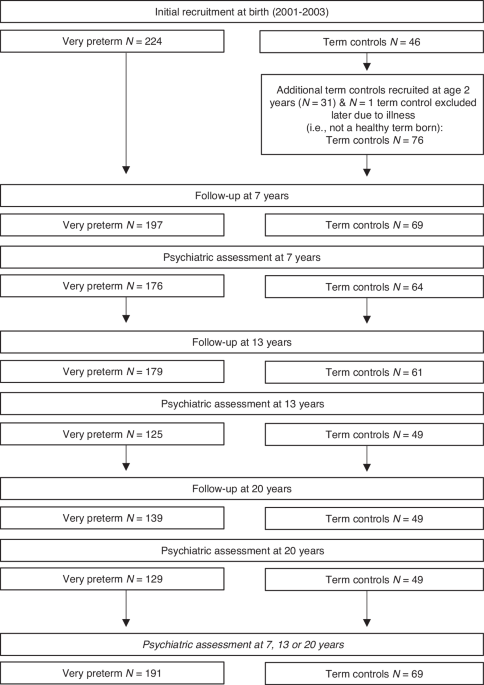
The VIBeS longitudinal cohort includes 224 children born VP (<30 weeks’ gestation or with birthweight <1250 g) recruited at the Royal Women’s Hospital, Melbourne between 2001 and 2003, and a control group of 77 children born at term (≥37 weeks’ gestation) recruited at birth (n = 46) or at age 2 years from maternal and child health centres (n = 31) (see Fig. 1). One term-born participant was later excluded due to the diagnosis of a congenital disorder known to affect neurodevelopment. Medical, social and neurodevelopmental data were collected at birth and at ages 2, 5, 7, 13 and 20 years. All parents and children were invited to participate in each follow-up assessment (unless they had withdrawn from the study). Psychiatric outcomes were assessed using clinical structured interviews at age 7, 13 and 20 years.
Participants were assessed at the Royal Children’s Hospital, Melbourne by trained assessors who were blinded to gestational age at birth, medical history and previous assessment results. Ethical approval was granted by the Human Research Ethics Committee at the Royal Children’s Hospital, Melbourne, Australia. The authors assert that all procedures contributing to this work comply with the ethical standards of the relevant national and institutional committees on human experimentation and with the Helsinki Declaration of 1975, as revised in 2008. Parents or guardians provided written informed consent and children provided assent for the 7 and 13-year follow-up assessments. Participants provided written informed consent to the 20-year assessment.
Measures
Psychiatric Assessment
The Developmental and Well-Being Assessment (DAWBA)21 is a formal structured interview that was administered to the child’s primary caregiver to assess psychiatric diagnoses in their child at ages 7 and 13 years. The Mini International Neuropsychiatric Interview (M.I.N.I)22 was administered to participants at the 20-year follow-up to assess psychiatric diagnoses. Both the DAWBA and the M.I.N.I assess the presence or absence of a wide range of psychiatric disorders across criteria from the Diagnostic and Statistical Manual of Mental Disorders, Fourth (DSM-IV) and Fifth (DSM-5) Edition. The main psychiatric outcomes of interest for the current study were diagnoses of mood disorder and anxiety disorder. For this, specific diagnoses from the DAWBA and M.I.N.I were combined into broader diagnostic categories of mood disorders and anxiety disorders.13 In addition, a third category of emotional disorder (the combination of mood and/or anxiety disorder) was computed.
Perinatal and demographic characteristics
Perinatal data including gestational age, birthweight, biological sex, small for gestational age (SGA; birthweight more than two SD below the mean), multiple birth (singleton versus multiple) and length of hospital stay (days) were collected directly from the child’s hospital medical record. Family social risk was assessed at age 2 years using a composite index computed from information across six variables: (1) Family structure, (2) maternal age, (3) primary caregiver educational level, (4) primary income earner employment status and (5) occupation, and (6) primary language spoken at home.23 Each variable was scored as 0 (low risk), 1 (medium risk) or 2 (high risk). Variable scores were then summed and dichotomised around the median into lower (scores 0 to 1) and higher (scores 2 to 12) social risk.23
Analysis
To describe changes in rates of mood and anxiety disorder, and emotional disorder (a combination of mood and anxiety disorder) in VP and term-born participants, we estimated prevalence with 95% confidence intervals (CIs) for both birth groups at three assessment ages (7, 13 and 20 years). To address potential selection bias due to missing data, multiple imputation was performed using chained equations, conducted separately for each outcome and birth group. Each imputation model included the variables that were assumed to be common causes of both the outcomes and outcome missingness: the same outcomes at previous time points, gestational age and social risk. Outcome data and social risk were imputed using logistic regression models. A total of 50 imputations were produced, and final proportion estimates accounting for clustering due to multiple births were calculated using Rubin’s rules.24
Odds ratios (ORs) were estimated to describe the associations of peri- and neonatal factors (i.e. gestational age, birthweight, SGA, child biological sex, multiple birth, intraventricular haemorrhage [IVH], cystic periventricular leukomalacia, treatment with oxygen at 36 weeks postmenstrual age, moderate to severe white matter abnormalities on brain MRI, length of hospital stay, maternal age at child’s birth and social risk at age 2 years) with any emotional (i.e. mood or anxiety) disorder at age 7, 13 or 20 years for VP participants. Missing data in outcomes and neonatal factors were imputed using multiple imputation by chained equations. All imputation models were logistic regression models that included mood and anxiety outcomes at each time point, gestational age, social risk, oxygen at 36 weeks’ postmenstrual age, and moderate to severe white matter abnormalities. A total of 50 imputations were produced and final ORs accounting for clustering of multiple birth were calculated using Rubin’s rules.24
All analyses were performed using Stata version 18.0
Results
Of the participants recruited at birth (N = 224), structured psychiatric interview data were available for 176 (78.6%) VP and 64 (84.2%) term-born children at 7 years, for 125 (55.8%) VP and 49 (64.5%) term-born children at 13 years, and for 129 (57.6%) VP and 49 (64.5%) term-born adults at 20 years. Overall, 260 participants (191 (85.3%) VP and 69 (90.8%) term-born) had at least one structured psychiatric interview (see Fig. 1)
Perinatal and demographic characteristics of VP and term-born participants who had at least one psychiatric interview at age 7, 13 or 20 years are described in Table 1. Participants born VP were more likely to be a multiple birth (42% versus 6%) and from families with a higher social risk (60% versus 30%), compared with term-born peers. In general, VP and term-born participants who had at least one structured psychiatric interview at 7, 13 or 20 years were comparable to those who did not have a psychiatric interview (see Supplementary Table S1 (online)) with the exception of sex and social risk, where VP-born individuals who did not have a psychiatric interview were more likely female (66.7% versus 46.1%), and for both birth groups individuals who did not have a psychiatric assessment were more likely from a family with a higher social risk (VP, 75.0% versus 59.6%; term-born, 60.0% versus 29.9%).
At age 7 years, the prevalence of anxiety disorders was similar in VP and term-born children with 8.6% (95% CI: 4.5–12.7%) and 8.4% (95% CI: 1.2–15.6%), respectively (Fig. 2a). At age 13 years, the prevalence rate for anxiety disorders in VP participants (14.7%, 95% CI: 8.7–20.7%) was approximately twice that of term-born adolescents (7.5%, 95% CI: 0.0–17.7%). At age 20 years, in contrast to earlier timepoints, there was a marked increased rate for anxiety disorders in both VP (21.3%, 95% CI: 14.1–28.5%) and term-born participants (26.1%, 95% CI: 12.5–39.7%).
Percentage (%) and 95% confidence interval of anxiety (a) and mood disorder (b), and emotional disorder (i.e. anxiety or mood disorder; c). Estimates were obtained using multiple imputation
Compared with anxiety disorders, the rates for mood disorders were lower at all ages (Fig. 2b). At 7 years, the rate for mood disorders was 0.9% (95% CI: 0.0–2.6%) for VP and 3.5% (95% CI: 0.0–8.4%) for term-born children. These rates increased slightly to 2.8% (95% CI: 0.0–6.2%) for VP and 4.9% (95% CI: 0.0–13.5%) for term-born individuals at age 13 years. At age 20 years, the prevalence rate for mood disorders tripled to 10.8% (95% CI: 5.3–16.3%) in VP-born participants and increased to 7.5% (95% CI: 0.0–16.5%) in term-born adults.
Emotional disorders showed prevalence rates that closely mirrored those of anxiety disorders at ages 7 and 13 years in both birth groups (Fig. 2c). At age 20 years, the rate increased markedly to 24.9% (95% CI: 17.5–32.4%) in VP and 29.0% (95% CI: 15.1–42.9%) in term-born participants
In VP individuals, higher social risk at age 2 years more than doubled the odds for a diagnosis of any emotional disorder at age 7, 13 or 20 years (OR 2.51, 95% CI: 1.18, 5.35, Table 2). Having a grade 3 or 4 IVH, being female sex or being SGA slightly increased the odds for a diagnosis of any emotional disorder in childhood, adolescence or adulthood (ORIVH 1.50, 95% CI: 0.28, 8.13; ORfemale 1.57, 95% CI: 0.79, 3.09; ORSGA 1.71, 95% CI: 0.54, 5.41)
Discussion
As expected, we found a marked increase in the prevalence rates of anxiety and mood disorders from childhood to young adulthood in both VP and term-born individuals, but differences between birth groups were modest, with the largest difference observed for prevalence rates of anxiety at age 13 years
Our finding of similar rates for an emotional disorder between birth groups across these important developmental periods suggest similar developmental trajectories for these mental health diagnoses for VP and term-born individuals. This is different to the results from previous meta-analyses and cohort studies largely describing higher prevalence rates in this population in emotional disorders when compared against term controls.1,2,14,15,25,26 For instance, an individual participant data meta-analysis showed increased odds of 1.9–2.0 for anxiety and 1.5 for mood disorders in VP/VLBW adults compared with term controls. Cohort studies that were not included in this meta-analysis have reported increased odds of 1.3–1.8 for mood disorders among VP/VLBW adults.25,26 However, it is worth noting that other studies have reported comparable rates for anxiety and mood disorders between EP/ELBW and term groups.5,27,28 Taken together, the inconsistencies in findings across studies may reflect different diagnostic tools, participant age, group selection criteria and sample sizes used across studies.
Given individuals born VP/VLBW are at elevated risk for impairments across a range of domains persisting into adulthood,19,29 the current finding of similar rates of emotional disorders between birth groups across development is notable. It is possible that ongoing positive parenting and supportive home and school environments have promoted psychological resilience in this population.30,31,32,33,34 Further, VP individuals have greater access to developmental surveillance and early intervention, and as such, may have received greater support as emotional problems emerged, resulting in lower rates of long-term mental health disorders. The impact of the COVID-19 pandemic and its associated lockdowns in Victoria should be acknowledged, since data collection for the 20-year assessment in the current study commenced during pandemic restrictions. Multiple studies have documented increased psychological distress in young adults, including elevated anxiety and mood problems, during35,36,37,38,39 and after the pandemic. Results from the current study suggest a pattern of slightly lower rates of anxiety and overall emotional disorders in individuals born VP compared with those born at term at 20 years. It is possible that the VP group may have coped better with the social isolation associated with pandemic restrictions36 given that this population is more likely to be reserved and socially withdrawn than their term-born peers.40,41,42,43
In VP participants, having a family with higher early social risk markedly increased the likelihood for emotional disorder at age 7, 13 or 20 years. This finding corroborates earlier work from our cohort,44 as well as other general and preterm population studies that have demonstrated that socioeconomic status, maternal education, marital status, maternal age and ethnicity may influence the development of mood, anxiety and general behavioural problems.16,17,19,20,45,46 Although the group of term-born participants was small and lacked statistical power, early social risk was not associated with an increase in the odds for emotional disorder (OR 0.76, 95% CI: 0.15–3.90). Other factors that modestly increased the odds for an emotional disorder in VP individuals in our study included female sex, high grade IVH and SGA. Both population-based and preterm studies have demonstrated that female individuals are more prone to emotional and internalising problems.17,25,47 However, only a few preterm studies have reported IVH or SGA to be associated with childhood emotional or behavioural outcomes, particularly in adults born VP.19,48,49 Both current and prior research highlight the need to comprehensively evaluate medical, behavioural and social-environmental factors that shape the development and progression of anxiety and mood disorders.
The longitudinal design in which we examined anxiety and mood disorders across three critical developmental periods was a strength for understanding the evolution and stability of these disorders. We used multiple imputation to address potential selection bias due to attrition and missing data. The present study used different informants and diagnostic measures over time (i.e. parent-reports for the DAWBA in childhood and adolescence and self-reports for the M.I.N.I. in adulthood). The change of informant and measurement tools is often inevitable in long-term longitudinal studies, with parents’ or teachers’ perspectives required for young children,50 reflecting best practice in longitudinal research in both population-based and preterm studies.14,15,51,52,53 Previous research has recognised that agreement between different informants on individual mental health and across time is limited and can introduce bias.52 Interestingly, adolescents themselves often have a more positive perception and outlook about their mental health and quality of life than their parents.54,55 Changes in reported mental health symptoms over time are influenced by many factors including onset and symptomology of disorders, sex and social-environmental factors.
Given the small number of specific diagnoses in our study, we combined specific diagnoses into broader diagnostic categories of anxiety and mood disorder.13 To our knowledge, this is the first study to describe prevalence rates for mood and anxiety disorders in childhood, adolescence and adulthood in VP and term-born individuals. However, the prevalence rates reported here need to be interpreted cautiously given the nature of mood and anxiety disorders, which is prone to change over time at both group and individual level. In order to produce robust results, more large-scale longitudinal studies are needed that allow for studying these outcomes over time.
In conclusion, the results of our study suggest that despite increasing rates for anxiety and mood disorders from childhood to adulthood, the developmental pattern for those born VP is similar to that of term-born peers. For those born VP, the results suggest that assessment and targeted support for families who have increased socio-economic risk may be helpful to promote positive mental health outcomes. Importantly, the influence of social risk on mental health outcomes was maintained over time, suggesting that assessment and support that is provided early in life can potentially have longer term implications for mental health in this population.
Data availability
The data that support the findings of this study are available on request from the VIBeS study team. The data are not publicly available due to privacy or ethical restrictions
References
Anderson, P. J. et al. Psychiatric disorders in individuals born very preterm/very low-birth weight: an individual participant data (IPD) meta-analysis. EClinicalMedicine42, 101216 (2021)
Burnett, A. C. et al. Prevalence of psychiatric diagnoses in preterm and full-term children, adolescents and young adults: a meta-analysis. Psychol. Med.41, 2463–2474 (2011)
Lund, L. K. et al. Low birth weight and psychiatric morbidity; stability and change between adolescence and young adulthood. Early Hum. Dev.88, 623–629 (2012)
American Psychiatric Association. Diagnostic and Statistical Manual of Mental Disorders: DSM-5 5th edn (American Psychiatric Association, 2013)
Burnett, A. C. et al. Mental health in young adults born extremely preterm or extremely low birthweight with contemporary neonatal intensive care. Psychol. Med. 53, 5227–5234 (2023)
Kieling, C. et al. Child and adolescent mental health worldwide: evidence for action. Lancet378, 1515–1525 (2011)
Polanczyk, G. V., Salum, G. A., Sugaya, L. S., Caye, A. & Rohde, L. A. Annual research review: a meta-analysis of the worldwide prevalence of mental disorders in children and adolescents. J. Child Psychol. Psychiatry56, 345–365 (2015)
Kessler, R. C. et al. Lifetime prevalence and age-of-onset distributions of mental disorders in the World Health Organization’s World Mental Health Survey Initiative. World Psychiatry6, 168–176 (2007)
World Health Organization. World Mental Health Report: Transforming Mental Health for All (World Health Organization, 2022)
Robinson, R. et al. Mental health outcomes of adults born very preterm or with very low birth weight: a systematic review. Semin. Fetal Neonatal Med.25, 101113 (2020)
Fitzallen, G. C., Sagar, Y. K., Taylor, H. G. & Bora, S. Anxiety and depressive disorders in children born preterm: a meta-analysis. J. Dev. Behav. Pediatr.42, 154–162 (2021)
Nosarti, C. et al. Preterm birth and psychiatric disorders in young adult life. Arch. Gen. Psychiatry69, E1–E8 (2012)
Yates, R. et al. Rates and stability of mental health disorders in children born very preterm at 7 and 13 years. Pediatrics145, e20192699 (2020)
Lærum, A. M. et al. Psychiatric disorders and general functioning in low birth weight adults: a longitudinal study. Pediatrics139, e20162135 (2017)
Jaekel, J., Baumann, N., Bartmann, P. & Wolke, D. Mood and anxiety disorders in very preterm/very low-birth weight individuals from 6 to 26 years. J. Child Psychol. Psychiatry59, 88–95 (2018)
Farkas, C., Girard, L.-C. & MacBeth, A. Predictors of emotional problems in 5-year-old children: an international comparison between two cohorts in Chile and Scotland. Curr. Psychol.42, 390–405 (2023)
Mendelson, T., Kubzansky, L. D., Datta, G. D. & Buka, S. L. Relation of female gender and low socioeconomic status to internalizing symptoms among adolescents: a case of double Jeopardy? Soc. Sci. Med.66, 1284–1296 (2008)
Racine, N. et al. Perinatal risk and protective factors associated with diagnosis of mental health disorders in children by age 9 years. Eur. Child Adolesc. Psychiatry34, 3565–3575 (2025)
Wollum, A. E. K., Berdal, E. K., Iversen, J. M., Indredavik, M. S. & Evensen, K. A. I. Outcomes and predictors of functioning, mental health, and health-related quality of life in adults born with very low birth weight: a prospective longitudinal cohort study. BMC Pediatr.22, 628 (2022)
Gray, R. F., Indurkhya, A. & McCormick, M. C. Prevalence, stability, and predictors of clinically significant behavior problems in low birth weight children at 3, 5, and 8 years of age. Pediatrics114, 736–743 (2004)
Goodman, R., Ford, T., Richards, H., Gatward, R. & Meltzer, H. The development and well-being assessment: description and initial validation of an integrated assessment of child and adolescent psychopathology. J. Child Psychol. Psychiatry41, 645–655 (2000)
Sheehan, D. V. et al. The Mini-International Neuropsychiatric Interview (M.I.N.I.): the development and validation of a structured diagnostic psychiatric interview for DSM-IV and ICD-10. J. Clin. Psychiatry59(Suppl 20), 22–33 (1998)
Roberts, G. et al. Rates of early intervention services in very preterm children with developmental disabilities at age 2 years. J. Paediatr. Child Health44, 276–280 (2008)
Rubin, D. B. Multiple Imputation for Nonresponse in Surveys81 (John Wiley & Sons Inc., 2004)
Moody, G. L., Horwood, J., Harris, S. L., Darlow, B. A. & Woodward, L. J. Mental health outcomes of a national cohort of adults born with very low birthweight. J. Clin. Med.13, 7591 (2024)
Westrupp, E. M., Northam, E., Doyle, L. W., Callanan, C. & Anderson, P. J. Adult Psychiatric outcomes of very low birth weight survivors. Aust. N. Z. J. Psychiatry45, 1069–1077 (2011)
Johnson, S., O’Reilly, H., Ni, Y., Wolke, D. & Marlow, N. Psychiatric symptoms and disorders in extremely preterm young adults at 19 years of age and longitudinal findings from middle childhood. J. Am. Acad. Child. Adolesc. Psychiatry58, 820–826 (2019)
Van Lieshout, R. J., Boyle, M. H., Saigal, S., Morrison, K. & Schmidt, L. A. Mental health of extremely low birth weight survivors in their 30s. Pediatrics135, 452–459 (2015)
Wolke, D., Johnson, S. & Mendonça, M. The life course consequences of very preterm birth. Annu. Rev. Dev. Psychol.1, 69–92 (2019)
Taylor, H. G., Minich, N., Schluchter, M., Espy, K. A. & Klein, N. Resilience in extremely preterm/extremely low birth weight kindergarten children. J. Int. Neuropsychol. Soc.25, 362–374 (2019)
Twilhaar, E. S. & Wolke, D. Fostering positive mental health outcomes in vulnerable children: pathways to resilience after preterm birth. J. Child Psychol. Psychiatry66, 1860–1874 (2025)
Wolke, D., Jaekel, J., Hall, J. & Baumann, N. Effects of sensitive parenting on the academic resilience of very preterm and very low birth weight adolescents. J. Adolesc. Health53, 642–647 (2013)
Zhou, Y., Bartmann, P., Tsalacopoulos, N. & Wolke, D. Developmental trajectories of internalizing problems among individuals born very preterm/very low birthweight: early risk and resilience factors. Eur. Child Adolesc. Psychiatry34, 3197–3208 (2025)
Treyvaud, K. et al. Can the home environment promote resilience for children born very preterm in the context of social and medical risk? J. Exp. Child Psychol.112, 326–337 (2012)
Kleine, R. et al. Impact of the COVID-19 pandemic on young people with and without pre-existing mental health problems. Sci. Rep.13, 6111 (2023)
Arjmand, H. A., Seabrook, E., Bakker, D. & Rickard, N. Mental health consequences of adversity in Australia: national bushfires associated with increased depressive symptoms, while COVID-19 pandemic associated with increased symptoms of anxiety. Front. Psychol.12, 635158 (2021)
Bell, I. H. et al. The impact of COVID-19 on youth mental health: a mixed methods survey. Psychiatry Res.321, 115082 (2023)
Meyer, D. et al. Comparing the impact of high versus low lockdown severity on the mental health of young people in Australia during the COVID-19 pandemic. Psychiatry Res.322, 115121 (2023)
Australian Institute of Health and Welfare. COVID-19 and the Impact on Young People. (Australian Institute of Health and Welfare, 2021)
Pyhala, R. et al. Self-reported mental health problems among adults born preterm: a meta-analysis. Pediatrics139, e20162690 (2017)
Eryigit-Madzwamuse, S., Strauss, V., Baumann, N., Bartmann, P. & Wolke, D. Personality of adults who were born very preterm. Arch. Dis. Child. Fetal Neonatal Ed.100, 524–529 (2015)
Husby, I. M. et al. Long-term follow-up of mental health, health-related quality of life and associations with motor skills in young adults born preterm with very low birth weight. Health Qual. life outcomes14, 56 (2016)
Liu, Y. et al. The effect of very preterm birth on the five-factor model of personality traits: a meta-analysis of individual participant data. Eur. J. Pers.39, 498–517 (2024)
Treyvaud, K. et al. Psychiatric outcomes at age seven for very preterm children: rates and predictors. J. Child Psychol. Psychiatry54, 772–779 (2013)
Hack, M. et al. Behavioral outcomes and evidence of psychopathology among very low birth weight infants at age 20 years. Pediatrics114, 932–940 (2004)
Johnson, J. G., Cohen, P., Dohrenwend, B. P., Link, B. G. & Brook, J. S. A longitudinal investigation of social causation and social selection processes involved in the association between socioeconomic status and psychiatric disorders. J. Abnorm Psychol.108, 490–499 (1999)
Sekaran, V. C. et al. Predictors of adolescent internalizing and externalizing mental health symptoms: a school-based study in Southern India. Int. J. Environ. Res. Public Health21, 393 (2024)
Linsell, L. et al. Prognostic factors for behavioral problems and psychiatric disorders in children born very preterm or very low birth weight: a systematic review. J. Dev. Behav. Pediatr.37, 88–102 (2016)
Burnett, A. C. et al. Predicting long-term neurodevelopmental outcomes for children born very preterm: a systematic review. Arch. Dis. Child. Fetal Neonatal Ed.111, F169–F176 (2026)
Scott, A., Winchester, S. B. & Sullivan, M. C. Trajectories of problem behaviors from 4 to 23 years in former preterm infants. Int. J. Behav. Dev.42, 237–247 (2018)
Clark, C., Rodgers, B., Caldwell, T., Power, C. & Stansfeld, S. Childhood and adulthood psychological ill health as predictors of midlife affective and anxiety disorders: the 1958 British Birth Cohort. Arch. Gen. Psychiatry64, 668–678 (2007)
Reef, J., van Meurs, I., Verhulst, F. C. & van der Ende, J. Children’s problems predict adults’ DSM-IV disorders across 24 years. J. Am. Acad. Child Adolesc. Psychiatry49, 1117–1124 (2010)
Bailey, M. et al. Associations between childhood trauma and adolescent psychiatric disorders in brazil: a longitudinal, population-based birth cohort study. Lancet Glob. Health13, e309–e318 (2025)
Gardner, F. et al. Behavioral and emotional adjustment of teenagers in mainstream school who were born before 29 weeks’ gestation. Pediatrics114, 676–682 (2004)
Baumann, N., Bartmann, P. & Wolke, D. Health-related quality of life into adulthood after very preterm birth. Pediatrics137, e20153148 (2016)
Acknowledgements
We acknowledge the valuable contribution of Victorian Infant Brain Studies (VIBeS) team members, participants, and their families to the project over the years. All phases of this study were supported by the Australian National Health and Medical Research Council (NHMRC; Centre for Research Excellence 1060733; Project Grants 237117, 491209 and 1066555; Investigator Grant 1176077 to P.J.A.)
Funding
Open Access funding enabled and organized by CAUL and its Member Institutions
Author information
Authors and Affiliations
Department of Paediatrics, Monash Children’s Hospital, Monash University, Melbourne, VIC, Australia
Nicole Tsalacopoulos
School of Psychological Sciences, Monash University, Melbourne, VIC, Australia
Nicole Tsalacopoulos, Sarah C. H. Thompson, Leona Pascoe & Peter J. Anderson
Clinical Sciences, Murdoch Children’s Research Institute, Melbourne, VIC, Australia
Nicole Tsalacopoulos, Sarah C. H. Thompson, Lauren Pigdon, Thi-Nhu-Ngoc Nguyen, Jeanie L. Y. Cheong, Lex W. Doyle & Peter J. Anderson
Department of Pediatrics, University Hospital Würzburg, Würzburg, Germany
Nicole Tsalacopoulos
Clinical Epidemiology and Biostatistics Unit, Murdoch Children’s Research Institute, Melbourne, VIC, Australia
Rheanna M. Mainzer
Department of Paediatrics, University of Melbourne, Melbourne, VIC, Australia
Rheanna M. Mainzer, Leona Pascoe & Jeanie L. Y. Cheong
School of Psychology and Public Health, La Trobe University, Melbourne, VIC, Australia
Karli Treyvaud
Centre for Community Child Health, Murdoch Children’s Research Institute, Melbourne, VIC, Australia
Leona Pascoe
Newborn Research, The Royal Women’s Hospital, Melbourne, VIC, Australia
Lauren Pigdon, Jeanie L. Y. Cheong & Lex W. Doyle
Department of Obstetrics, Gynaecology, and Newborn Health, University of Melbourne, Melbourne, VIC, Australia
Jeanie L. Y. Cheong & Lex W. Doyle
Center for Perinatal & Infant Research, Rady Children’s Hospital of Orange County, Orange, CA, USA
Terrie E. Inder & Peter J. Anderson
Department of Pediatrics, School of Medicine, University of California Irvine, Irvine, CA, USA
Terrie E. Inder & Peter J. Anderson
Authors
- Nicole TsalacopoulosView author publications
Search author on:PubMed Google Scholar
- Rheanna M. MainzerView author publications
Search author on:PubMed Google Scholar
- Sarah C. H. ThompsonView author publications
Search author on:PubMed Google Scholar
- Karli TreyvaudView author publications
Search author on:PubMed Google Scholar
- Leona PascoeView author publications
Search author on:PubMed Google Scholar
- Lauren PigdonView author publications
Search author on:PubMed Google Scholar
- Thi-Nhu-Ngoc NguyenView author publications
Search author on:PubMed Google Scholar
- Jeanie L. Y. CheongView author publications
Search author on:PubMed Google Scholar
- Lex W. DoyleView author publications
Search author on:PubMed Google Scholar
- Terrie E. InderView author publications
Search author on:PubMed Google Scholar
- Peter J. AndersonView author publications
Search author on:PubMed Google Scholar
Contributions
Substantial contributions to conception and design, acquisition of data, or analysis and interpretation of data: N.T., R.M.M., S.C.H.T., K.T., L.Pa., L.Pi., T.N.N.N., J.L.Y.C., L.W.D., T.E.I., P.J.A. Drafting the article or revising it critically for important intellectual content: all authors
Ethics declarations
Competing interests
The authors declare no competing interests
Consent statement
Parents or guardians provided written informed consent and children provided assent for the 7 and 13-year follow-up assessments. Participants provided written informed consent to the 20-year assessment
Additional information
Publisher’s note Springer Nature remains neutral with regard to jurisdictional claims in published maps and institutional affiliations
Supplementary information
Supplementary information (download PDF )
Rights and permissions
Open Access This article is licensed under a Creative Commons Attribution 4.0 International License, which permits use, sharing, adaptation, distribution and reproduction in any medium or format, as long as you give appropriate credit to the original author(s) and the source, provide a link to the Creative Commons licence, and indicate if changes were made. The images or other third party material in this article are included in the article’s Creative Commons licence, unless indicated otherwise in a credit line to the material. If material is not included in the article’s Creative Commons licence and your intended use is not permitted by statutory regulation or exceeds the permitted use, you will need to obtain permission directly from the copyright holder. To view a copy of this licence, visit http://creativecommons.org/licenses/by/4.0/.
About this article
Cite this article
Tsalacopoulos, N., Mainzer, R.M., Thompson, S.C.H. et al. Anxiety and mood disorders from childhood to adulthood in very preterm and term-born individuals.
Pediatr Res (2026). https://doi.org/10.1038/s41390-026-05377-7
Received:31 March 2026
Revised:08 July 2026
Accepted:13 July 2026
Published:15 August 2026
Version of record:15 August 2026
DOI
:https://doi.org/10.1038/s41390-026-05377-7
