



How weight-loss drugs could help treat addiction, arthritis, more
04:54
1 medications already do double duty as diabetes and obesity treatment. There may be much more to come
From heart health to cancer protection, research keeps uncovering potential benefits of the blockbuster drugs
There are also intriguing questions about whether GLP-1s could be used to help people live longer or one day be prescribed for preventive use — even in those who don’t have health problems
Dr. Harlan Krumholz, a cardiologist and professor at the Yale School of Medicine, calls GLP-1 drugs “generational breakthrough medications” with “profound benefits” beyond weight loss and diabetes — everything from lowering cardiovascular risk to helping patients who have sleep apnea or chronic kidney disease
Krumholz says he’s so enthusiastic about the drugs that he’s declined to be a consultant for the pharmaceutical companies that make them to avoid creating the impression it’s the reason why he’s so positive about the medications
“I think we’re still just beginning to understand how they can be used,” Krumholz, director of the Yale New Haven Hospital Center for Outcomes Research and Evaluation, tells TODAY.com
“Each (trial) is a marvelous and remarkable finding that’s positive, like it’s this winning streak that just continues. … The weight loss is not fully explaining what’s going on. The benefits of these GLP-1s extend beyond the weight loss.”
“The sky is the limit with these medications,” said NBC News medical contributor Dr. Natalie Azar on TODAY. “People are very, very optimistic.”
GLP-1 drugs are making many people healthier, particularly those who have metabolic disorders, says Dr. Nicolas Musi, director of the Diabetes and Aging Center at Cedars-Sinai in Los Angeles. He has received a grant for an upcoming study from Eli Lilly, the maker of GLP-1 drugs Zepbound and Mounjaro
The doctor calls GLP-1 benefits for fatty liver disease, sleep apnea, arthritis and inflammation “very exciting.”
He and his team are looking into whether GLP-1s can slow biological aging
“I think there’s good potential because overweight and obesity are linked with aging, meaning it can reduce lifespan and health span, which is the time in which we’re healthy,” Musi tells TODAY.com
“The real question is: In healthy people who don’t have any of these diseases, will it be helpful to them? And that we don’t know. It’s very premature.”
He points out low-dose aspirin was once routinely recommended to help prevent the first heart attack or stroke, but the guidance changed as evidence showed it wasn’t beneficial for most healthy adults. “We learned the hard way that we need evidence and not just assume things,” Musi says
Why GLP-1s Impact So Many Systems in the Body
GLP-1 stands for glucagon-like peptide-1, a hormone that’s naturally produced by the small intestine after a meal and mimicked by the drugs. It triggers the pancreas to release insulin, which helps regulate blood sugar, according to the National Library of Medicine. It also slows down stomach emptying and signals fullness to the brain
GLP-1 medications improve metabolic abnormalities that happen in patients who are overweight or have obesity, leading to a “downstream effect” on obesity-related health problems, Musi says
But there’s more. Receptors for GLP-1 are found most everywhere in the body, meaning the hormone is active in many different organs and organ systems
The brain has the highest density and diversity of these receptors, but they’re also found in the pancreas, GI tract, heart, vasculature, kidneys, lungs and the thyroid, Krumholz says
“This is a very key substance in our body that helps regulate so many different things, and in a favorable way,” he notes. “We’re still trying to understand exactly how it works.”
GLP-1 has so many beneficial impacts because it probably targets inflammation, Azar said on TODAY. She’s a rheumatologist who sees patients with chronic inflammatory diseases
“Not until some of my patients have gotten on some of these (GLP-1) medicines was I finally able to see a reduction in their systemic inflammation,” Azar said. It made her realize GLP-1s would have applications “far beyond” weight loss and diabetes, she added
Novo Nordisk, the pharmaceutical giant that makes Ozempic and Wegovy, is continuing to invest in research that “deepens our understanding of the potential for our medicines for appropriate patients across a diverse set of complications,” a spokesperson tells TODAY.com
Eli Lilly, the maker of Zepbound and Mounjaro, didn’t reply to a request for comment
Here are GLP-1 benefits getting attention. Some have been approved by the U.S. Food and Drug Administration, and others show promise but are still being studied
Heart
Krumholz calls the GLP-1 class of medications a “heart drug.”
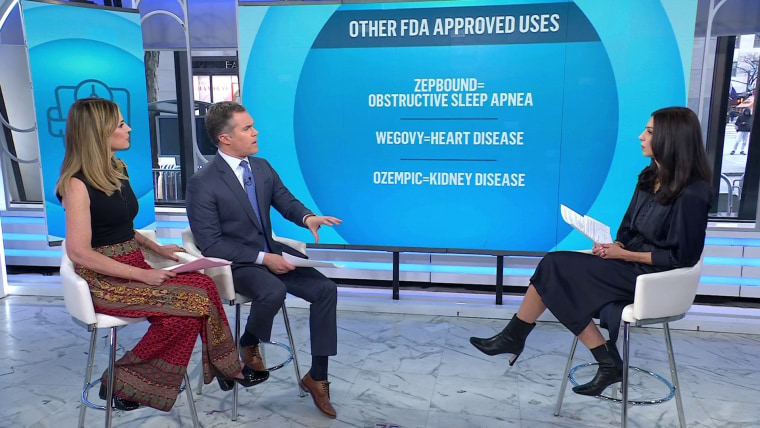
Wegovy is already FDA-approved to reduce the risk of heart attack and stroke in adults with heart disease and excess weight. Ozempic has a similar approval in patients with Type 2 diabetes and heart disease
GLP-1s reduce obesity and insulin resistance, both known risk factors in heart disease
But there are more promising benefits. Krumholz co-authored a paper that found tirzepatide, the active ingredient in Zepbound and Mounjaro, lowered systolic blood pressure by almost seven points compared to a placebo in people with obesity or overweight. Current blood pressure medications rarely provide that much benefit, he says
Semaglutide, the active ingredient in Ozempic and Wegovy, reduced high-sensitivity C-reactive protein (CRP) — a marker of cardiovascular inflammation — even in people who didn’t lose weight, a study found
GLP-1s also appear to make blood vessels healthier, Krumholz notes. He wonders whether researchers should test GLP-1 microdosing — taking a much lower dose than what’s recommended — in the context of boosting cardiometabolic health, even in people who aren’t battling obesity
Sleep Apnea
Zepbound is the first FDA-approved medication for obstructive sleep apnea, a condition where the upper airway collapses during sleep, interrupting breathing. It’s more common in people who are overweight or have obesity. If untreated, the disorder can lead to sleep deprivation and complications, such as high blood pressure and heart problems, researchers warn
GLP-1s “significantly reduce” the severity of the disorder, studies have found
Kidney Disease
Ozempic is FDA-approved to reduce the risk of worsening kidney disease, kidney failure and death due to cardiovascular disease in adults with Type 2 diabetes and chronic kidney disease
GLP-1s “favorably influence” risk factors for kidney disease, such as high blood sugar, high blood pressure and excess weight, studies have found
They may also have a “direct effect on helping the kidneys stay healthy,” perhaps by lowering inflammation in the organs or removing extra sodium from the body, but more research is needed, the National Kidney Foundation notes
Fatty Liver
Wegovy is FDA-approved to treat metabolic dysfunction-associated steatohepatitis (MASH) in adults with moderate-to-advanced fibrosis, or excessive scar tissue in the liver
MASH, a severe form of fatty liver disease, happens when fat buildup in the liver causes inflammation and scarring, the FDA notes. Risk factors include obesity and Type 2 diabetes
The condition is “very common and very problematic,” so improvement with GLP-1 drugs is “very exciting,” Musi says
Cancer
GLP-1 use was associated with a 41% lower risk of developing obesity-related cancers — such as endometrial, breast, bowel, kidney, pancreatic, thyroid, ovarian, esophageal, gastric, liver and gallbladder — in non-diabetic obese patients who took the drugs to lose weight, a 2026 study found
Cancer risk reduction should not yet be a “stand-alone reason” to prescribe GLP-1s, but the drugs “deserve serious investigation as cancer prevention agents,” the authors said in a statement
Women with excess weight who used GLP-1s were about 30% less likely to develop breast cancer than those who didn’t take the drugs, according to separate research presented at the 2026 American Society of Clinical Oncology annual meeting
The results suggest “it’s worth investigating these weight-loss drugs as potential cancer prevention tools,” Dr. Elizabeth McDonald, the first author and a professor of radiology at the University of Pennsylvania Perelman School of Medicine, said in a statement
“(GLP-1s) do affect many different targets and pathways associated with cancer development, so we’re eager to study them in this context.”
Could a woman who is not obese might one day have a GLP-1 drug prescribed because she has a higher risk of breast cancer?
“We should at least be testing that hypothesis, and that might be where a microdosing approach comes in for people at risk,” Krumholz says
Evidence suggests GLP-1 drugs have the potential to lower the risk for gastrointestinal cancers, “even in the absence of obesity,” studies have found
Addiction
Semaglutide may help curb alcohol addiction, studies have found, with some patients who take the drug for weight loss also reporting a sudden lack of interest in alcohol
Beyond alcohol, use of GLP-1s was also “consistently associated” with reduced risks of developing substance use disorders involving opioids, stimulants and other substances, a study that involved U.S. veterans with Type 2 diabetes found
The medications may reduce cravings for drugs and alcohol in a similar way they diminish food cravings — they seem to quiet the preoccupation with needing a substance, experts told NBC News
“It’s not just appetite and satiety — our own reward system seems to be tied up in this,” Krumholz explains
Fertility
GLP-1s themselves don’t boost fertility, but could put a woman’s body into a more optimal state for conception before she tries to get pregnant, experts previously told TODAY.com
For example, the drugs can have beneficial effects on polyendocrine metabolic ovarian syndrome (previously known as PCOS), a common cause of infertility in women, Musi says
GLP-1s are a “promising treatment to consider” for the condition, leading to an emerging off-label use of the drugs, researchers noted
“We want the ovary to live in a healthy body, meaning healthy blood sugar, healthy blood pressure. The environment needs to be optimal to throw out a healthy egg,” said Dr. Rekha Kumar, endocrinologist at New York Presbyterian Weill Cornell Medical Center, on TODAY. She’s the senior medical adviser for Found Health, a digital health platform that provides access to GLP-1 drugs
“People who have PCOS or Type 2 diabetes … the body environment isn’t optimal for the ovary. So using GLP-1s can treat insulin resistance, abnormal blood sugar, reduce inflammatory body fat, and then the ovary works better.”
The drugs can be used in the months leading up to get a woman to a healthier place in order to be pregnant, but should be stopped two months prior to trying to conceive, she said
Longevity
When people ask Krumholz if the GLP-1 class of drugs is a “fountain of youth,” he says it seems to fit the definition
“If it’s about reducing risk, if that’s what a fountain of youth is — I mean, it sort of is helping you live longer and better. I guess you’d have to say it is,” he notes
“This thing somehow has such wide-ranging health benefits that it does seem to be turning back the clock in some ways.”
GLP-1s may help improve health span and longevity by tackling underlying metabolic abnormalities, Musi says
But there is currently no real evidence — even from animal studies — indicating these drugs are going to extend longevity in people without those health problems, so research is underway to provide more answers, he adds
Musi does not recommend GLP-1s for healthy people at this point. “I know there’s a lot of excitement, but it’s definitely premature,” he says
Are GLP-1s Too Good to Be True?
Any intervention has risks, Musi cautions. Krumholz says he’s always worried about a harmful side effect being discovered down the road with any drug and urges continued vigilance when it comes to GLP-1s
“I’m not without a healthy concern that we need to continue to monitor, see what’s going on,” Krumholz notes. “Our excitement should always be in some ways accompanied by realistic expectation that there could be something that we don’t know yet.”
But he’s more confident about this class of drugs because it’s already been used for 20 years. Millions of Americans are currently on GLP-1s — 11% of U.S. adults currently use them for weight loss alone
The most common side effects of GLP-1 drugs are gastrointestinal issues such as nausea, stomach pain, diarrhea, constipation and vomiting. More serious complications include possible thyroid tumors, including cancer; pancreatitis and gallbladder problems
There are also concerns about muscle loss, a very small risk for vision loss; and the impact on mental health, with some patients reporting they have less pleasure and excitement in life while on the drugs, known as “Ozempic personality.”
Krumholz believes considerable reofiles and their benefits
In contrast with irrational exuberance, a phrase that refers to hype overriding reality, “I think this is rational exuberance,” Krumholz says
