


Download PDF
Abstract
Background
Although obesity and mental health problems represent two of the most pressing public health challenges, their developmental interplay remains insufficiently understood. Thus, we examined how depressive and anxiety symptoms, self-esteem, and psychological resilience are associated with weight development during adolescence
Methods
We included 1280 11-year-old children from the Finnish Health in Teens cohort, following 814 of them for 4.3 years. Mental health was assessed with validated self-administered scales at age 11. Psychological resilience was determined by complete mental health after exposure to stressful life events. Body mass index z-score (BMIz) and waist-to-height ratio (WtHr) were calculated at ages 11 and 16
Results
In models adjusted for sex, age, physical activity, dietary pattern, puberty status, caregivers’ BMI and education level, depressive symptoms were associated with higher baseline BMIz but smaller increases in mean BMIz thereafter (p = 0.030). High self-esteem was associated with lower baseline BMIz, yet with steeper increases over follow-up (adjusted model, p = 0.021). Anxiety symptoms and resilience were not associated with BMIz after adjustments. Similar patterns were observed for WtHr.
Conclusion
Findings highlight that mental health is associated with physical growth in adolescence, emphasizing the need to consider mental health in understanding and addressing patterns of weight development and their underlying dynamics
Impact
This study provides up-to-date, longitudinal evidence on how mental health shapes subsequent weight development during the critical and rapid growth period of adolescence
Both positive and negative dimensions of mental health play a role in shaping adolescent weight development, with evidence that some youths experiencing mental health difficulties exhibited smaller increases in BMI z-score, even when starting from a higher baseline BMI
It should be acknowledged that in contemporary society, adolescents with mental health difficulties may not necessarily present immediate excessive weight gain but instead follow stable or even declining weight trajectories
Introduction
Obesity and mental health challenges have both reached epidemic levels, posing considerable public health concerns that increasingly affect young people.1,2 Roughly half of all mental disorder cases emerge during childhood and adolescence,3 with subclinical symptoms being even more prevalent. The Developmental Origins of Health and Disease framework suggests that periods of rapid physical growth are especially sensitive to external influences and insults.4 Given that accelerated growth and substantial psychosocial changes occur during adolescence, this developmental stage may represent a critical window for the emergence and consolidation of the relationship between obesity and mental health challenges.5 Therefore, it is essential to understand if and how these associations change with age in order to clarify how the dynamic relationship between mental health and weight development evolves across adolescence. So far, this has remained poorly understood.
Previous research on mental health and physical growth has primarily focused on psychological distress, such as depression or anxiety, and the risk of obesity, with substantial evidence supporting their co-occurence.6,7,8,9,10 Two meta-analyses summarizing longitudinal studies in adolescents concluded that particularly females with depressive symptoms have an elevated risk of obesity over varying follow-up periods.9,10 This finding is corroborated by another systematic review.11 Anxiety, another indicator of psychological distress, has received less research attention, with most existing evidence coming from cross-sectional studies.8 Although a few longitudinal studies suggest that anxiety in adolescence may increase the risk of consequent obesity,11,12 the overall literature remains scarce and inconclusive.
Psychological distress during adolescence may also manifest as weight loss or insufficient weight gain. In fact, weight loss is a diagnostic criterion for major depressive disorder and has been reported to be more common than weight gain among adolescents experiencing depression.13,14 One previous longitudinal study found that although affective symptoms were associated with obesity in middle age, they were associated with a slower mean increase in BMI between ages 11 and 15 compared to those without such symptoms.15 However, since most earlier studies have used categorical obesity measures or examined outcomes in adulthood, they may have missed these early, adolescence-specific patterns in weight development that emerge alongside the onset of symptoms. Therefore, we examined age as a moderator to determine whether these associations changed across this critical developmental period.
In addition, self-esteem is a key component of positive mental health, affecting both psychological and physical well-being.16 In adolescents, low self-esteem has frequently been associated with concurrent obesity.17,18 Although childhood low self-esteem has been associated with increased weight gain over time, and high self-esteem with a leaner body,19,20 these findings are not consistently supported.21,22 Moreover, given that much of the existing evidence is derived from earlier cohorts, their relevance may be limited in the context of today’s adolescents, who are exposed to unique and growing pressure related to body image and appearance.
Early life stress and adversity, such as parental separation, and exposure to household mental illness or substance abuse, have consistently been linked to psychological distress and higher weight outcomes.23 However, not all individuals exposed to such stressful events experience negative outcomes, and some can adapt and thrive despite facing substantial challenges. These individuals demonstrate resilience, the ability to recover or “bounce back” from adversity and stress.24,25 Resilience has been associated with a lower risk of mental health problems in adolescents.26 Higher levels of resilience are associated with a lower prevalence of obesity in some cross-sectional studies,27 but not in all.28 Nevertheless, most prior studies have measured resilience as a trait or perceived capacity, which includes subjective evaluation. Only one longitudinal study has used an operationalization similar to ours, examining psychological resilience as a demonstrated capacity, including both exposure to stress and positive psychological adaptation.29 In that study, resilient individuals in young adulthood were more likely to have a favorable health profile and healthy body weight compared to non-resilient peers, although no longitudinal associations were observed. Thus, surprisingly little is known about how psychological resilience relates to weight development over time.
In the present study, we applied the dual-factor model of mental health.30 This model proposes that mental health comprises two related yet distinct dimensions, negative and positive indicators of mental health. In addition, the dual-factor model provides a framework for conceptualizing psychological resilience as complete mental health that is characterized by the absence of psychological distress and the presence of positive psychological functioning, despite exposure to early stressful life events (SLEs). Thus, we firstly aimed to examine whether psychological distress (depressive and anxiety symptoms) and positive psychological functioning (self-esteem) associate with body mass index z-score (BMIz) or waist-to height ratio (WtHr) at the mean age of 11 years and with subsequent weight development over a 4-year follow-up period. We hypothesize that adolescents experiencing psychological distress or lower levels of positive psychological functioning have BMIz and WtHr developmental patterns that differ from those of their peers who do not experience these symptoms. For the second aim, we combined positive and negative dimensions of mental health and SLEs into a composite psychological resilience variable and examined whether psychological resilience phenotypes associate with BMIz or WtHr at age 11 and with changes in these outcomes over a 4-year follow-up. We hypothesize that adolescents manifesting psychological resilience show different developmental trajectories in BMIz and WtHr, compared to their non-resilient peers.
Methods
Study design and participants
This study used data from the prospective cohort study Finnish Health in Teens (www.finhit.fi). During the pilot study conducted in 2011, all adolescents born in Finland between 26 February and 6 May 2000 were recruited through mailed invitations. In total, 1599 adolescents chose to participate, yielding a participation rate of 14%. The adolescents completed a self-administered questionnaire on their anthropometric measurements, mental health, and health behaviors. The first follow-up was conducted in 2015–2016, when the adolescents self-reported their anthropometric measurements and physical activity. The participation rate at follow-up was 63%.
In the present study, we included 1280 adolescents with a mean age of 11.2 (standard deviation [SD]: 0.1) years at baseline, who met the following criteria: data were available on at least one mental health indicator at baseline (symptoms of depression, n = 1257; anxiety, n = 1267; or self-esteem, n = 1276), with no more than 50% of responses missing from the raw questionnaire items, and on anthropometric measurements at baseline (BMIz, n = 1271; WtHr, n = 1270) or follow-up (BMIz, n = 814; WtHr, n = 810). The average follow-up period length was 4.3 (±0.1) years. Of this sample, 36% of participants were lost to follow-up (n = 466). Adolescents who dropped out of the study had caregivers with significantly lower levels of education and higher BMI, had experienced a greater number of SLEs, and were more frequently classified as either resilient or non-resilient, compared to those who remained in the study (Supplementary Table S1).
Written informed consent was obtained from adolescents and caregivers. The study protocol received approval from the Coordinating Ethics Committee of the Hospital District of Helsinki and Uusimaa (169/13/03/00/10)
Measurements
Anthropometry at baseline and follow-up
Families were instructed to measure and report their adolescents’ height, weight, and waist circumference through a web-based survey as explained in detail elsewhere.31 The home-based measurements were previously validated.32 BMI was calculated as weight in kilograms divided by height in meters squared (kg/m2) and computed to an age- and sex-specific BMIz according to the International Obesity Task Force.33 WtHr was determined by dividing waist circumference in centimetres by height in centimetres. BMIz was used to reflect overall adiposity, whilst WtHr served as a measure for central obesity.34
Indicators of mental health
All indicators of mental health were self-reported at baseline. We imputed missing scale items with a mean of existing items when the participants responded to more than 50% of the items in a scale (n = 104–110). Sensitivity analyses were conducted by excluding participants with imputed values (data not shown). The results were similar, indicating that the findings were minimally affected by the imputation of missing item values
Depressive symptoms were evaluated using the 20-item Centre for Epidemiological Studies Depression Scale for Children (CES-DC).35 CES-DC is a self-administered questionnaire that assesses a range of depressive symptoms during the preceding week. CES-DC demonstrated a strong internal consistency in this sample, with a Cronbach’s alpha of 0.81. Previous studies have also reported a good internal consistency for CES-DC.35 The composite score of the scale ranged from 0 to 60, with higher scores indicating more severe symptoms. We used a recommended cut-off score of ≥15 to categorize a clinical level of depressive symptoms.36
Anxiety symptoms over the preceding 3 months were assessed using 24 items from the Screen for Child Anxiety-Related Emotional Disorders (SCARED) child-reported version.37 The internal consistency of the SCARED scale was high (Cronbach’s alpha = 0.87), which is consistent with findings from previous studies.37 The composite score on the scale ranged from 0 to 48, with higher scores signifying a higher level of anxiety symptoms. We used a cut-off score of ≥22 on the SCARED scale to identify clinically significant anxiety symptoms.38
Self-esteem was evaluated using the 24-item Self-Perception Profile for Children (SPPC).39 The SPPC scale had high internal consistency (Cronbach’s alpha = 0.81), which aligns well with previous studies.39 The composite score on the scale ranged from 24 to 96, with higher scores reflecting higher self-esteem. Since there are no clinical cut-offs for SPPC, belonging to the highest tertile was considered an indication of high self-esteem
Psychological resilience was operationalized by exposure to early SLEs and attainment of complete mental health, which included the absence of psychological distress and the presence of positive psychological functioning, following prior works.24,25,29 To evaluate early SLEs requiring adaptation within the family domain, we used nine items from the Life Events Checklist,40 following prior work conducted among Finnish adolescents.41 These baseline SLEs ranged from events such as the death of a family member to the birth of a sibling. Participants reporting any SLEs were considered exposed, whilst those reporting no SLEs were considered unexposed.29 Complete mental health encompassed the absence of clinically significant symptoms of depression and the absence of clinically significant symptoms of anxiety (i.e., psychological distress), as evaluated using CES-DC and SCARED, respectively, and a high self-esteem score (i.e., positive psychological functioning), as measured by the SPPC. Suboptimal mental health was considered as presenting symptoms of depression or anxiety, or self-esteem scores below the highest tertile. Based on these variables of binary mental health and binary exposure to SLEs, individuals were categorized into four phenotypes: resilient (complete mental health after exposure to SLEs), non-resilient (suboptimal mental health after exposure to SLEs), complete mental health (complete mental health without exposure to SLEs), and suboptimal mental health (suboptimal mental health without exposure to SLEs).
Covariates
Personal information regarding age and sex was obtained from the Population Information System at the Population Register Centre. Adolescents reported their usual leisure time physical activity (in hours/week) at baseline and follow-up through a questionnaire. Puberty status was self-evaluated by adolescents using the five-point Tanner scale42 and categorized into prepubertal, pubertal, or post-pubertal. Caregivers’ BMIs were calculated based on their self-reported height and weight at baseline and at follow-up. Based on a self-administered food propensity questionnaire at baseline, adolescents were clustered as having a dietary pattern defined as healthy, unhealthy, or avoiding fruit and vegetable.43 At baseline, caregiver was asked to report their highest level of educational qualification, which was categorized into lower (comprehensive school), middle (vocational school or equivalent), and higher level (university degree or equivalent). Categorical dietary pattern and caregiver’s educational level were included as baseline covariates as they were reported only at baseline and considered as stable background characteristics.
Statistical analyses
Statistical analyses were calculated using R Studio, version 2022.12.0+353. BMIz and WtHr exhibited a satisfactory normal distribution (skewness <1.8). We considered p ≤ 0.05 as statistically significant. Given the a priori, hypothesis-driven framework, interrelated nature of predictors, outcomes, and models, and transparent reporting of all analyses irrespective of statistical significance, we did not apply formal correction for multiple testing in the regression analyses. This approach has been deemed appropriate in similar settings.44,45 Interpretation of results focuses on effect estimates, confidence intervals, consistency, p values, and their statistical significance.
Using separate linear regression models, we examined the cross-sectional association of each mental health indicator (depressive symptoms, anxiety symptoms, self-esteem, and psychological resilience) as predictors of BMIz and WtHr at baseline. We adjusted the analyses for sex and age (Model 1) and additionally for physical activity, dietary pattern, puberty status, caregivers’ BMI, and caregivers’ education level (Model 2)
To study the longitudinal associations of each baseline mental health indicator and psychological resilience with changes in BMIz and WtHr during the follow-up period, we employed linear mixed models (LMMs), using the same adjustments as for cross-sectional analyses (Model 1 and Model 2). Separate models were estimated for each mental health indicator and for psychological resilience, with BMIz and WtHr examined independently as outcomes. For these analyses, we centered continuous depressive symptoms, anxiety symptoms, self-esteem, and age. We fitted random intercepts to allow the average BMIz and WtHr to vary between individuals. Mental health indicators and psychological resilience were included as fixed effects, and their interactions with age were considered to examine how the association of each mental health indicator with BMIz and WtHr changes with age. Random slopes for age were also considered but not included. Two measurements per participant were insufficient to reliably estimate these parameters.
To illustrate the results of the LMMs, participants were categorized based on their scores on each continuous mental health indicator into three groups: low (<mean − 1 SD), average, and high (>mean + 1 SD). This stratification was used to interpret the interaction with age, e.g., how the association between mental health indicators and BMIz/WtHr evolves across early adolescence. In addition, pairwise comparisons were conducted between mental health groups and resilience phenotypes using the emmeans package in R. Post hoc pairwise comparisons were corrected for multiple testing using the false discovery rate (FDR; Benjamini-Hochberg method; pcor).
Results
Participants characteristics
Our sample consisted of 1280 participants (51% girls) with a mean (SD) age of 11.2 (0.1) at baseline. Participant characteristics are presented in Table 1. In the entire sample, 17% presented with overweight or obesity, and 15% with central obesity at baseline. In the subsample with follow-up data available, 15% lived with overweight or obesity, and 9% with central obesity at follow-up. The mean BMIz increased by 0.09 units (p < 0.001), while the mean WtHr decreased by 0.01 units (p < 0.001) over the follow-up period.
Clinically significant symptoms of depression and anxiety based on recommended cut-off scores at baseline were observed in 18 and 9% of participants, respectively. Moreover, 26% were defined as resilient and 52% as non-resilient, whilst 10% had suboptimal mental health, and 12% were defined as having complete mental health. Of the sample, 78% reported at least one SLE during their lifetime. The most reported SLEs were the birth of a sibling (45%) and family relocation (30%) (Supplementary Table S2).
Associations between mental health indicators and anthropometry at baseline
The cross-sectional associations between mental health indicators and BMIz at baseline are presented in Table 2. After adjusting for sex and age (Model 1), higher levels of both depressive and anxiety symptoms were associated with higher BMIz (b = 0.008, p = 0.027 and b = 0.007, p = 0.05, respectively). After adjusting for physical activity, dietary pattern, puberty status, caregivers’ BMI, and caregivers’ education level in addition to the Model 1 covariates (Model 2), these associations were no longer statistically significant (p value > 0.1). Higher self-esteem was associated with lower BMIz (b = −0.028, p < 0.001) in Model 1, and the associations remained significant in Model 2 (b = −0.020, p < 0.001). Compared with their resilient peers, adolescents classified as non-resilient had significantly higher BMIz in Model 1 (b = 0.168, p = 0.014). Similarly, adolescents classified as having suboptimal mental health had significantly higher baseline BMIz compared with resilient adolescents (b = 0.283, p = 0.004). These associations were no longer statistically significant in Model 2 (p > 0.1). Similar, but consistent associations in Models 1 and 2 were observed for WtHr (Supplementary Table S3).
Associations between mental health indicators and change in anthropometry
Depressive and anxiety symptoms
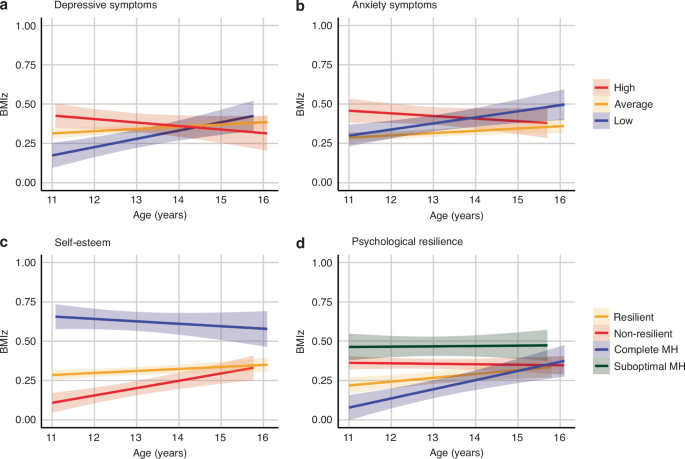
During the follow-up time, mean BMIz trajectory increased, while a decreasing mean WtHr trajectory was observed (Table 3; Supplementary Table S4). Despite this difference, the longitudinal associations between phenotypes and WtHr were parallel to those of BMIz. We found significant negative interactions between age and symptoms of depression and anxiety on BMIz measurements (p for interactions between symptoms × age <0.05; Table 3, Fig. 1a, b). After adjusting for covariates in Model 2, the interaction between depressive symptoms and age remained statistically significant, though attenuated (b = −0.002, p = 0.030), whereas the interaction with anxiety symptoms was no longer significant (p > 0.05).
The interaction between age × a depressive symptoms, b anxiety symptoms, c self-esteem, or d psychological resilience predicting changes in BMIz, corresponding to the terms reported in Table 3. Shaded areas indicate confidence intervals corresponding to ±1 standard error of the mean. Note. These results are from Model 1. In Model 2, the depression × age (p = 0.030) and self-esteem × age (p = 0.021) interactions remained significant. The anxiety × age interaction was attenuated in Model 2 (p = 0.08). For depressive symptoms, anxiety symptoms, and self-esteem, participants were grouped into low (mean − 1 SD), average, and high (mean + 1 SD). The y-axis range is restricted to 0.00–1.00.
Pairwise comparisons of estimated marginal trends revealed differences in yearly BMIz change across groups according to low, average, and high levels of symptoms (Table 4, Fig. 2a). In Model 1, adolescents with high depressive symptoms exhibited a slower increase in BMIz compared to those with low (difference = −0.066, pcor = 0.008) and average (difference = −0.043, pcor = 0.011) symptom levels. This pattern was consistent in Model 2, suggesting a more gradual change in BMIz among adolescents with high depressive symptoms relative to the low group (difference = −0.069, pcor = 0.017). No significant group differences in anxiety symptoms were found in either model (pcor > 0.08).
Yearly changes in BMIz with 95% confidence intervals, alongside pairwise group comparisons: low, average, and high levels of depressive and anxiety symptoms, self-esteem (a), and different resilience phenotypes (b). For depressive symptoms, anxiety symptoms, and self-esteem, participants were grouped into low (mean − 1 SD), average, and high (mean + 1 SD). Pairwise comparisons between the low, average, and high groups were conducted using the emmeans package in R (see Table 4). *p < 0.05, **p < 0.01; FDR-corrected p values from Model 1. The y-axis is restricted to −0.10 to 0.015.
Groups with high depressive and anxiety symptoms showed steeper decreases in WtHr over time (Supplementary Figs. S1 and S2), and these associations were consistent in both models. Pairwise comparisons confirmed differences between groups of high compared to average and high compared to low depressive symptoms groups, whereas no consistent differences were observed for anxiety symptoms (Supplementary Table S5)
Self-esteem
For self-esteem, age showed a positive overall effect on BMIz (Table 3). In contrast to depressive and anxiety symptoms, the interaction between age and self-esteem on BMIz was positive (p for interaction self-esteem × age <0.05; Table 3, Fig. 1c). After adjusting for covariates in Model 2, the interaction between self-esteem and age remained statistically significant, though attenuated slightly (b = 0.002, p = 0.021). Again, we illustrated the interaction by examining changes in mean BMIz across groups with high, average, and low levels of self-esteem (Table 4, Fig. 2a).
In the pairwise comparisons, the change in BMIz differed significantly between the high and low groups and between the average and low groups: steeper increases in BMIz over time occurred in the high and average groups compared to the low self-esteem group (difference = 0.048, pcor = 0.042 for high vs. low; difference = 0.035, pcor = 0.044 for average vs. low). These associations remained significant in Model 2 (difference = 0.052, pcor = 0.031 for high vs. low; difference = 0.050, pcor = 0.023 for average vs. low).
Similar associations were observed for WtHr in relation to self-esteem. Higher self-esteem was associated with lower baseline WtHr, while the positive self-esteem × age interaction indicated a lower decline in WtHr over time in the high self-esteem group than seen in the other groups (Supplementary Tables S4 and S5, Supplementary Figs. S1 and S2)
Psychological resilience
Being classified as resilient was associated with an increase in BMIz over time (b = 0.026, p = 0.017) in Model 1. However, the association was not significant after further adjustments in Model 2 (p > 0.1) (Table 3). Compared to the resilient phenotype, the other resilience phenotypes did not differ significantly in the change in BMIz (interactions p < 0.1) (Table 3, Fig. 1d). Based on pairwise comparisons, a steeper increase in BMIz was observed in complete mental health phenotype compared with the non-resilient phenotype (difference = 0.051, pcor = 0.043) (Table 4, Fig. 2b). After adjustment in Model 2, this difference was attenuated.
Regarding WtHr, all resilience phenotypes showed minor changes over time. The non-resilient phenotype exhibited a more pronounced decline compared to the complete mental health phenotype, but the difference was attenuated in Model 2 (Supplementary Tables S4 and S5, Supplementary Figs. S1 and S2)
Discussion
We demonstrated that both negative and positive indicators of mental health were associated with modest subsequent changes in BMIz and WtHr in a contemporary adolescent cohort. A slight increase in mean BMIz was observed, whereas WtHr demonstrated a decreasing trend during the 4-year follow-up in our sample. Moreover, in both anthropometric outcomes, the pattern of change differed depending on the severity of psychological distress and the level of positive psychological functioning. While depressive and anxiety symptoms were linked to higher BMIz at age 11, the negative interaction observed in the longitudinal models indicated that these associations weakened over the course of the 4-year follow-up, especially in the case of depressive symptoms. In contrast, adolescents with higher self-esteem showed lower baseline BMIz yet experienced the most pronounced increases in BMIz over the subsequent 4 years. At age 11, BMIz differed between psychological resilience phenotypes, with non-resilient and suboptimal mental health phenotypes having the highest BMIz. However, over the follow-up period, only those with a complete mental health phenotype differed from the rest, showing faster increases in BMIz. WtHr, a marker of central obesity, also evolved similarly according to the mental health phenotypes.
We found that psychological distress, particularly depressive symptoms, was associated with attenuated BMIz development. To our knowledge, this is the first study to demonstrate such BMIz development among adolescents born in the 2000s. While previous studies have predominantly reported ongoing excessive weight gain among adolescents with psychological distress,11,46 our findings point to a potentially distinct developmental trajectory, particularly for those with a high level of depressive symptoms at early adolescence. Our findings are in line with a few earlier studies reporting that greater depressive symptoms may be associated with attenuated weight gain between the ages of 11 and 15 compared to adolescents with fewer symptoms.13,15
Nevertheless, our findings should be interpreted with caution. The observed attenuation in BMIz development among high-risk adolescents may reflect underlying processes related to energy-balance behaviors, such as appetite regulation, weight-control practices, and disordered eating patterns,11,47 which were not directly assessed in the present study. In addition, depressive symptoms were measured at a single time point, preventing us from distinguishing between persistent, transient, and emerging symptoms. Depressive symptoms in adolescence follow diverse developmental trajectories.48 Thus, the observed associations could reflect persistent psychological distress directly affecting long-term weight development, temporary symptom episodes followed by behavioral normalization, or reverse causation where high baseline BMI accompanied by emerging distress leads to weight-related behavioral changes. However, our findings suggest that depressive symptoms during adolescence may not drive continued excessive weight gain from ages 11 to 15. Instead, adolescents with lower levels of symptoms appeared to catch up and even surpass the BMIz of those with higher levels of symptoms.
In the present study, self-esteem showed inverse associations with BMIz and WtHr at the age of 11, consistent with previous literature and contrasting the associations for depressive symptoms.17 However, adolescents with high self-esteem experienced faster increases in BMIz and relatively stable WtHr over time. Thus, during the follow-up time, the trajectories of high and low self-esteem approached each other. Due to the observational nature of our data, we can only speculate on the underlying mechanisms. Adolescents with high self-esteem have been shown to experience greater body appreciation and lower attainment in health risk behaviors.49,50 In contrast, low self-esteem may increase vulnerability to body dissatisfaction and engagement in unhealthy weight-control practices50,51 which could contribute to more stable weight trajectories despite higher BMIz levels. Nevertheless, in this study, we could not distinguish whether these differences reflect baseline disparities or whether self-esteem directly influences weight development longitudinally. Contrary to some prior findings,20 low self-esteem did not predict rapid BMIz gain during adolescence in the present study. However, it was associated with persistently high BMIz and a decreasing WtHr throughout the follow-up period. Our findings underscore the need for further research to disentangle the temporal dynamics between self-esteem and weight change.
Our baseline findings on psychological resilience are consistent with prior research indicating that resilient individuals tend to have more favorable weight outcomes.27,29 Specifically, at age 11, adolescents classified as resilient had lower BMIz than their non-resilient peers, particularly compared to those in the suboptimal mental health phenotype. However, in line with previous longitudinal evidence, resilience phenotypes did not predict changes in weight development over subsequent years.29 Adolescents with the complete mental health phenotype had the lowest BMIz at age 11, yet they showed the fastest increase over time. Instead, the suboptimal mental health and non-resilient phenotypes had the highest BMIz at age 11 and relatively stable trajectories during follow-up. Resilient adolescents, in turn, resembled the pattern of complete mental health, with a slight increase over follow-up. This resulted in largely similar BMIz levels in all phenotypes at the follow-up. It should be noted that the groups of complete mental health and suboptimal mental health phenotypes were relatively small, with consequently wide confidence intervals. These estimates should therefore be interpreted with caution.
In our study, adversities include a range of family-related SLEs that likely vary in severity and impact. These events have previously been associated with depressive symptoms and frequent alcohol use at age 15.41 Following previous work, we regarded any SLEs as an equivalent exposure.29 However, this approach may not capture variation in the frequency and severity of different life events. A large proportion of participants (78%) reported at least one SLE. Together with the strict criterion for the complete mental health phenotype (both positive functioning and absence of clinically significant symptoms), this may have inflated the exposed group and consequently influenced the distribution of resilience phenotypes and contributed to the relatively large proportion classified as non-resilient. However, in our additional analyses (data not shown), using a higher threshold for life events or excluding more common life events did not materially change results. We did not observe any consistent associations between any of the four resilience phenotypes and either outcome in longitudinal models. Taken together, these findings suggest that mental health may be a stronger contributor to adolescent weight development than resilience as defined in our study.
The link between mental health and weight changes during adolescence is complex and likely influenced by multiple social, psychological, and physiological factors. Social aspects such as lack of relationships, social isolation, and reduced time spent with peers may lead to changes in eating habits, which can affect weight development. Puberty is a critical developmental period marked by normal, gradual increases in BMI as part of typical growth.52 Adolescents with good mental health may better accept these bodily changes, reducing body dissatisfaction and preventing unhealthy behaviors.50 Conversely, poor mental health has been linked to behaviors such as altered appetite, disturbed sleep, excessive screen time, and physical inactivity, all of which can promote unhealthy weight changes.11 Although we adjusted for lifestyle factors, residual confounding may still exist in our findings. For example, we did not assess disordered eating behaviors (e.g., restrictive or binge eating), which may be linked to both mental health symptoms and weight changes. Further research is needed to clarify these pathways.
The strengths of the present study include its prospective design with a 4-year follow-up period during the critical period in adolescence. In addition, the use of a Finnish cohort born in the 2000s enhances the contemporary relevance of the findings. The questionnaire was extensive, allowing for the exploration of both psychological distress and positive psychological functioning, assessed using validated and reliable scales, along with the construction of a demonstrated psychological resilience variable. Given our rich dataset, we could adjust for some potential confounding factors that could partly explain some of the observed associations. Furthermore, we used age- and sex-specific BMIz as well as WtHr to reflect adiposity. These continuous outcome measures allowed us to more precisely and comprehensively examine associations than would be possible using only categorical outcomes. However, it is worth noting that our findings may be better understood as general developmental patterns than as changes between discrete weight categories. In addition, employing multilevel modeling as a statistical method provides advantages over a simple linear regression model, such as accounting for individual differences in physical growth.
Simultaneously, our results should be considered in the context of certain limitations. Firstly, the response rate was relatively low (14%), which may introduce selection bias and limit the generalizability of the results. As highlighted by the attrition analysis, the subsample with available follow-up data originated from parents with higher educational backgrounds than those who were lost from the follow-up.31 Combined with the low prevalence of overweight/obesity amongst adolescents implies a possible selection bias, particularly given that obesity and mental health issues are typically more common in disadvantaged socioeconomic groups.53 However, the youth in our study showed similar levels of depression and anxiety symptoms, as well as comparable rates of overweight, to those reported in the 2017 Finnish School Health Promotion Study at the end of comprehensive school.54 Since most participants remained within healthy BMIz ranges throughout the study period, this may have attenuated the associations between mental health and anthropometric measures. Thus, given the selective attrition of high-risk families, the present findings are likely conservative and may therefore underestimate the strength of these associations, particularly in more vulnerable populations.
Secondly, we relied on self-reported anthropometric measurements, potentially leading to limitations in reliability and accuracy.55 However, we previously reported the reliability of home-assessed height and weight and considered them fit for epidemiological studies.32 Thirdly, we assessed mental health only at the beginning of the study. To gain a nuanced picture of the associations between mental health and physical growth over time, we would need regular assessments of mental health as well as anthropometric measurements. Our study only measured anthropometric data at two time points over the 4-year follow-up. This may have limited our ability to capture the dynamics of weight development, which could be apparent with more frequent measurements. It is worth noting that some of the observed changes may reflect baseline differences in anthropometry. While the random effects model accounts for individual average responses, it does not fully adjust for baseline levels. Moreover, we have measured depressive and anxiety symptoms, which are not equivalent to psychiatric diagnoses.
To conclude, this study provides up-to-date insights into the relationship between positive and negative dimensions of mental health and psychological resilience with weight development during a critical period of physical and psychological growth. Adolescents with psychological distress, particularly depressive symptoms or low self-esteem, in early adolescence followed distinct, but generally stable weight trajectories compared with their psychologically healthier peers. Regarding psychological resilience, the findings were inconsistent, as the differences were observed only in Model 1 and only between non-resilient and complete mental health phenotypes. These results underscore the interplay between mental health and physical growth and highlight the importance of considering psychological factors in supporting healthy development during adolescence.
Data availability
The datasets generated and analyzed during the current study are available from the corresponding author on reasonable request
References
Mohajan, D. & Mohajan, H. K. Obesity and its related diseases: a new escalating alarming in global health. J. Innov. Med. Res.2, 12–23 (2023)
Lucero-Prisno, I. I. I. et al. Top 10 public health challenges to track in 2023: shifting focus beyond a global pandemic. Public Health Chall.2, e86 (2023)
Solmi, M. et al. Age at onset of mental disorders worldwide: large-scale meta-analysis of 192 epidemiological studies. Mol. Psychiatry27, 281–295 (2022)
Barker, D. J. Intrauterine programming of coronary heart disease and stroke. Acta Paediatr.86, 178–182 (1997)
Dietz, W. H. Critical periods in childhood for the development of obesity. Am. J. Clin. Nutr.59, 955–959 (1994)
Burke, N. L. & Storch, E. A. A meta-analysis of weight status and anxiety in children and adolescents. J. Dev. Behav. Pediatr.36, 133–145 (2015)
Arrondo, G. et al. Associations between mental and physical conditions in children and adolescents: an umbrella review. Neurosci. Biobehav. Rev.137, 104662 (2022)
Kokka, I., Mourikis, I. & Bacopoulou, F. Psychiatric disorders and obesity in childhood and adolescence—a systematic review of cross-sectional studies. Children10, 285 (2023)
Blaine, B. Does depression cause obesity: a meta-analysis of longitudinal studies of depression and weight control. J. Health Psychol.13, 1190–1197 (2008)
Mannan, M., Mamun, A., Doi, S. & Clavarino, A. Prospective associations between depression and obesity for adolescent males and females—a systematic review and meta-analysis of longitudinal studies. PLoS ONE11, e0157240 (2016)
Nwosu, E. et al. Longitudinal relationship between adolescents’ mental health, energy balance-related behavior, and anthropometric changes. Obes. Rev.24, e13629 (2023)
Roberts, R. E. & Duong, H. T. Do anxiety disorders play a role in adolescent obesity? Ann. Behav. Med.50, 613–621 (2016)
Maxwell, M. A. & Cole, D. A. Weight change and appetite disturbance as symptoms of adolescent depression: toward an integrative biopsychosocial model. Clin. Psychol. Rev.29, 260–273 (2009)
Gibson-Smith, D. et al. Major depressive disorder, antidepressant use, and subsequent 2-year weight change patterns in the Netherlands study of depression and anxiety. J. Clin. Psychiatry77, e144–e151 (2016)
Gaysina, D. et al. Symptoms of depression and anxiety, and change in body mass index from adolescence to adulthood: results from a British birth cohort. Psychol. Med.41, 175–184 (2011)
Orth, U. & Robins, R. W. Is high self-esteem beneficial? Revisiting a classic question. Am. Psychol.77, 5–17 (2022)
Moradi, M., Mozaffari, H., Askari, M. & Azadbakht, L. Association between overweight/obesity with depression, anxiety, low self-esteem, and body dissatisfaction in children and adolescents: a systematic review and meta-analysis of observational studies. Crit. Rev. Food Sci. Nutr.62, 555–570 (2021)
Miller, C. T. & Downey, K. T. A meta-analysis of heavyweight and self-esteem. Pers. Soc. Psychol. Rev.3, 68–84 (1999)
Meland, E., Breidablik, H. J., Thuen, F. & Samdal, G. B. How body concerns, body mass, self-rated health and self-esteem are mutually impacted in early adolescence: a longitudinal cohort study. BMC Public Health21, 496 (2021)
Ternouth, A., Collier, D. & Maughan, B. Childhood emotional problems and self-perceptions predict weight gain in a longitudinal regression model. BMC Med.7, 46 (2009)
Bjornelv, S., Nordahl, H. M. & Holmen, T. L. Psychological factors and weight problems in adolescents: the role of eating problems, emotional problems, and personality traits: the Young-HUNT study. Soc. Psychiatry Psychiatr. Epidemiol.146, 353–362 (2011)
Viner, R. M. & Cole, T. J. Who changes body mass between adolescence and adulthood? Factors predicting change in BMI between 16 year and 30 years in the 1970 British Birth Cohort. Int. J. Obes.30, 1368–1374 (2006)
Petruccelli, K., Davis, J. & Berman, T. Adverse childhood experiences and associated health outcomes: a systematic review and meta-analysis. Child Abuse Negl.97, 104127 (2019)
Luthar, S. S., Cicchetti, D. & Becker, B. The construct of resilience: A critical evaluation and guidelines for future work. Child Dev.71, 543–562 (2000)
Bonanno, G. A. & Diminich, E. D. Annual research review: positive adjustment to adversity—trajectories of minimal-impact resilience and emergent resilience. J. Child Psychol. Psychiatry54, 378–401 (2013)
Mesman, E., Vreeker, A. & Hillegers, M. Resilience and mental health in children and adolescents: an update of the recent literature and future directions. Curr. Opin. Psychiatry34, 586–592 (2021)
Foster, B. A. & Weinstein, K. Moderating effects of components of resilience on obesity across income strata in the National Survey of Children’s Health. Acad. Pediatr.19, 58–66 (2019)
Hall, A. et al. Association of adverse childhood experiences and resilience with obesity, high blood pressure, and parental report of behavioral health symptoms in children: a cross-sectional study. Glob. Pediatr. Health10, 2333794X231159518 (2023)
Nishimi, K. M., Koenen, K. C., Coull, B. A. & Kubzansky, L. D. Association of psychological resilience with healthy lifestyle and body weight in young adulthood. J. Adolesc. Health70, 258–266 (2022)
Magalhães, E. Dual-factor models of mental health: a systematic review of empirical evidence. Psychosoc. Interv.33, 89–102 (2024)
Figueiredo, R. A. et al. Cohort profile: The Finnish Health in Teens (Fin-HIT) study: a population-based study. Int. J. Epidemiol.48, 22–24H (2019)
Sarkkola, C. et al. Validity of home-measured height, weight and waist circumference among adolescents. Eur. J. Public Health26, 975–977 (2016)
Cole, T. J. & Lobstein, T. Extended international (IOTF) body mass index cut-offs for thinness, overweight and obesity. Pediatr. Obes.7, 284–294 (2012)
McCarthy, H. D. & Ashwell, M. A study of central fatness using waist-to-height ratios in UK children and adolescents over two decades supports the simple message – “keep your waist circumference to less than half your height. Int. J. Obes.30, 988–992 (2006)
Weissman, M. M., Orvaschel, H. & Padian, N. Children’s symptom and social functioning self-report scales comparison of mothers’ and children’s reports. J. Nerv. Ment. Dis.168, 736–740 (1980)
Fendrich, M., Warner, V. & Weissman, M. M. Family risk factors, parental depression, and psychopathology in offspring. Dev. Psychol.26, 40–50 (1990)
Monga, S. et al. Screen for Child Anxiety-Related Emotional Disorders (SCARED): convergent and divergent validity. Depress. Anxiety12, 85–91 (2000)
Birmaher, B. et al. Psychometric properties of the Screen for Child Anxiety Related Emotional Disorders (SCARED): a replication study. J. Am. Acad. Child Adolesc. Psychiatry38, 1230–1236 (1999)
Harter, S. The perceived competence scale for children. Child Dev.53, 87–97 (1982)
Johnson, J. H. Life events as stressors in childhood and adolescence. In Advances in Clinical Child Psychology. (eds Lahey, B. B. & Kazdin, A. E.) 219–253 (Springer US, 1982)
Fröjd, S., Kaltiala-Heino, R., Pelkonen, M., Von Der Pahlen, B. & Marttunen, M. Significance of family life events in middle adolescence: a survey on Finnish community adolescents. Nord. J. Psychiatry63, 78–86 (2009)
Tanner, J. M. Growth at Adolescence: With a General Consideration of the Effects of Hereditary and Environmental Factors Upon Growth and Maturation From Birth to Maturity 2nd edn (Blackwell Scientific Publications, 1962)
Figueiredo, R. A. et al. Identifying eating habits in Finnish children: a cross-sectional study. BMC Public Health19, 312 (2019)
Boulesteix, A. L. & Hoffmann, S. To adjust or not to adjust: it is not the tests performed that count, but how they are reported and interpreted. BMJ Med.3, e000783 (2024)
Rubin, M. When to adjust alpha during multiple testing: a consideration of disjunction, conjunction, and individual testing. Synthese199, 10969–11000 (2021). 3
Korczak, D. J., Lipman, E., Morrison, K. & Szatmari, P. Are Children and adolescents with psychiatric illness at risk for increased future body weight? A systematic review. Dev. Med. Child Neurol.55, 980–987 (2013)
Aguiar, A. et al. Understanding the dynamics emerging from the interplay among poor mental wellbeing, energy balance-related behaviors, and obesity prevalence in adolescents: a simulation-based study. Obes. Rev.24, e13628 (2023)
Shore, L., Toumbourou, J. W., Lewis, A. J. & Kremer, P. Longitudinal trajectories of child and adolescent depressive symptoms and their predictors—a systematic review and meta-analysis. Child Adolesc. Ment. Health23, 107–120 (2018)
Linardon, J., McClure, Z., Tylka, T. L. & Fuller-Tyszkiewicz, M. Body appreciation and its psychological correlates: a systematic review and meta-analysis. Body Image42, 287–296 (2022)
Arsandaux, J. et al. Health risk behaviors and self-esteem among college students: systematic review of quantitative studies. Int. J. Behav. Med.27, 142–159 (2020)
Stephen, E. M., Rose, J. S., Kenney, L., Rosselli-Navarra, F. & Weissman, R. S. Prevalence and correlates of unhealthy weight control behaviors: findings from the national longitudinal study of adolescent health. J. Eat. Disord.2, 16 (2014)
Saari, A. et al. New Finnish growth references for children and adolescents aged 0 to 20 years: length/height-for-age, weight-for-length/height, and body mass index-for-age. Ann. Med.43, 235–248 (2011)
Wang, Y. & Beydoun, M. A. The obesity epidemic in the United States—gender, age, socioeconomic, racial/ethnic, and geographic characteristics: a systematic review and meta-regression analysis. Epidemiol. Rev.29, 6–28 (2007)
Finnish Institute for Health and Welfare. Results of the School Health Promotion Study 2023 (Report 45/2023). (Finnish Health Institute for Health and Welfare, 2023)
Sherry, B., Jefferds, M. E. & Grummer-Strawn, L. M. Accuracy of adolescent self-report of height and weight in assessing overweight status: a literature review. Arch. Pediatr. Adolesc. Med.161, 1154–1161 (2007)
Acknowledgements
The authors sincerely thank all participants of the Fin-HIT study, along with the school staff, fieldworkers, and research coordinators who assisted with data collection
Funding
H.V. has received financial support from the Signe and Ane Gyllenbergs Stiftelse, Medicinska Understödsföreningen Liv och Hälsa, and The Foundation for Pediatric Research, and J.L. from the Strategic Research Council within the Academy of Finland. Open Access funding provided by University of Helsinki (including Helsinki University Central Hospital)
Author information
Author notes
These authors contributed equally: Jari Lahti, Heli Viljakainen
Authors and Affiliations
Folkhälsan Research Centre, Helsinki, Finland
Emilia Ankkuri, Sohvi Lommi, Jari Lahti & Heli Viljakainen
Faculty of Medicine, University of Helsinki, Helsinki, Finland
Emilia Ankkuri, Sohvi Lommi, Hanna Granroth-Wilding & Heli Viljakainen
Department of Psychology and Logopedics, Faculty of Medicine, University of Helsinki, Helsinki, Finland
Jari Lahti
Authors
- Emilia AnkkuriView author publications
Search author on:PubMed Google Scholar
- Sohvi LommiView author publications
Search author on:PubMed Google Scholar
- Hanna Granroth-WildingView author publications
Search author on:PubMed Google Scholar
- Jari LahtiView author publications
Search author on:PubMed Google Scholar
- Heli ViljakainenView author publications
Search author on:PubMed Google Scholar
Contributions
All authors have made a substantial contribution to the work being presented and meet the Pediatric Research authorship guidelines. J.L. and H.V. conceptualized the study. E.A. performed the literature search and data analysis with support from J.L. and H.V. H.G.W. assisted in interpreting the results. E.A. prepared the initial draft of the manuscript. All authors contributed to interpreting the results and editing and revising the manuscript, and approved the final version for submission
Ethics declarations
Competing interests
The authors declare no competing interests
Informed consent
Written informed consent was obtained from Finnish Health in Teens participating adolescents and their caregivers
Additional information
Publisher’s note Springer Nature remains neutral with regard to jurisdictional claims in published maps and institutional affiliations
Supplementary information
17.7.2026_Supporting_Information_Ankkurietal_REVISED_CLEAN (download PDF )
Rights and permissions
Open Access This article is licensed under a Creative Commons Attribution 4.0 International License, which permits use, sharing, adaptation, distribution and reproduction in any medium or format, as long as you give appropriate credit to the original author(s) and the source, provide a link to the Creative Commons licence, and indicate if changes were made. The images or other third party material in this article are included in the article’s Creative Commons licence, unless indicated otherwise in a credit line to the material. If material is not included in the article’s Creative Commons licence and your intended use is not permitted by statutory regulation or exceeds the permitted use, you will need to obtain permission directly from the copyright holder. To view a copy of this licence, visit http://creativecommons.org/licenses/by/4.0/.
About this article
Cite this article
Ankkuri, E., Lommi, S., Granroth-Wilding, H. et al. Associations of mental health with subsequent weight development during a 4-year follow-up in adolescence.
Pediatr Res (2026). https://doi.org/10.1038/s41390-026-05361-1
Received:19 September 2025
Revised:15 June 2026
Accepted:04 July 2026
Published:15 August 2026
Version of record:15 August 2026
DOI
:https://doi.org/10.1038/s41390-026-05361-1
