



Health and medicine
led project to examine psychedelic therapy for mental health
Federal award will help answer how psychedelic treatment works and who is most likely to benefit

A $4 million award from the Advanced Research Projects Agency for Health, or ARPA-H will examine compounds known as psychoplastogens, which promote neuroplasticity, which has positive effects during therapy. Illustration by Christian Van Bebber/ASU
About 30% of people diagnosed with depression don’t respond to standard first-line medication or therapy. With post-traumatic stress disorder, the nonresponse rates to medication and cognitive behavioral therapy may be as high as 40% and 50%, respectively
This leaves patients with few clinically proven alternatives. Many researchers have suspected that therapy coupled with mind-alternating compounds such as MDMA, ketamine and psilocybin could offer benefits. However, the Controlled Substances Act of 1970 classified these substances as having a high potential for abuse and no accepted medical use, condemning their study and therapeutic use to a few small trials.
But now, federal agencies are funding multimillion-dollar efforts to explore the potential of this wide variety of compounds. From early studies on their safety and efficacy, new questions are arising: Why do these treatments work? Why do they help some patients and not others? How can we reduce risks?
Researchers at Arizona State University will help answer those questions with support from a $4 million award from the Advanced Research Projects Agency for Health, or ARPA-H.
Candace Lewis, an assistant professor with a dual appointment in the School of Life Sciences and Department of Psychology, is the principal investigator on the project, Multi-Omic Neuroplastogen Response Atlas, or MONRA. The study will combine biological and behavioral data collected from multiple clinical trials of mind-altering treatments for depression and PTSD.
These clinical trials involve psychedelics such as psilocybin — the naturally occurring compound in “magic mushrooms” — and LSD, as well as psychoactive, but not classic psychedelic, compounds such as MDMA and ketamine. Taken together, these compounds are broadly defined as psychoplastogens
“In all of these compounds, despite having different pharmacological actions and being in different classes, they are not only inducing profound altered states of consciousness, they’re inducing structural change in neurons and synapses,” Lewis says. “Those structural changes are known as neuroplasticity and increase the biological mechanism of learning, and that’s a really good thing to have during an effective therapeutic experience.”
The MONRA dataset will underpin predictive models that can identify who is most likely to benefit from treatment, who may be at risk for adverse effects and how long effects will last
Headed by Lewis, the MONRA project includes researchers from across ASU, bringing together expertise in neuroscience, psychiatry, engineering, artificial intelligence, genomics and clinical translational research
“I see this ARPA-H award as ASU at its best,” says Dr. Holly Lisanby, founding dean of the John Shufeldt School of Medicine and Medical Engineering and co-investigator on the project. “It brings together experts from across disciplines to drive innovation at the convergence of medicine, engineering and artificial intelligence. That collaborative spirit is the hallmark of our school and the future of health care.”
Lisanby brings expertise in rapid-acting neurotherapeutics. Julie Liss, vice dean and professor in the College of Health Solutions, contributes her background in digital speech biomarkers.
MONRA also integrates artificial intelligence and multimodal machine learning from Visar Berisha, associate dean of research and commercialization, and Asif Salekin, an assistant professor, both in the Ira A. Fulton Schools of Engineering.
Rounding out the team of co-investigators are School of Life Sciences Assistant Professor Qiyun Zhu and Research Assistant Professor Sarah Mennenga. Zhu will provide support for computational genomics and bioinformatics. Mennenga is the data manager on the project, with an extensive background in psychedelic clinical trial management
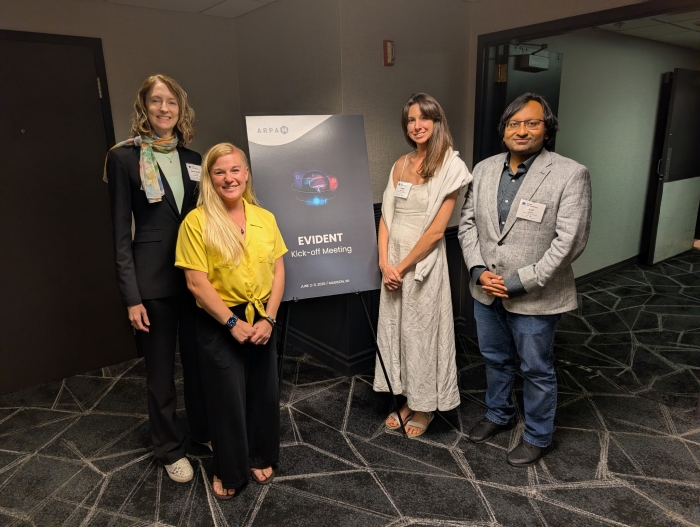
ASU is partnering with the U.S. Department of Veterans Affairs, Definium Therapeutics and Sunstone Therapies on the project. The ASU team is integrating additional biological measurements into studies already underway through its partners
Those measurements include genomic, epigenomic and proteomic biomarkers, as well as speech analysis. Each provides a different window into how psychedelic therapies affect the body and brain.
Genomics examines the genes people are born with, while epigenomics looks at how life experiences influence the activity of those genes. Lewis describes epigenomics as “a dynamic molecular map of what your body has been through,” shaped by stress, trauma, nutrition and other environmental factors
Proteomics measures the proteins circulating through the body, offering a snapshot of what’s happening in real time. Speech analysis uses machine learning to identify subtle patterns in language that may reveal changes in cognitive or mental health
Lewis hopes these approaches, taken together, will reveal biological signatures that can help personalize treatment
“If we can collect enough data, I’m hoping to be able to say, ‘We’ve looked at your genetics and epigenetics, and we think you’re a great candidate for this compound, but not that one,’” she says
For Lewis, the project reflects a broader evolution in psychedelic science. Early clinical trials focused largely on demonstrating that these therapies were safe and effective enough to move toward U.S. Food and Drug Administration approval. As federal interest and funding has expanded, researchers can investigate deeper questions about psychedelic compounds — and hopefully change lives
“This work has the potential to deliver more precise, personalized care and new hope for people living with mental health conditions,” Lisanby says
ASU HealthDowntown Phoenix campusFacultyJohn Shufeldt School of Medicine and Medical EngineeringSDG 03 Good Health and Well-BeingTempe campusCommunityPolicymakersEngineeringHealth and medicineHealth careSchool of Life SciencesDepartment of PsychologyPsychologyIra A. Fulton Schools of EngineeringResearchThe College of Liberal Arts and SciencesCollege of Health Solutions
ASU Health, Downtown Phoenix campus, Faculty, John Shufeldt School of Medicine and Medical Engineering, SDG 03 Good Health and Well-Being, Tempe campus, Community, Policymakers, Engineering, Health and medicine, Health care, School of Life Sciences, Department of Psychology, Psychology, Ira A. Fulton Schools of Engineering, Research, The College of Liberal Arts and Sciences, College of Health Solutions
More Health and medicine

Cardiovascular disease, osteoporosis, depression — these are just some of the health challenges research has shown women experience during their menopausal transition. While cardiovascular…
Read this story
AnthropologyHealthy LivingHealth careScienceSocial scienceResearch

Jennilin Boone has a passion for nursing.For 20 years, she worked in critical care while envisioning a time when she could pursue her master’s degree. After her husband lost his job three years ago,…
Read this story
Grants / AwardsEducationHealth care

If you find yourself binging on sweets and screen time this summer — skip the guilt. At least some of it. Just blame it on the heat.Many people are familiar with the winter version of …
Read this story
Healthy LivingSocial science
