


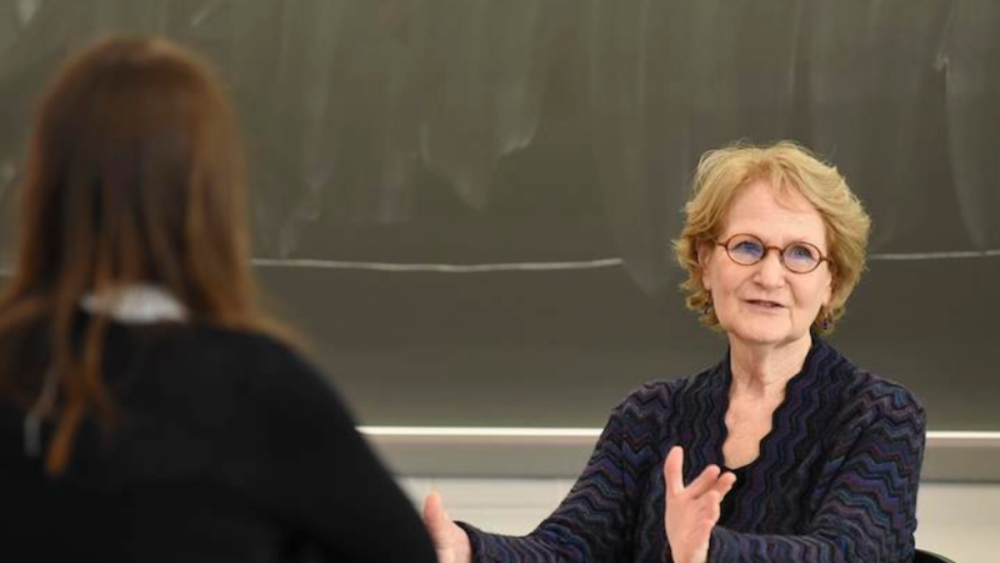
Pa. — After 34 years of research, teaching and mentorship in the Penn State Department of Nutritional Sciences, Barbara J. Rolls, Helen A. Guthrie Chair and professor of nutritional sciences, will retire on Aug. 31
Rolls joined the University in 1992. She pioneered research on how food characteristics influence eating behavior, establishing the foundation for strategies that continue to inform obesity prevention and healthy eating recommendations today
Transforming the field
When Rolls began her career, the study of eating behavior was predominantly rooted in psychology. As one of the first researchers to integrate ingestive behavior into nutritional sciences, she helped establish the field as a cornerstone of modern nutrition research
“I think the primary legacy of my lab has been understanding how the properties of food affect eating behavior,” Rolls said. “We really focused on how to do these studies meticulously to understand what to control for and how to systematically build knowledge.”
Her laboratory conducted groundbreaking studies examining how food characteristics influence eating behavior, identifying diet variety, energy density and portion size as three key factors that affect food intake. Those findings have influenced research in the field and continue to inform scientists, clinicians and public health professionals today
Rolls also translated her research into practical guidance through the development of the Volumetrics approach to healthy eating. This diet emphasizes consuming satisfying, nutrient-dense foods with lower calorie density to help people manage hunger while supporting healthy weight management
Her bestselling Volumetrics Diet books introduced these evidence-based guidelines to millions of readers and helped bridge the gap between nutrition research and everyday dietary choices. The Volumetrics Diet has also consistently been a top-rated diet in various U.S. news outlets
Rolls credits former department head John Milner with recognizing that the study of eating behavior belonged within nutritional sciences and recruiting her to the department. Since then, she said, she has watched the department become a leader in eating behavior research, with faculty and former students continuing to advance the field through interdisciplinary collaborations
“I do think research into eating behavior has turned out to be really foundational in the field,” Rolls said. “This area is now one of the department’s main research priorities, so I am really proud that the legacy is going to continue.”
Professional excellence
Rolls also helped establish one of the most prominent professional communities within the field. She was a founding member of the Society for the Study of Ingestive Behavior (SSIB), later serving as its president 1991-92. After her term with SSIB, Rolls also served as president of another distinguished society in the field, the Obesity Society
Throughout her career, Rolls received numerous national and international honors, including election as a fellow of the American Association for the Advancement of Science, the International Award for Modern Nutrition, the Obesity Society’s Presidential Medal of Distinction and the Hoebel Award for Creativity from SSIB
This year, SSIB recognized her career with a Presidential Symposium that featured presentations from several of her former trainees before honoring Rolls with the Distinguished Career Award during the society’s annual meeting earlier this month
“Barbara has become an integral part of the history of Penn State’s Department of Nutritional Sciences and etched her influence into the field of human nutrition,” said Craig Newschaffer, the Raymond E. and Erin Stuart Schultz Dean of the College of Health and Human Development. “Even in this moment, with public attention so focused on pharmacologic approaches to weight loss, the principles and approaches Barbara pioneered are being turned to again and again by experts to assure healthy and enduring weight management and gut function — a true testament to the enduring impact of her discoveries.”
A legacy of mentorship
While her scientific discoveries have had a lasting impact, Rolls said those she has mentored are what she is most proud of in her career
Throughout the years, she has mentored graduate students, postdoctoral scholars, early-career researchers and faculty members, scientists and industry leaders at Penn State and beyond. Rolls’ commitment to mentoring earned her the American Society for Nutrition’s Foundation Mentorship Award, which recognizes outstanding mentorship in developing nutrition science investigators, an honor she considers especially meaningful
Kathleen Keller, professor of nutritional sciences, credits Rolls’ mentorship as one of the defining influences on her own career
“Being able to work with and receive mentorship from Barbara as a junior faculty member was one of the defining moments of my career,” Keller said. “I credit much of my current success in learning from and collaborating with her. Her love of mentoring students and junior faculty will be one of her enduring legacies.”
To continue supporting future generations of scientists, Rolls recently established the Rolls’ Mentorship Award through SSIB that will recognize outstanding mentors within the organization
In addition to her mentees, Rolls was influential in the education of nearly every doctoral student in nutritional sciences through the department’s graduate seminar. Through this course, she has introduced first-year graduate students to research ethics, scientific writing, critical evaluation of literature and effective communication — skills she said she believes are fundamental to conducting rigorous science
“I have always wanted students to understand that science is exciting,” Rolls said. “You have to be meticulous, but you also have to enjoy asking questions and working together to find answers.”
Throughout her career, she encouraged students to embrace curiosity, collaboration and scientific integrity, emphasizing that good science is built through careful experimentation, thoughtful interpretation and a willingness to build on the ideas of others.
Looking toward the future
Although retiring from her full-time faculty role, Rolls said she does not plan to step away from research entirely. She plans to continue collaborating with former students and colleagues on ongoing projects while remaining engaged with the department as a professor emerita
“Barbara Rolls is a brilliant researcher whose impact on the field is indelible,” said Meg Bruening, professor and head of the Department of Nutritional Sciences. “She fundamentally changed how we understand eating behavior, but what has always impressed me most is her commitment to mentoring others. Her influence extends far beyond her own discoveries through the students, postdoctoral scholars and colleagues she has helped become leaders in nutritional sciences. I have no doubt her legacy will continue to shape the field for years to come.”
That legacy will also continue through three lasting contributions that will preserve her work for future generations
The first is the Barbara J. Rolls Collection, a publicly accessible archive of research data from studies conducted between 1988 and 2025, available through Penn State’s ScholarSphere. The collection, assembled by Alaina Pearce, assistant librarian in the Penn State University Libraries, includes decades of meticulously curated data from controlled feeding studies involving children and adults, providing future researchers with a unique resource for exploring new questions about eating behavior, food intake and obesity. Ten of the earliest studies are currently available in the collection, with additional data being added on a regular basis, with the full collection projected to be completed by spring 2027.
“There are still lots of questions that people can try to answer,” Rolls said. “Making these data available will hopefully help researchers continue to better understand eating behavior in the future.”
In addition to this collection, Rolls has donated many of her research and professional materials to Penn State University Libraries’ Archives and Special Collections. The archival collection will preserve materials associated with her research, including questionnaires, institutional review board documents and other study materials linked to the datasets in the Barbara J. Rolls Collection. Together, the collections will provide future researchers with both the data and the materials needed to understand the studies behind them, preserving an important record of Rolls’ contributions to the field of nutritional sciences.
The third contribution is her recently published autobiographical review in the Annual Review of Nutrition, which chronicles the scientific discoveries, mentors, collaborators and experiences that shaped her career. By documenting both the evolution of her research and the growth of the field itself, the article offers future scientists a firsthand perspective on the development of modern nutrition and eating behavior research and demonstrates to students where a career in nutritional sciences can lead them.
“I hope my legacy is the excitement, integrity and creativity that I have tried to instill in the people I have trained,” Rolls said. “You have to be your own biggest critic, understand the limitations of your work and always strive to do the best science you can.”
Last Updated August 28, 2026
Contact
- bsm5187@psu.edu
