


Add Us On GoogleAdd as a preferred source on Google
N.Y. (WBNG) – Researchers at Binghamton University are studying ticks in the field and in the lab, working to better understand how the pests behave and what diseases they carry — including Lyme disease, cases of which are on the rise nationally
Michael Stastny, a Binghamton University PhD student, has spent the last five years researching ticks. He began his work under Professor Tracy Curtis at SUNY Broome before continuing as a graduate student at Binghamton University
His research centers on a hypothesis first raised by Curtis — that ticks do more than wait to latch onto passing hosts
“Tracy had this idea that although ticks are known to quest, they climb up stuff and wait to hitchhike onto things — she had this hunch that they will actually hunt people down, and that they will seek out a stationary host,” Stastny said. “That was brand new information to me. It really struck my interest.”
The research confirmed the hypothesis
“She was right. They will seek out stationary human hosts in nature,” Stastny said. “From that, I was interested in figuring out why that may be, which is more or less one of the founding premises of my project now.”
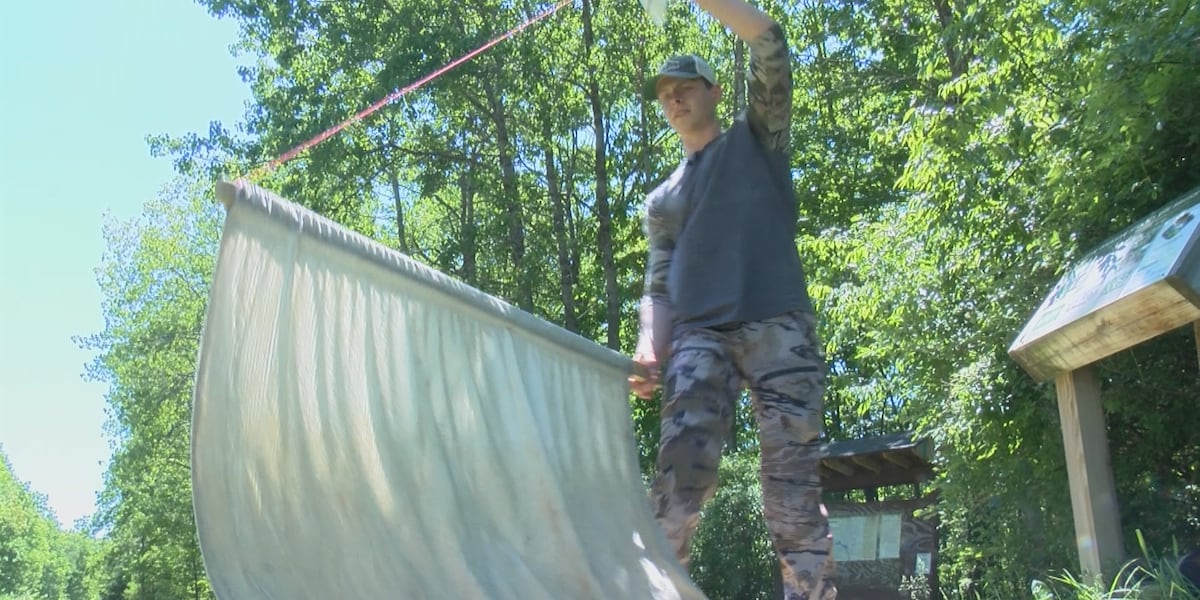
Stastny spends much of his time in wooded areas around the Binghamton University campus, dragging a large canvas across the ground through tall grass to collect ticks. During our one-hour search with him, he found 13 ticks
Unlike some researchers, Stastny keeps the ticks alive for further study
“We like to keep them alive so we can do our assays. Most researchers will euthanize them here and now, so they’re just going back to the lab with dead samples,” he said
Back in the lab, ticks are tested in two separate arenas — one measuring vertical climbing behavior using a four-foot-tall dowel, and another using a meter-and-a-half square grid to measure what Stastny calls hunting behavior
One finding from Stastny’s research has been the proximity of ticks to residential areas
“The knowledge that they’re right under our noses quite frequently is a bit of a daunting one,” he said. “I’ve collected right against the siding of houses and dorms around here. They are right below your windowsill half the time. They can be very close — they’re not necessarily out in the middle of preserves or public parks.”
Mandy Roome, co-director of the Binghamton University Tick-Borne Disease Research Center, added that the tick populations continue to grow
“One female deer tick lays about two thousand eggs, so one tick turns into two thousand,” she said. “The population is always exponentially growing. So even if you have a die-off rate of 90 percent, tick populations are still growing.”
Roome said testing collected ticks for pathogens is a major part of the center’s work
“We test them for different pathogens to see what they’re carrying. Typically, it’s one in three that are infected with the Lyme bacteria,” Roome said. “We want to see what they’re carrying, where it’s going, and what we can do with that.”
Emergency department visits for tick bites are up this year. CDC data show a 13 percent increase compared to 2025. In 2023, about 89,000 cases of Lyme disease were reported to the CDC, though the agency estimates nearly half a million people were diagnosed and treated that year. The Department of Health and Human Services has set a goal of reducing Lyme disease cases by 25 percent by 2035
Roome said other tick-borne diseases are also spreading
“We kind of watched Lyme move north and west, sort of out of the Hudson Valley across the state, and we’re seeing the same thing with anaplasmosis as well,” she said. “It’s good to have that information so you know what’s happened, you know what’s happening, and you can kind of predict what will happen so that you can prepare for it from a public health standpoint.”
Despite years of working directly with ticks, Stastny said awareness — not fear — guides his approach
“They’re here and there’s something I can do about it. The only thing I can do is just make sure that I’m comfortable and safe,” he said
He offered several recommendations for people spending time outdoors:
- Dress appropriately — avoid shorts and open-toed shoes in grassy or wooded areas
- Check yourself thoroughly after coming inside
- Change clothes and shower after outdoor activity
- Ask someone to check hard-to-reach areas, such as the center of the back
Copyright 2026 WBNG. All rights reserved
