


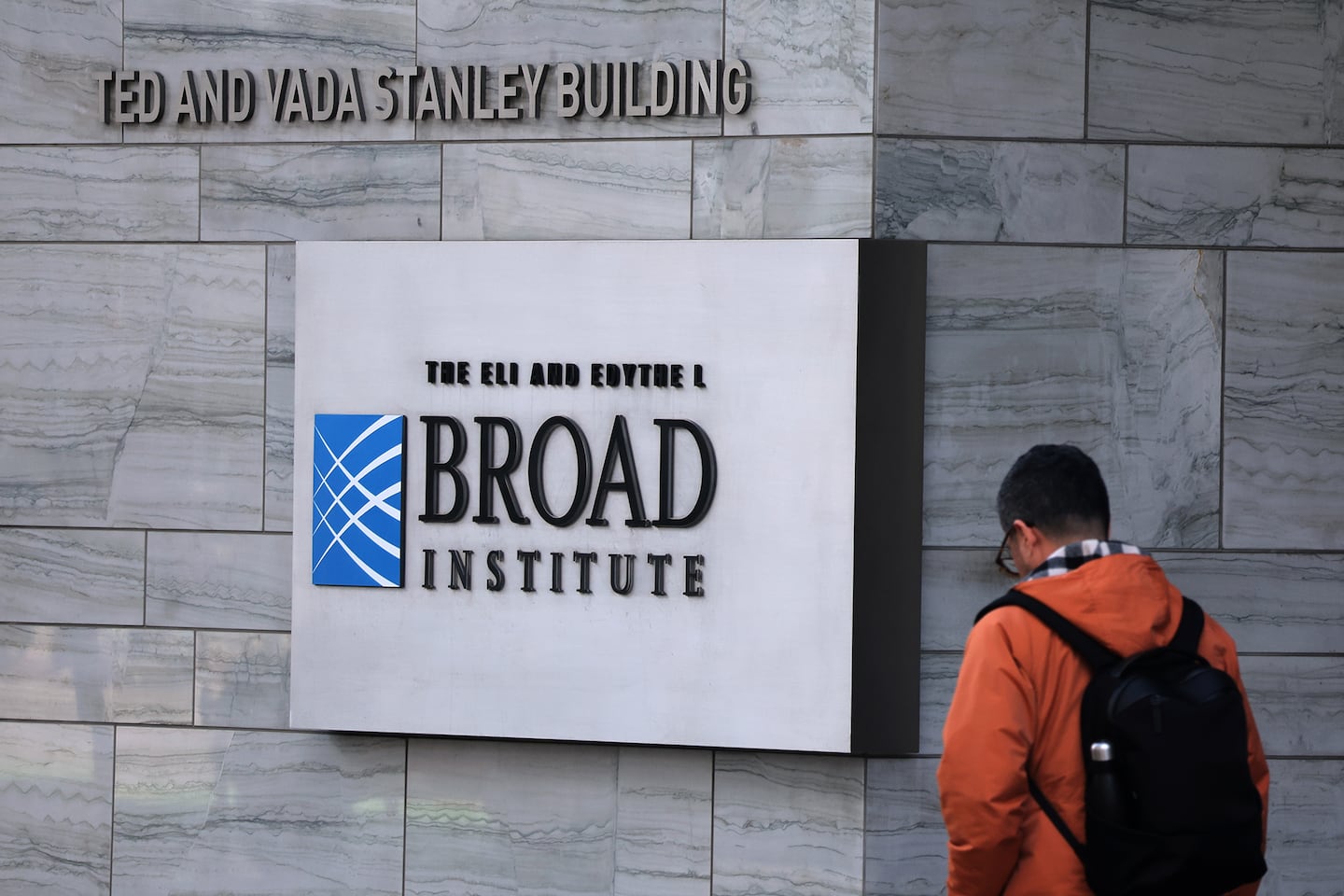
The Broad Institute, Boston Children’s Hospital, and Maine’s Jackson Laboratory announced a collaboration Tuesday to develop gene therapies for people with rare diseases and to make the life-saving therapies cheaper and more accessible to patients
With relatively few gene therapies on the market, families of children with rare genetic disorders have few options but to partner individually with researchers and raise millions of dollars to develop treatments for their conditions
The newly formed non-profit Center for Therapeutic Genetics will create precision medicines and share those methods, data, and training with other clinicians so they can do the same. The goal is to make these personalized treatments more like clinical procedures, such as organ transplants, so doctors don’t have to seek separate regulatory approvals for each use, said Dr. Winston Yan, founding director of the new center
“Rare disease families, they carry too much on their shoulders today, and it just feels so unfair,” Yan said. “If we achieve our vision, we think there’s a world in which those families can just show up to such a center and have this be the standard of care. You get a genetic diagnosis? Well, here is a procedure that will get you your genetic treatment, and that feels really exciting to me.”
One in 10 Americans lives with a rare disease — half of whom are children, according to the National Organization for Rare Disorders. Less than 5 percent of known rare diseases, of which there are more than 10,000, have approved treatments
Developing treatments for these diseases has been a challenge because of a lack of scientific tools and investment. But the science now exists to create transformative treatments, largely because of breakthroughs in gene editing and gene therapy
Getting treatments to patients, however, remains a problem, Yan said
“There’s a lot of headwinds for biotech,” Yan said, noting that many rare diseases often don’t affect enough people to drive commercial investment in developing treatments. “That means that patients fundamentally don’t have access to life-saving technologies, even though in many cases the science actually works. You can actually treat their diseases meaningfully with these technologies.”
The center’s goal, he said, is to create treatment platforms, including disease models, manufacturing processes, safety data, and clinical programs that can be shared and replicated by others
The center will initially focus on developing precision gene-editing treatments for children with rare forms of genetic epilepsies, an effort supported by a federal grant through ARPA-H, the country’s “moonshot” agency for health research. Earlier this month, the agency announced that it will spend up to $160 million to advance custom gene editing treatments for a number of rare diseases
“Our model is not to be family-funded for particular diseases,” said Timothy Yu, one of the center’s founding partners and an attending physician in the division of genetics and genomics at Boston Children’s Hospital. “Our model is to try to raise money philanthropically to support the field, to pick the conditions that will advance the field the furthest, the quickest, and with the most confidence.”
“I don’t want to set the expectation that people should be calling us to put their name on a waiting list,” Yu added
The center is also currently in its “founding phase” and not yet accepting patient referrals or providing clinical care, according to Tuesday’s announcement
Pamela Gavin, chief executive officer of the National Organization for Rare Disorders, said the center’s work could address a “phenomenal need.”
“We’re excited about what they’re building because it addresses one of the greatest unmet needs in rare disease,” Gavin said. “They’re not only advancing the science of genetic medicine, they’re also developing repeatable approaches that could make these therapies more scalable and ultimately more accessible for patients with very small populations.”
The new collaboration would help make critical reaceutical and biotechnology companies, said Patricia Musolino, a critical care and vascular neurologist at Mass General Brigham, who has been involved in gene therapy for 15 years
“We want to change the way we’re thinking about genetic medicines,” said Musolino, who also recently received a grant from ARPA-H to work on genomic medicines to treat rare genetic vascular diseases
In the future, gene therapy would ideally be treated more like surgical procedures, she said
“The surgeon doesn’t have to go to the FDA to get approved for exactly what he’s going to be doing to fix your gallbladder or your lungs,” she said. “He’s going to use the approved re
But expanding access to treatment for rare diseases is a complex challenge, Gavin said. She noted that her organization and others around the country have been working to address similar issues
The National Organization for Rare Disorders runs a network of nearly 50 leading U.S. medical and research institutions that are dedicated to advancing rare disease diagnosis, care, and research
“The science is advancing remarkably quickly,” Gavin said. “The harder challenge now is building the systems that allow those scientific advances to reach patients safely, efficiently, and at scale. That’s not something any one institution can solve alone.”
Allyson Chiu can be reached at allyson.chiu@globe.com. Follow her on X @_allysonchiu
