


Mental Health
This Athlete Is Teaching Millions That Anxiety & Bravery Aren’t Opposites
Author:Sela BreenJuly 21, 2026
Assistant Health Editor
By Sela Breen
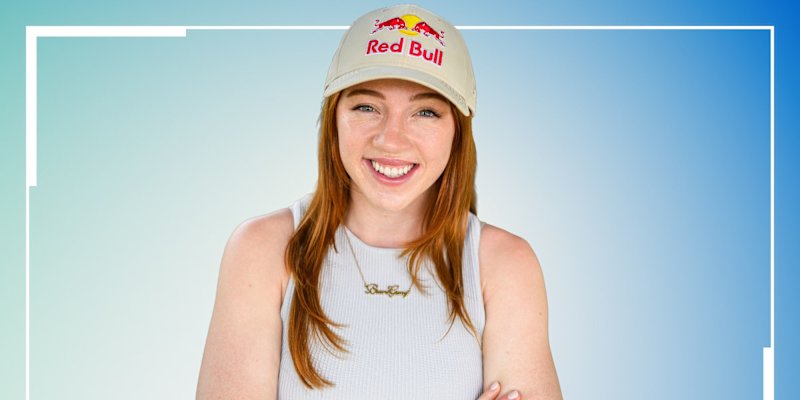
Image by Red Bull Media House x mbg creative
July 21, 2026
It was 2025, and Molly Carlson was preparing to do a running dive off a 22-meter platform, which is the equivalent of over 70 feet in the air. Little did she know, she had mismeasured her approach. Her feet landed too far forward and slid past the edge of the platform, and suddenly she was in the air before she was ready, rotating through a dive she hadn’t planned to take
She landed safely in the water after completing a double flip, not the quad she had planned to do, but the memory has stuck with her. “I can remember that dive like it was yesterday,” she says. “It just lives rent-free in my brain.”
Carlson is a World Series cliff diver and a Red Bull athlete, one of the most recognizable faces in a sport most people didn’t know existed five years ago. She hurls herself off structures the height of a six-story building and hits the water at 75 kilometers an hour (that’s over 46 miles per hour)
Most people would be terrified about dropping down from that height, but Carlson’s anxiety takes a different form
“Why do I care what people think about the color suit I’m wearing?” she says, recalling what goes through her brain as she prepares for a dive. “Is it too many sparkles? Oh my gosh, what if I land on my booty and people are going to judge me for that?”
Carlson has lived with anxiety her whole life, and she will be the first to tell you that being an extreme athlete and being anxious are not contradictions. The two parts of her life actually complement one another. The innate human fear of jumping off a cliff is what actually allows Carlson to stay in the moment when she competes
The unlikely origin
Carlson grew up in Thunder Bay, Ontario, and started jumping off the one-meter springboard at eight years old. She fell in love right away with the jumping, flipping, and feeling of moving her body through the air in a way that felt a little crazy
“I’ve always lived with anxiety and stress and fear,” she says. “But my actions would always show otherwise, and I thought that was always special.”
She earned a scholarship to Florida State University for traditional springboard diving, competing on the three-meter and 10-meter, but COVID cut her time there short. Around the same time, a message arrived from Team Canada asking if she would come to Montreal and try diving off their 20-meter platform
Her first instinct was absolutely not. But after two months of being bored and restless in lockdown, she changed her mind and decided to give it a shot. The platform was 18 meters at the time, nearly six stories above the water, and she had never felt a height like it. “It felt like time stopped in the air,” she says. “That jump took at least five minutes. I swear I was flying.”
For someone whose brain never stops running, that stillness was a revelation, and she’s been chasing that feel ever since. “My brain is always going with anxiety and spiraling,” she says. “So to have just a moment of bliss is something I crave. And I found it in high diving.”
Fear as a tool, not an obstacle
A common assumption about cliff divers is that they’re fearless, Carlson says. She says people expect the athletes to just show up and chuck themselves off platforms, but this couldn’t be further from the reality
“We’re all scared up there, we’re all stressed,” she says. “But you need to just completely accept that fear’s supposed to be there because it’s going to keep you safe. You need that little ounce of fear to make sure that you’re sharp up here.”
That acceptance is the whole game. To dive safely from that height, she has to be so locked into the present moment that her brain shuts off and her body takes over. It’s what many athletes refer to as a flow state, and fear is what gets her there
But getting to that flow state takes lots of training and calculation. During the season, Carlson does one 90-minute water session each day, in addition to conditioning, trampoline work, ballet, gymnastics, and all sorts of flips throughout the week
What “in the moment” actually requires
Carlson’s mental work is grounded in serious physical stakes. She’s only able to practice her high dives four times a week, twice on Tuesday and twice on Thursday, because the impact is so punishing
Women in this sport are hitting the water at 75 kilometers an hour, the men at 85 and up. That’s equivalent to over 46 miles and 52 miles an hour, respectively. “It feels like you’re hitting concrete at the end of the day,” Carlson says
Divers are meant to take four months completely off the 20-meter platform every year so their bodies can recover. This restriction, in addition to only being able to practice high dives four times a week, means they may only practice the dives they compete with a handful of times
“As a perfectionist, I feel like I’m not ready,” she says, especially because she comes from the world of traditional diving, where she repeated a dives hundreds of times before competing with it
Instead of practicing her dives, Carlson’s training is built around handling that impact and generating explosive power. Because of knee injuries, Carlson avoids loading her back, so she and her boyfriend, who is also a cliff diver, do a lot of trap bar deadlifts, then move straight into box jumps
“You have a sport that’s worth three seconds,” she says. “So what can you fit into three seconds is the goal of this sport.” That means there’s no long-distance cardio, just sprints, sled pushes, and bike intervals
She also does a lot of neck and core work so her body can absorb the hit. “The more you can be strong, the more you can handle an impact,” she says. Even with all of this training, her body is already showing signs of the repeated impacts. She tapes her knees during training after two MRIs showed she’s lacking cartilage, which she describes as the legacy of being an early guinea pig for a sport that was so new when she started that there weren’t even permanent training facilities
RELATED READ:How To Relieve Sore Muscles From A New Fitness Routine
Starting over from zero meters
Carlson had a competition coming up a month after her big slip in 2025, so she had to prepare the same dive that had gone wrong. Unsurprisingly, she started having mental blocks
Her solution was to go all the way back to the beginning. She practiced the running approach on flat ground, zero meters up. Ten reps without slipping, then she advanced to three meters. Ten clean reps, then she did five, seven, ten, and fifteen meters
“As soon as I built up the confidence from ground zero, I just knew that I’d be fine,” she says. She made it back on the platform in time to compete
The lesson reaches well beyond diving. “There’s nothing wrong with baby steps,” she says. “No matter what it is in your life, whether it’s stress for a test, whether it’s relearning a dive or a mental block on anything, going back to what you know you’re going nail is just going to help confidence. Rushing back into something is never going to help in the long run.”
How she stays locked in
Between dives is where Carlson says her anxiety can spiral. On the edge, she’s locked in on surviving. But back in the room waiting for her next dive, her brain kicks into gear, so she needs something to do with it
“I’m literally playing 2048 until I can’t breathe,” she says. “It’s just something that grounds me, gets me in the moment.” It might sound silly, but she says when she begins getting frustrated at the game, she knows she’s focused enough to dive
Outside of diving, the anxiety is harder to manage. “It’s typically about what are people thinking,” she says, with the true root of her anxiety being the age-old question, Am I enough?
Currently, she’s working on creating reassuring mantras for herself. “The thing with living with anxiety is you’re always figuring it out.”
Learning to be real
Before cliff diving, Carlson was a self-described filter girl. She grew up on Instagram, posting carefully curated versions of herself and hiding behind Snapchat filters and insecurity. She trained alongside Olympians who only ever posted perfect dives, never a failure, and she internalized the message
That pressure fed a dark period. As a 5’7″ athlete, competing against girls who were 5’2″, she started wondering whether getting smaller was the only path to the Olympics. “It was just a really, really lonely time,” she says, and part of what made it so lonely was that she never saw anyone else talking about it
The shift came during COVID, when Carlson started making TikToks for fun, jumping off a roof into a pool while everyone else sat on their couch. She was just being herself—funny, terrified, and honest. Then one of her videos blew up, and so did the next one. Soon, she hit a million followers
Authenticity, she realized, was the thing people actually craved, and it doubled as its own form of bravery. “I could cry about it to this day, because at 16 I truly thought I had to be someone else,” she says
Carlson built a hashtag called the Brave Gang, where people share their own version of bravery. “I don’t care if it’s your first cartwheel, or your first jump off a 10 meter,” she says. She’s seen people tag it to share coming-out moments and, just the other day, she saw a mom use it before going on her first date after a divorce. “These are all really big things that I hope people are proud of, because it takes so much bravery to do these small things that people don’t understand.”
The community has helped her as much as anyone. Posting honestly reminds her she’s allowed to be herself, and it means no one has to sit in their anxious head alone
Self-care as ritual, not indulgence
Carlson does a lot of work to take care of her body mentally and physically. Cliff diving takes Carlson around the world for six months a year, so she’s built a set of self-care habits that keep her mentally and physically grounded on the road. Here are her go-to travel and recovery tips:
- Stay an extra day: Flying home right after a three-day competition used to wreck her. “You get home, you’re sick, you have the rundown cold,” she says. Now, she and her teammates stay one extra day to sleep in and let the adrenaline settle heading to their next location.
- Hydrate like it matters: Between the travel and competing in the heat, consistent hydration is non-negotiable.
- Bring your skincare routine: Doing the same simple routine everywhere creates a sense of normalcy. Sunscreenis especially critical for Carlson, who describes herself as very ginger and spends long days in full sun.
- Do your makeup: Before competing, Carlson spends 30 minutes on her makeup. Not because the competition requires it, but because it grounds her. Look good, feel good.
- Use a foot hammock: Carlson says her whole team uses these inexpensive foot hammocks that hook onto the tray table on planes. Keeping your feet elevated on long flights prevents swelling when your body is already beaten up from competition. She says it’s a complete game changer.
RELATED READ:Research Shows This Antioxidant-Rich Fruit Supports Recovery, Performance & Sleep
The takeaway
Carlson doesn’t want you to stop being scared. She wants you to let the fear be there, and embrace it. She has built a career, a community, and a platform on the idea that bravery and anxiety can live side by side, that you don’t have to feel fearless to do something that terrifies you
“Accepting that fear is 100% allowed to be there is step one to doing some very cool stuff,” she says
