


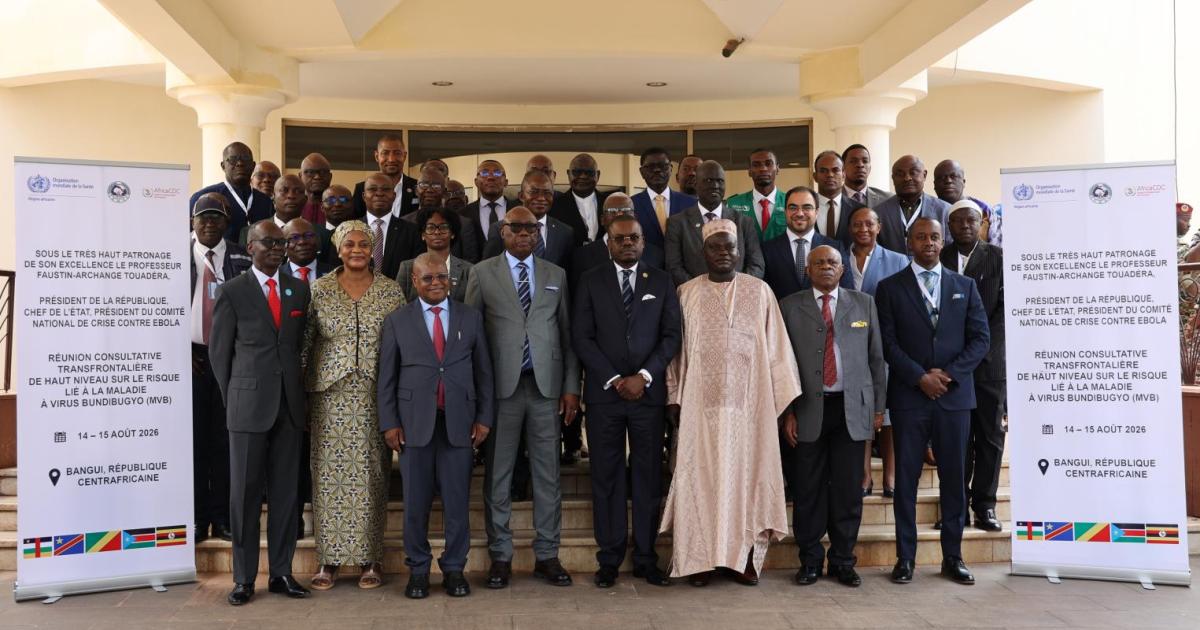
Bangui – A high-level cross-border meeting opened on Friday, 14 August 2026, in Bangui, Central African Republic, to strengthen preparedness and coordination in response to the risks posed by Bundibugyo virus disease. Convened by the World Health Organization (WHO), the meeting brings together the Central African Republic, the Democratic Republic of the Congo, Republic of the Congo, South Sudan and Uganda, to strengthen regional cooperation in addressing the threat of Bundibugyo virus disease and other cross-border health emergencies.
As part of efforts to harmonize alert mechanisms, strengthen surveillance at points of entry, and engage border communities in preparedness and response, the participating countries reaffirmed their commitment to working together on joint actions that transcend administrative boundaries
“It is essential that our countries work closely together, pooling our efforts and collective wisdom, particularly along our shared borders, where communities exchange not only goods but also maintain family ties rooted in shared cultures and traditions,” said Central African Republic Prime Minister Félix Moloua
The Democratic Republic of the Congo declared an outbreak of Bundibugyo virus disease on 15 May 2026. Three months later, more than 4,300 cases had been confirmed in the country, including more than 2,000 deaths. Against this background, Baltasar Engonga Edjo’o, President of the Commission of the Economic and Monetary Community of Central Africa (CEMAC), warned of the continued threat posed by Ebola. “Central Africa is well aware of the human, economic and social risks posed by the spread of the virus,” he said, noting that the Commission had already mobilized a subregional technical group and adopted a regional roadmap to intensify surveillance and strengthen security measures at points of entry.
“Viruses do not stop at borders,” said WHO Regional Director for Africa, Dr Mohamed Janabi, underscoring the importance of a collective approach to investing in preparedness. “When one country prepares, Africa becomes stronger. Our borders may separate our countries, but they cannot divide our health security.”
Stakeholders at the meeting emphasized the need to strengthen community-based surveillance and ensure the rapid sharing of health information. The participating countries committed to translating agreements into concrete actions and making preparedness a political priority
The Central African Republic highlighted that a mobile laboratory has been deployed in Obo, near the borders with the Democratic Republic of the Congo and South Sudan. The team on the ground is conducting enhanced surveillance, with a particular focus on community engagement and participation, as well as best practices for infection <a href="https://healthylife7.com/simple-snake-prevention-tips/” title=”Simple snake prevention tips”>prevention and control
The meeting, marked by calls for solidarity and cross-border cooperation, is expected to result in a joint roadmap and common action protocols
