


Funding Supports Bench-to-Bedside Pipeline
Key Takeaways
- New grants from the National Institutes of Health National Center for Advancing Translational Sciences total $29 million over seven years
- The Clinical and Translational Science Institute has brought in $157 million in funding since 2006
- These grants will support research teams translating discovery science to treatments for all people, faster
The University of Rochester Medicine Clinical and Translational Science Institute (CTSI) received grants totaling more than $29 million from the National Institutes of Health (NIH) to support translational science and research that improves human health outcomes. For more than 20 years, CTSI has supported health research at URochester Medicine, bringing in over $157 million in federal funding to help research teams develop more treatments for all people, faster. This support was made possible through the NIH’s National Center for Advancing Translational Sciences (NCATS) and the Clinical and Translational Science Awards Program. The institute celebrated this achievement on Thursday, July 23, 2026, at the Saunders Research Building at the URochester Medicine Health Sciences Campus.
Co-Directors Wilson and Zand provide remarks at the grant celebration.
CTSI Supports URochester Research Teams
“The University of Rochester is a national leader in research that improves human health,” said University President Sarah Mangelsdorf. “This funding will ensure our researchers have the tools they need to connect, learn, and get what they need to advance their knowledge and practice, develop cutting-edge treatments and therapies, and bring hope to people receiving care in the Rochester region and beyond.”
CTSI provides education and career development, services and support, and funding to research teams at URochester Medicine
“For twenty years, CTSI has served a critical infrastructure role for translational science and research at URochester Medicine,” said David Linehan, MD, CEO of URMC and Dean of the School of Medicine and Dentistry. “The CTSI team supports our academic and clinical missions by accelerating lab discoveries to bedside implementation and promoting team science. They will continue to play a pivotal role in achieving our research mission.”
In 2006, the institute was one of the first across the US to receive funding through the NIH’s support of innovative translational science and research
“For a patient waiting for answers, or a family hoping for a better treatment for a loved one, medical research that develops better health outcomes is deeply personal,” said Senator Chuck Schumer. “The University of Rochester earned this major $29 million federal NIH award through two decades of outstanding work and proven results, and I will keep fighting to protect the NIH investments that allow Rochester’s scientists to make discoveries that improve and save lives.”
“Medical breakthroughs don’t happen by accident—they happen because we invest in the researchers, institutions, and partnerships that turn discovery into better care for families,” said Congressman Joe Morelle. “For two decades, the University of Rochester’s Clinical and Translational Science Institute has been at the forefront of that mission, and I’m proud to celebrate this milestone and the more than $29 million in NIH funding that will help deliver lifesaving innovations for our community and communities across the country.”
Translational Science and Improving Health for All
The new grant funding is organized around two key themes. The first is translational science—removing research barriers by innovating through artificial intelligence and machine learning and accelerating high-quality clinical trials
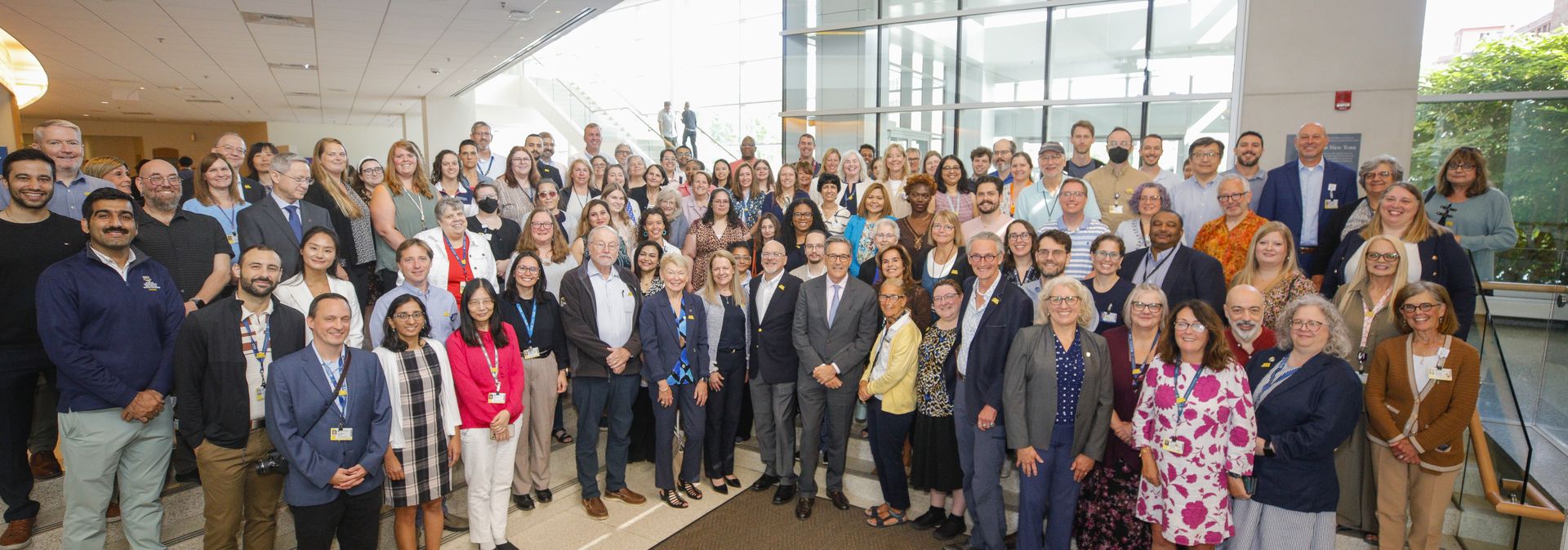
URochester leaders, faculty, staff, and research teams turned out for the event.
The second is improving health for all—utilizing translational science to improve and foster translational research from bench to bedside, address local and national health priorities, and improve access to cutting-edge clinical trials
“We are showing the research community how translational science can reduce barriers to make research more meaningful for all,” said Karen Wilson, MD, MPH, co-director of CTSI. “Translational science can make a real difference in the lives of those receiving treatment because it makes healthcare research faster, less expensive, and more impactful.”
The grant will have practical benefits for research teams at URochester Medicine
“Our new grants will fund training and mentorship of up-and-coming translational scholars, support innovative research projects, offer training and education programs to improve our clinical trials workforce, support best-in-class informatics services, and more,” said Martin Zand, MD, PhD, co-director of CTSI
CTSI has been partnering with the community since it first received funding in 2006, providing a link between community members, local agencies, and research teams. The new grant will strengthen URochester ties to rural communities through direct engagement and expanding access to research opportunities through innovative methods. CTSI is working closely with Common Ground Health and Edith Williams, MS, PhD, of the Center for Community Health and Prevention for these community engagement activities.
The current grant period continues through 2032
Under NCATS’ leadership, the Clinical and Translational Science Awards (CTSA) Program supports a national network of medical institutions that speeds the translation of research discoveries into improved care. Currently, more than 60 leading medical institutions across the nation receive CTSA Program funding. The institutions offer expertise, resources and partnerships at the national and local levels to improve the health of individuals and communities. The CTSA Program also nurtures the field of translational science through education, training and career support at all levels.
