


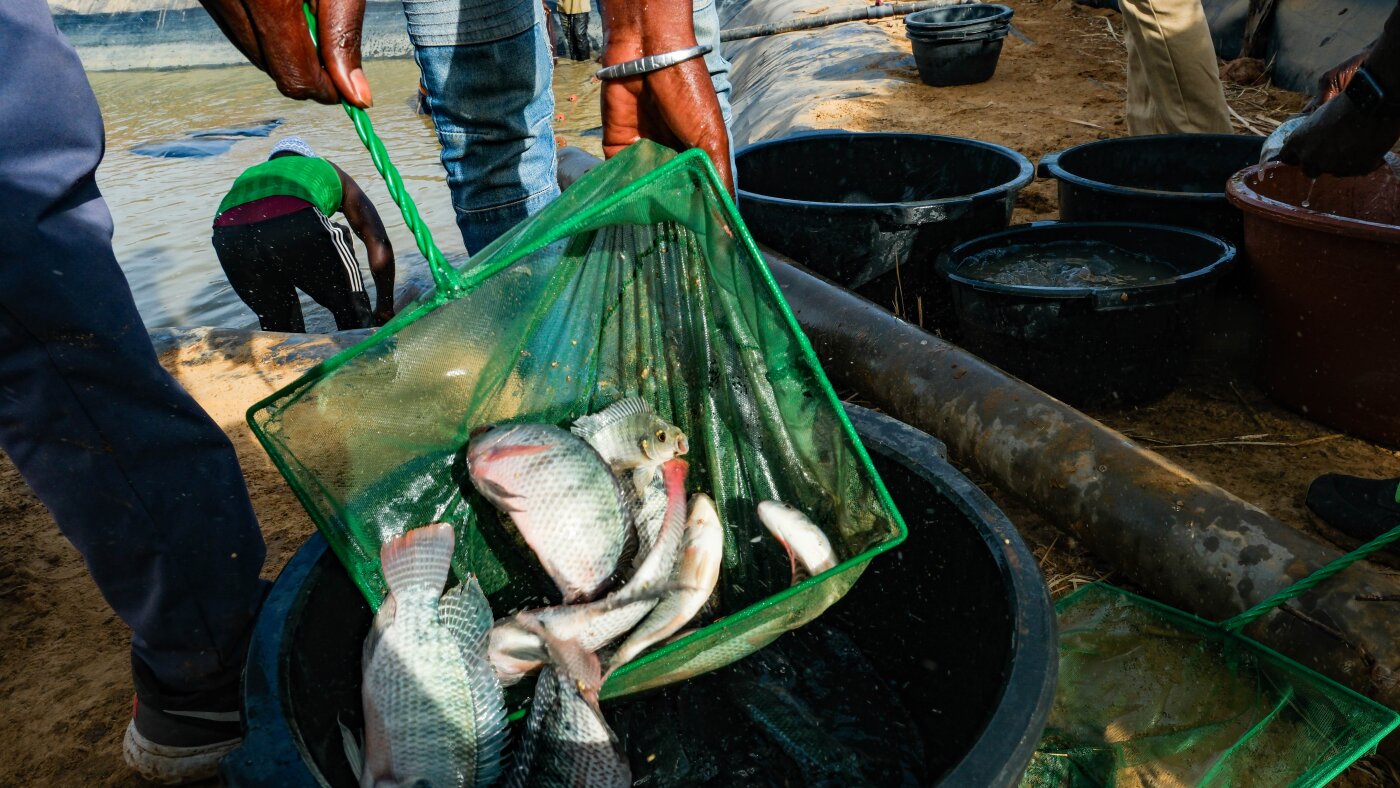
Could fish be a secret ingredient for rice farmers to avoid disease and make more money?
July 12, 20266:49 AM ET
Jonathan Lambert
,

Rolando Arrieta
Researchers net tilapia, which they’ll transport to the paddies of a rice farm in the Senegal River Valley.
Ricci Shyrock for NPRhide caption
toggle caption
Ricci Shyrock for NPR
Momy Seck Ndao has been planning for this day for months
The environmental engineer is standing beside two swimming-pool sized ponds, each lined with a black tarp and full of hundreds of tilapia. Two of her colleagues trudge through the pond in waders, trying to corral the fish with a net
“For this project, we need a lot of tilapia, about 1,900,” says Ndao, as she eyes the horizon. They’re in a race against the rising sun
It’s still relatively low but will soon heat this part of the Senegal River valley to about 100 F, hot enough to bake the fish on the way to their final destination — a rice field
There, these tilapia — and a handful of other fish — are the key ingredients in an ambitious experiment. Ndao and her colleagues are trying to see if adding fish to rice farms can help solve three problems plaguing rice farmers, and Senegal more broadly — food insecurity, poverty and a debilitating disease
Global Health
A plan to get lifesaving food to hungry kids was working well — until it wasn’t
To Ndao, it’s a particularly Senegalese solution
The national dish, thieboudienne, is a delectable combo of rice and fish. “We eat it every day. So if you grow rice and fish in the same area, you just need to add vegetables,” Ndao says with an easy laugh, “and you will have your daily dish.”
Fishing expedition
But first, Ndao and her team have to catch those tilapia and schlep them to the farm
Once enough fish are concentrated by the net into a writhing mass, other colleagues swoop in with smaller buckets to scoop them up. Quickly, but careful not to spill, they shuttle the buckets to a big green tank on the bed of a pickup
The team is on a mission to scoop up nearly 2,000 tilapia at a fish farm in Dagana, Senegal.
Ricci Shyrock for NPRhide caption
toggle caption
Ricci Shyrock for NPR
It takes about an hour to load up the fish. Kayla Kauffmann, a Stanford disease ecologist on the project, rushed over to the truck just after the tank was sealed. “I wanted to look in before they closed it,” she says. “It’s quite the operation.”
Today’s operation began before dawn and is far from over
On the outskirts of the coastal town of Saint Louis, the team — over a dozen scientists, aquaculture technicians and interns — set off in the dark. Before reaching the tilapia farm in Dagana, about 80 miles northeast across the vast expanse of the Sahel, some of the caravan peeled off to catch a few larger fish of a different species, which will be the main disease-fighters
Momy Seck Ndao, an environmental engineer who is part of the fish-rice project, wrangles an African bonytongue fish, also called heterotis, that escaped its bucket. The fish will soon be introduced to a rice farm, where researchers hope it’ll eat snails that spread a debilitating disease called schistosomiasis.
Ricci Shyrock for NPRhide caption
toggle caption
Ricci Shyrock for NPR
The next and final stop, about 20 minutes away, is Keur Mbaye, where the fish will be introduced to a rice field. There, all those fish will live and poop, fertilizing the crop
It’s one of 60 fields across the region where the team, in conjunction with local farmers, will be trying out this potential win-win-win solution. To Ndao, the stakes are high
“The potential is here,” she says. “Everything will depend on what they will see in this experiment, what they will learn.”
For stories about life in our changing world, subscribe to NPR’s Global Health newsletter
Dangerous worms, protective fish
Rice production is booming along the winding Senegal river, which forms the border with Mauritania to the north. The immense Sahara is just a hundred-some miles away. Historically, the semi-arid climate meant that farming could only happen during the rainy season. But dam construction starting in the 1980s helped supply a steadier stream of water for crops
Knee-deep in a Keur Mbaye rice field, Kauffman holds out in her gloved hand a tiny example of what else the dams allowed to flourish — freshwater snails that can carry the disabling disease known as schistosomiasis
Small snails like this one can carry the worms that spread schistosomiasis.
Ricci Shyrock for NPRhide caption
toggle caption
Ricci Shyrock for NPR
“The link between dam construction and schistosomiasis is really strong,” she says. “After a dam is built, way more people end up with schisto.”
The disease, which afflicts more than 200 million people a year, is caused by a parasitic worm that spends part of its life cycle in freshwater snails. There, the worm replicates itself, producing thousands of parasites that slink back into the water
“They then try to find a person that’s wading in the water, like a rice farmer, and burrow into that person’s skin,” says Kauffmann. Ultimately, they lay eggs in the intestines or urinary tract, causing a slew of problems from stomach pain to bladder cancer
Before dam construction, freshwater snail numbers were kept in check by migratory prawns that eat snails. But the dam “cut off their migration route,” says Kauffman. Fewer prawns meant more snails, and more schistosomiasis. Now, this part of Senegal has among the highest burdens of schistosomiasis anywhere, affecting about a third of children
For rice farmers, the disease has become an occupational hazard. Dgibi Dia has farmed these fields in Keur Mbaye for decades. Standing near the pickup truck holding nearly 2,000 fish, he says he’s had multiple painful bouts with schistosomiasis
Dgibi Dia is a rice farmer who has had multiple painful bouts with schistosomiasis.
Ricci Shyrock for NPRhide caption
toggle caption
Ricci Shyrock for NPR
“This always happens to us since we are in the water most of the time,” he says. Each time, he and his fellow farmers get the same sort of symptoms
“We cannot sleep at night because of the itching,” he says. Stomach pain is accompanied by “gurgling sounds,” he says, “as if we had something running inside the stomach.” He also experiences bloody diarrhea and fever, and symptoms can persist for months
“It’s difficult,” he says. “When you are sick, you cannot work properly.”
There are drugs to treat schistosomiasis, but Dia says they’re hard to come by. Abdoulaye Ndiaye, another farmer, agrees, adding that they’re often too expensive. And while the drugs can cure a single bout, they don’t prevent re-infection
“We live in the fields,” Ndiaye says. “Prevention is for our benefit.”
Rice farmer Abdoulaye Ndiaye hopes that adding fish to farms can help him avoid getting schistosomiasis.
Ricci Shyrock for NPRhide caption
toggle caption
Ricci Shyrock for NPR
That’s where the fish come in — as snail superpredators
Tilapia may eat the occasional snail, but that’s not their main job. The team is adding a few heavyweights — African bonytongue — to each field to be superpredators. The three-foot-long fish are also known as heterotis
“It’s a species which can eat a lot of snails per day,” says Ndao
African bonytongue fish, also called heterotis, can eat a lot of snails in a day.
Ricci Shyrock for NPRhide caption
toggle caption
Ricci Shyrock for NPR
Thrashing fish
Adding them to rice fields, she hopes, will lead to fewer snails, and thus less schistosomiasis. Getting them into the fields proves tricky. One of the heterotis leapt out of its container onto the dusty ground. Ndao had to rush over to grab hold of the thrashing fish with both hands
“Heterotis is very, very crazy,” she says, “very hard to catch.”
Eventually, she succeeds. After checking to make sure the water in the rice fields is suitable for the fish, the team starts shuttling both the few heterotis, and the hundreds of tilapia, to the water in buckets
Ndeye Mbaye, part of the research team, releases tilapia into a rice field. The roughly 600 tilapia added to this field will fertilize the rice with their feces, and help feed the farmers.
Ricci Shyrock for NPRhide caption
toggle caption
Ricci Shyrock for NPR
Gently, the buckets are lowered into the water, so the fish can acclimate to the temperature. “We do it slowly and let the fish go by themselves.”
Several minutes later, their scales flash in the sun as the fish disappear into the shoots of growing rice. There, the heterotis will eat snails. And all those tilapia, about 600 per field, have a different job — pooping
“The feces of the fish is a very important natural fertilizer for the rice,” says Ndao, and should boost yield
Many benefits
Rice production may be booming in the Senegal River Valley, but it’s not enough to meet the county’s appetite. As a result, Senegal imports about half the rice it consumes
Rice fields in the Senegal River Valley.
Ricci Shyrock for NPRhide caption
toggle caption
Ricci Shyrock for NPR
“We need to increase the yield, to obtain food security,” says Ndao. Fertilizer can boost yields, but is often expensive for farmers and the chemicals can runoff into rivers and lakes. Adding fish to farms could be a more sustainable way to boost yields, says Ndao. As a final bonus, the farmers can harvest some of the fish to eat for themselves or sell
These benefits have helped sustain fish and rice aquaculture across Asia for centuries, but it’s pretty rare in Africa. Not many of the farmers Ndao talks with have heard of it. She highlights these possible benefits when trying to recruit farmers
Dgibi Dia was drawn to the project for many reasons, but especially the fish. “There are no fish in this area,” he says, gesturing around his fields. “We have a shortage. We pray that it will be a success.”
There’s reason to think it will be. Over the past several years, Ndao and her colleagues tried growing fish and rice together on a smaller number of farms. One of them, near Saint Louis, belongs to Ousmane Diallo
One day, “madam Ndao came to see us while we were working in the rice fields and explained the project,” he says. He’d never heard of growing rice and fish together, but was game to try. Once fish were introduced to the farm, Ndao checked in often to see how things were going. It’s a major part of her job
“I call them every two days, until harvest,” says Ndao. With dozens of farmers to track, that means a lot of time on the phone. “My colleagues, they call me Sonatel, the national telecom agency,” she says laughing, because “I’m always on the phone.”
Diallo says whenever his phone rang, “it’s usually her. She is very determined.”
A blueprint for success
That kind of determination is essential for Ndao and her team’s ultimate goal — scaling up. This year, that means more than doubling the number of fields they’re studying to get a fuller understanding of what growing rice and fish together can do
Researchers Momy Seck Ndao and Kayla Kauffman search for snails in the rice fields. The research team is measuring snail density before and after adding fish to farms, to see whether the fish can reduce the snail-borne parasite that causes schistosomiasis.
Ricci Shyrock for NPRhide caption
toggle caption
Ricci Shyrock for NPR
A smaller pilot study, published earlier this year, hints at the benefits. Ndao and her colleagues found that adding fish to farms increased rice yields by about 25%, significantly boosted income and slightly reduced snail numbers. But the sample size was relatively small, so big questions remain, says Ndao. “There are so many things to do.”
Over the coming months, the team will be using drones to more closely track rice growth, taking more detailed measurements of changes in snail numbers to understand the impact on schistosomiasis, and gathering more information on what farmers are actually doing with the fish
Answering all these questions is crucial for understanding just how big a difference fish-rice aquaculture could make. In turn, Ndao says the results will help make the case to more farmers to try putting fish on their farms, and hopefully, sustain the practice. For the project to make a meaningful dent in reducing disease, improving food security and farmer livelihoods, the practice has to be expanded
The farmers who’ve participated in the project so far offer a compelling personal case
Abou Diallo was able to paint and renovate his house from the extra money he earned after adding fish to his rice farm boosted crop yields.
Ricci Shyrock for NPRhide caption
toggle caption
Ricci Shyrock for NPR
“I make more income, and sell much more rice than before,” says Abou Diallo, standing outside his freshly painted turquoise-and-white cement house, not far from Saint Louis
Before adding fish to his farm, Abou Diallo could sell about 60 bags of rice a season. After adding fish, he sells between 90 and 95 bags, he says. “It has changed my life.” The extra funds allowed him to buy a flock of sheep and renovate his home, he says, including giving it a new coat of paint. He was able to eat and sell his own fish, which he says taste better than those he gets from the ocean. “There is a big difference.”
