


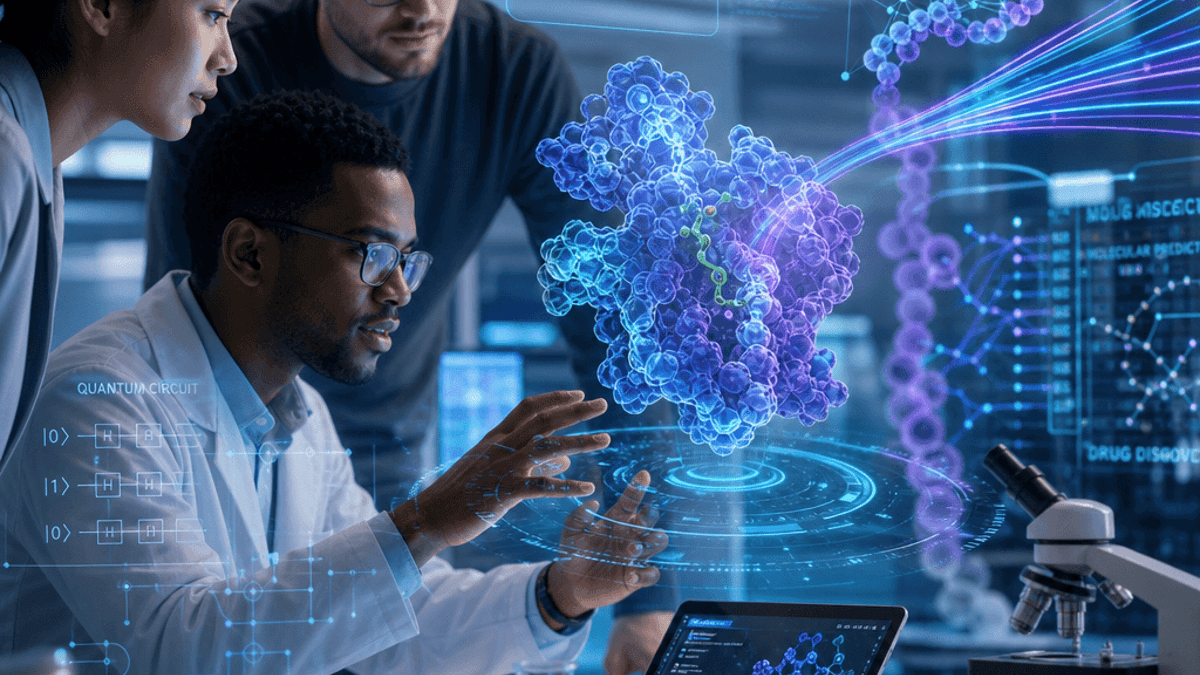
A grassroots team of researchers just cracked open a new frontier in drug development – one that Big Pharma hasn’t bothered with. Working nights and weekends with cobbled-together funding, they’ve demonstrated how quantum computing paired with AI can generate novel peptides to treat rare diseases and help underserved populations. The breakthrough, detailed by Wired, shows what’s possible when cutting-edge tech meets mission-driven science outside the usual venture-backed playbook
The future of drug discovery isn’t happening in gleaming research labs with billion-dollar budgets. It’s unfolding in the spare hours of scientists who refused to wait for institutional buy-in. A team of researchers just proved that quantum computing and AI can work together to generate novel peptides – the building blocks of potential treatments for rare diseases that typically get ignored by traditional pharmaceutical development
The project emerged from frustration as much as inspiration. Traditional drug discovery focuses on blockbuster medications with massive patient populations, leaving rare diseases and underserved communities behind. These researchers saw an opening where emerging technologies could flip that equation. By combining quantum computing‘s ability to model complex molecular interactions with AI’s pattern recognition capabilities, they created a system that can design peptide candidates far faster than conventional methods.
Peptides occupy a sweet spot in drug development – they’re larger than small-molecule drugs but smaller than biologics like antibodies. That makes them incredibly versatile for targeting specific disease mechanisms, but also notoriously difficult to design. The molecular combinations explode into astronomical numbers, creating a search space that overwhelms classical computers. That’s where quantum computing changes the game
Quantum systems can evaluate multiple molecular configurations simultaneously, something classical computers must process sequentially. When you layer AI on top to identify promising patterns and predict how peptides will interact with biological targets, you get a hybrid approach that could compress years of lab work into months. The team’s success suggests this isn’t just theoretical – it’s a working proof of concept that could reshape how we approach drug development for neglected diseases
What makes this story particularly striking is how it happened. The researchers didn’t wait for a major grant or corporate partnership. They pieced together whatever funding they could find and treated it as a side hustle alongside their day jobs. That bootstrap mentality stands in sharp contrast to the billions poured into AI drug discovery by well-funded startups and pharmaceutical giants, which typically chase the same commercially
The convergence of quantum computing and AI in biotech has been hyped for years, but practical applications have been sparse. Most quantum computers remain experimental, prone to errors, and limited in the problems they can solve. Yet this team found a specific use case – peptide generation for rare diseases – where even current-generation quantum systems provide measurable advantages. It’s a reminder that breakthrough applications often come from precisely defined problems rather than trying to boil the ocean.
For underserved populations and rare disease patients, this approach offers something that’s been in desperately short supply: hope backed by novel science. Pharmaceutical companies have little financial incentive to develop treatments when patient populations number in the thousands rather than millions. But if quantum-AI hybrid systems can dramatically reduce development costs and timelines, the economics shift. Suddenly, rare diseases become
Advertisement
The work also highlights a growing trend in scientific research – the democratization of advanced technologies. Cloud-based quantum computing platforms from IBM and others have made quantum re-barrier isn’t technology access anymore; it’s creativity and determination
This isn’t the end of the story, though. Generating promising peptide candidates is just the first step. Those molecules still need to survive the brutal gauntlet of preclinical testing, animal studies, and human trials. Most won’t make it. But the ability to generate and screen candidates at quantum speed means more shots on goal, which improves the odds that something breaks through
The pharmaceutical industry is watching. If this side-hustle approach proves scalable, it could force a reckoning about how drug discovery gets funded and prioritized. Major players may need to reassess their R&D strategies or risk getting leapfrogged by smaller, more nimble teams using advanced computational tools. For patients with rare diseases who’ve been waiting decades for treatment options, that disruption can’t come fast enough
What started as a researchers’ side project just opened a new chapter in drug development – one where quantum computing and AI tackle the diseases traditional pharma economics left behind. If this hybrid approach scales, we’re looking at more than just faster peptide generation. We’re seeing the blueprint for how emerging technologies can democratize medicine itself, shifting focus from blockbuster drugs to treatments that actually serve the underserved. The big question now isn’t whether this works – these researchers already proved that – it’s whether the pharmaceutical establishment will adapt fast enough to matter.
