


FocusViet Nam New EraBringing Resolutions to LifeHanoi Investment PromotionLand Law InsightsHanoi TourismHo Chi Minh City in focusViệt Nam InsightIUU Combat500-day campaign
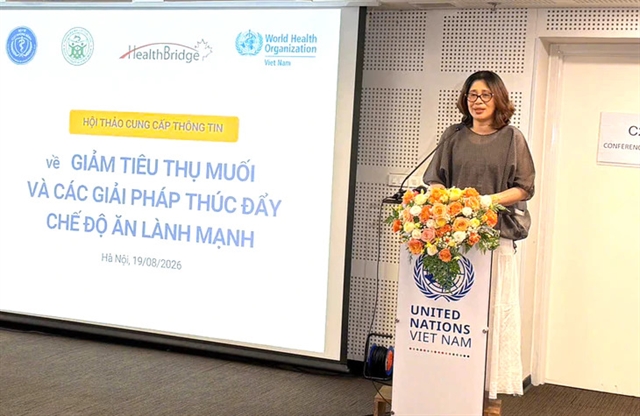
| Dr Lê Thái Hà, deputy head of the Việt Nam Administration of Disease Prevention, speaks at the workshop. — Photo suckhoedoisong.vn |
HÀ NỘI — Excessive salt consumption and overuse in your daily diet can increase the risk of various diseases, particularly cardiovascular disease, hypertension, stroke and chronic kidney disease, said Dr Lê Thái Hà, deputy head of the Ministry of Health’s Việt Nam Administration of Disease Prevention at a health workshop in Hà Nội on Wednesday
The workshop, which provided information on reducing salt consumption for healthy diets, was attended by scientists from the National Institute of Nutrition and the National Institute of Hygiene and Epidemiology as well as doctors from the National Heart Institute at Bạch Mai Hospital, Hà Nội University of Public Health, the Việt Nam Stroke Association and international organisations
Hà said reducing salt consumption is key to helping prevent non-communicable diseases. As non-communicable diseases are on the rise, providing accurate information about the harmful effects of excessive salt intake and providing guidance on adopting healthy lifestyles is urgent
Associate Professor Trương Tuyết Mai, deputy director of the National Institute of Nutrition under the Ministry of Health, said salt consumption among Vietnamese people remains high
In 2015, the average salt intake in Việt Nam was 9.4g per person per day, falling to 8.1g per day in 2023. However, this is still about 1.6 times higher than the WHO-recommended level of less than 5g per day, equivalent to about one teaspoon
High-risk groups, including people with hypertension and diabetes, still consume more salt than the general population, Mai said
Information presented at the workshop shows that Việt Nam is facing an increasing burden of non-communicable diseases, including cardiovascular disease, diabetes, hypertension and cancer. These diseases also account for a large proportion of deaths in the country
Experts said the trend is closely linked to lifestyle-related risk factors and unhealthy diets, particularly high salt consumption and the growing intake of processed foods, fast food and sugar-sweetened beverages
Dr Hà said efforts to prevent the harmful effects of excessive salt consumption should not be limited to healthcare facilities, through consultations provided by health workers after people have developed diseases, but should begin in the community and with the daily meals of every family
Preventing diseases early is a key orientation set out by the Politburo in Resolution 72. Helping people change their behaviour, choose appropriate diets and maintain healthy lifestyles should begin even before diseases emerge, she said
According to Dr Hà, communication plays an important role in raising public awareness and promoting behavioural change. Information on the harmful effects of excessive salt consumption, the benefits of reducing salt intake and ways to adopt a healthy diet should be communicated accurately, clearly and in a manner appropriate to different target groups
Dr Angela Pratt, WHO representative in Việt Nam, said a healthy diet plays an important role in shaping people’s physical and mental health from early childhood through adulthood
She said one worrying trend today is the excessive consumption of unhealthy foods, which is among the major health risks facing Việt Nam and many other countries
Việt Nam is facing an increasing burden of non-communicable diseases such as cardiovascular disease, diabetes and cancer. Unhealthy diets, high consumption of processed foods and fast food containing high levels of fat, salt and sugar, along with rising consumption of sugar-sweetened beverages, are among the key risk factors of concern, she said
The WHO recommends that countries carry out comprehensive, evidence-based policy measures to promote healthy diets and create a healthier food environment
Such measures can not only provide consumers with more information to make healthier food choices, but also help protect children and vulnerable groups from the negative impacts of advertising for unhealthy foods and beverages, she said
Tags
