


Stefani Sassos, M.S., R.D.N., NASM-CPT
Sun, August 16, 2026 at 10:34 AM UTC
Want to know how strong you really are? Try hanging from a bar. It sounds almost too easy to count as a strength test. There are no dumbbells and there is no complicated movement to master. But the moment your feet leave the ground, you find out just how much work it takes to support your own body
That’s why I love the dead hang as a personal trainer. It’s a deceptively simple challenge that puts your grip and upper-body strength to the test and gives you something you can track over time
For women, especially as we get older, that kind of strength matters. Being able to hold your own body weight requires more than strong hands and arms; it’s a basic measure of how well your body can grip, stabilize, and support itself
Why muscle mass and grip strength matter more after age 40
Muscle mass and overall strength naturally change with time, and that process becomes increasingly important to address as we get older. The 40s are also an era of perimenopausal transition for many women, and those hormonal shifts can affect body composition and muscle mass. If you haven’t already started to build a strength reserve, don’t worry—it’s not too late
“Grip strength is one of those things that seems small until you realize how connected it is to overall functional strength and independence,” explains corrective <a href="https://healthylife7.com/jackson-runners-share-how-they-exercise-safely-in-the-summer-heat/” title=”Jackson runners share how they exercise safely in the summer heat”>exercise specialistTatiana Lampa, CPT.“As women age, we naturally want to preserve muscle mass, bone health, coordination, and the ability to perform everyday tasks with confidence. Grip strength plays a huge role in all of our daily activities because your hands are essentially the connection between your body and the load you’re moving.”
You may not realize it, but Lampa says that grip strength factors into many of our daily activities, from carrying groceries to lifting a suitcase, picking up a child, even getting yourself up from the floor. “A strong grip makes all of those actions easier,” she adds
Not only that, but Lampa says that from a training perspective, you can have a very strong lower body and core, but if your grip gives out first, it can limit the amount of strength work you can actually perform. “For women especially, I like to think of grip training as part of a longevity strategy, not just a gym skill.”
What is a dead hang?
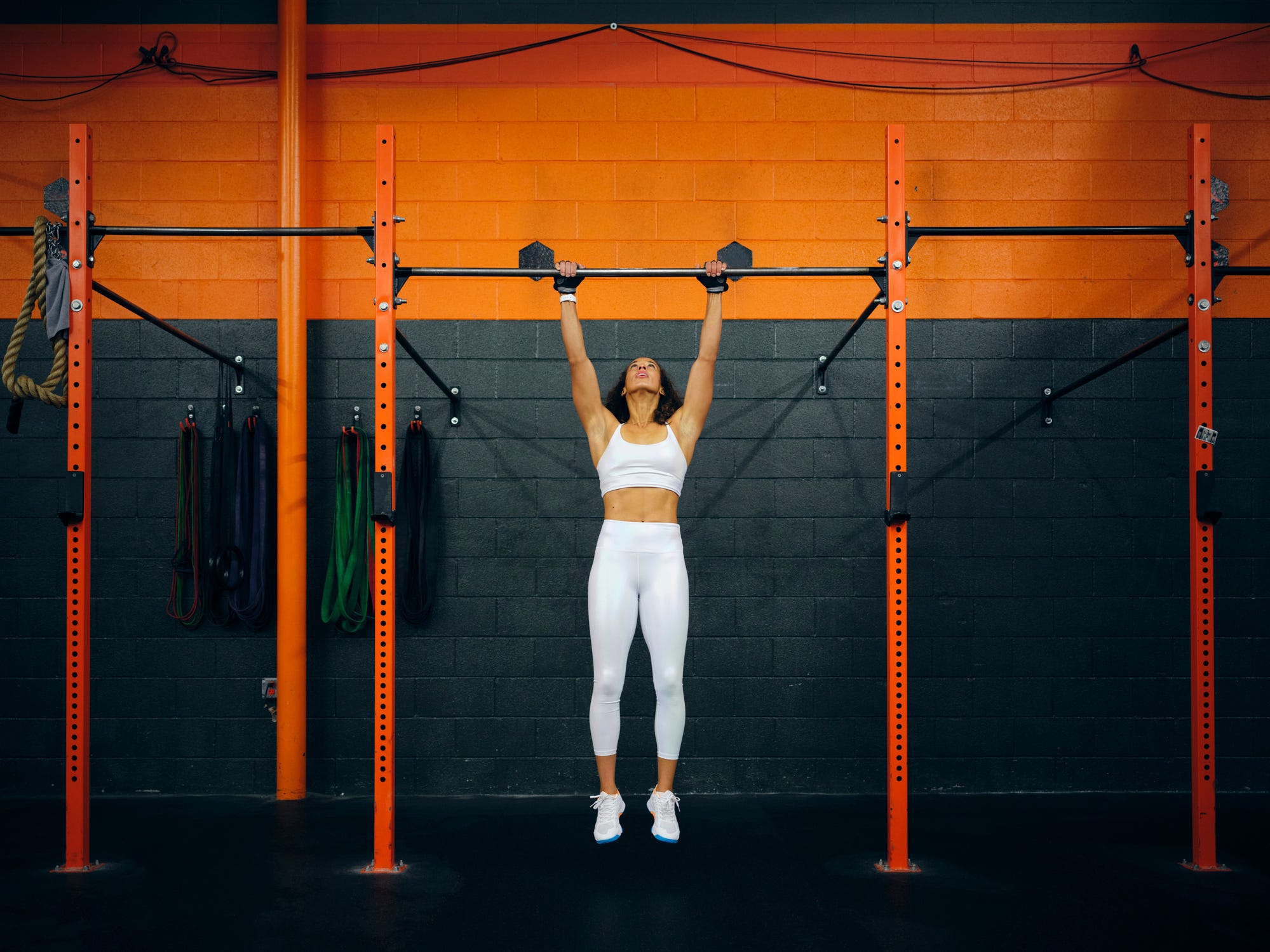
A dead hang involves gripping an overhead bar and allowing your body to hang beneath it with your feet off the ground. The dead hang isn’t a full-body workout, but it combines several components of strength in one deceptively simple movement including:
Grip and forearms: Your fingers, hands, and forearms work continuously to keep you holding on to the bar
Shoulders and upper back: The muscles around the shoulders help stabilize your body while you’re hanging
Core: Your abdominal muscles help maintain control and prevent excessive swinging
One of the biggest mistakes Lampa sees is letting the body completely go once you grab the bar. “A dead hang doesn’t necessarily mean switch everything off. You still want some intentionality through your shoulders and core,” she explains. “I would rather see someone perform a controlled 10-second hang with great positioning than a 30-second hang where they’re losing shoulder control and swinging around.” That doesn’t mean aggressively pulling your shoulder blades down or squeezing them together—the goal is controlled muscular engagement.
How to do a proper dead hang
Before you start, make sure you’re using a sturdy pull-up bar that’s correctly installed and designed to support your body weight
Grip the bar. Use an overhand grip with your hands approximately shoulder-width apart, or slightly wider if that feels better for your shoulders
Lift your feet. Start with your arms straight and your body hanging beneath the bar
Engage your shoulders. Gently draw your shoulder blades away from your ears
Brace your core. Keep your torso controlled and avoid excessive swinging
Breathe normally. Don’t hold your breath
Hold. Stay in the position for as long as you can maintain good form
Come down with control. Don’t simply drop from the bar
Some common mistakes Lampa sees include:
Shrugging aggressively into the ears and not creating space through the neck
Completely relaxing the shoulders, especially if someone doesn’t have good overhead mobility or shoulder control
Having too wide a hand grip, which can make the position unnecessarily difficult
Holding their breath instead of breathing normally
Swinging just to add more time
She also adds that you should feel your hands, forearms, shoulders, and upper back working, but not sharp, pinching, or shooting pain. “There’s an important distinction between ‘this is hard’ and ‘this hurts,’” Lampa advises.If you experience sharp or stabbing shoulder pain, numbness or tingling, significant elbow or wrist pain, or a feeling that the shoulder is unstable, stop and reassess
How long should you be able to hang?
There’s no magic number. I’ve found in my experience as a personal trainer that 30 seconds is a good goal for most women, but you can certainly work your way up to 60 seconds and even 90 seconds. If you’re starting from zero, even five to 10 seconds is a good starting point. And if you can already hang for 20 seconds, work toward 30
Rather than testing your maximum every day, practice several controlled holds with rest between them. “For example, if your current max is 20 seconds, you could do 3 to 4 sets of 10 to 15 seconds rather than repeatedly testing your 20-second maximum,” Lampa advises. “The goal is to gradually increase the amount of work your grip can tolerate.”
Exercises to improve your dead-hang time
If you can’t support your full body weight from a bar, don’t worry. You can build toward it with a few different variations:
Support hang: Place a sturdy box or bench beneath the bar. Grip the bar while keeping your feet on the support. Gradually shift more of your weight into your hands while maintaining control through your shoulders. As you get stronger, use less assistance from your legs
Farmer’s carry:If you don’t have access to a bar, try this exercise instead to start building grip strength. Hold a pair of dumbbells or kettlebells at your sides. Stand tall, keep your core engaged and walk slowly while maintaining your grip. Try 2 to 3 carries of 20 to 40 seconds, resting between sets. As your grip improves, gradually increase the weight or duration. “Farmer’s carry is an exercise that can be super helpful to translate into daily activities like carrying your groceries,” Lampa says. “You can progress with this exercise by adding more load and distance/time as well.”
If your goal is to increase the amount of time you can hang, Lampa recommends training both your overall grip strength and the specific muscles and positions involved in hanging
For grip:
Farmer’s carry
Heavy dumbbell holds
Hex bar deadlifts
Dumbbell or barbell deadlifts
For hanging specifically:
Band-assisted dead hangs
Short unassisted hangs
Scapular pull-ups
Slow eccentric/negative pull-ups
The bottom line
Your 40s are an opportunity to assess your strength. The good news about the dead hang is that it’s simple, requires very little equipment, and is scalable. And it gives you an immediate challenge: Can you support your own body weight?
Start wherever you are, whether that’s five seconds or 30, and build from there. The point isn’t just to hang from a bar, but to be strong enough to carry, pull, hold, lift, and support yourself for the years ahead
Why Trust Good Housekeeping?
Stefani Sassos is a NASM-certified personal trainer, Women’s Fitness Specialist and Behavior Change Specialist with over a decade of experience in the fitness industry. As the fitness director of the Good Housekeeping Institute,she tests exercise equipment and develops informed workout content to help readers lead healthier lives
Tatiana Lampa is a NYC-born fitness professional, certified personal trainer and corrective exercise specialist with over a decade of experience. With a degree in Nutrition & Exercise Sciences, she specializes in helping women build strength, improve movement, and reduce back pain through sustainable training. She is the founder of the Training with T App and a 1:1 online coaching program, and teaches Pilates mat classes and at Tremble. Tatiana has coached hundreds of clients worldwide and worked with leading brands and publications, including Women’s Health, Health, and Good Housekeeping.
You Might Also Like
Eat These Expert-Recommended Foods to Lower Your Blood Pressure Naturally
We’ve Tested Over 300 Sets of Bed Sheets. These Are the Best
