


Feature story
For refugees, churches “need to exercise their prophetic voice”
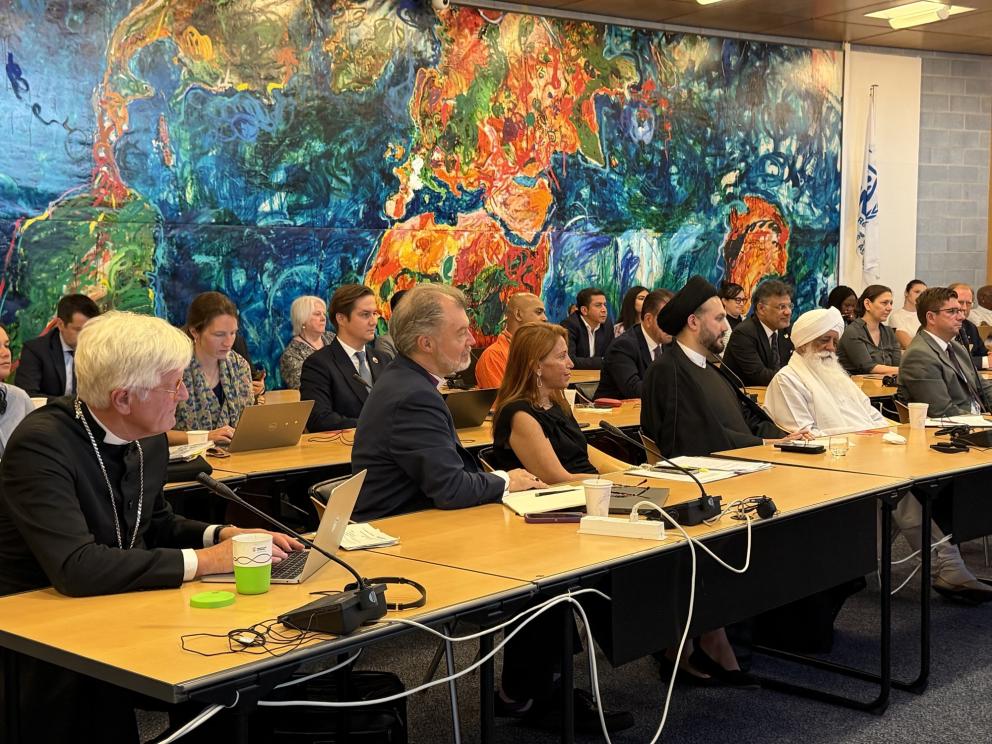
During a panel discussion on “Shared Sacred Flourishing,” religious leaders reflected on why words aren’t enough, what it means to exercise a prophetic voice, and the issue of the misuse of religion.
Image
Marianne Ejdersten/WCC
The dialogue, on 28 July, was organized by Religions for Peace and the UN High Commissioner for Refugees (UNHCR).
H. E. Metropolitan Emmanuel, Elder Metropolitan of Chalcedon, member of the World Council of Churches (WCC) executive committee and chair of the Advisory Board of the Interfaith Alliance for Safer Communities, moderated the discussion.
He noted the importance of journeying with refugees, not speaking for them. “This essence lies hidden in the communities,” he said.
He later added, “Words are not enough,” as he asked the speakers to briefly reflect on what more religious leaders and faith actors can do for refugees, stateless persons, and other displaced people.
Bishop Mark Edington, bishop in Charge of the Convocation of Episcopal Churches in Europe, said that churches can exercise their prophetic voice. “In particular, we need to exercise our prophetic voice to challenge the negative caricatures,” he said. “The question we should ask refugees is not ‘what do you need,’ but ‘tell me your story.’ Because without that we are just having a conversation among ourselves.”
Bishop Prof. Dr Heinrich Bedford-Strohm, moderator of the WCC central committee, spoke out about the misuse of religion. “Looking at the two world superpowers, those leaders are a terrible example of the misuse of religions,” he said, giving the example of Russia and the United States
“In Russia and the United States, the persecution of people is done in the name of Jesus Christ.”
Bedford-Strohm emphasized that churches need to be visible and hearable in public advocacy. “We cannot pray in any way without doing justice, and we need to make that clear, and we need to make it prophetically and publicly hearable.”
In addition to the dialogue, the day included a commemorative event marking the 75th anniversary of the 1951 Refugee Convention
The dialogue brought together partners with the Members of the Multi-Religious Council of Leaders, Religions for Peace, and UNHCR leadership, to explore how values-based approaches can strengthen protection, dignity, social cohesion, and solutions for displaced populations, and provided a space for open exchange between humanitarian actors and faith leaders in a spirit of collaboration. It was also an opportunity to hear more about the “Shared Sacred Flourishing” framework and its relevance to displacement contexts.
WCC to enter Dialogue on Displacement and Shared Sacred Flourishing (WCC news release, 27 July 2026)
WCC, UN Refugee Agency sign historic memorandum of understanding that deepens collaboration (WCC news release, 1 June 2026)
WCC leaders visit UN Refugee Agency (WCC news release, 9 June 2026)
