


Close Menu
healthylife7.comhealthylife7.com

    Subscribe to Updates

    Get the latest creative news from FooBar about art, design and business.

    What's Hot

    Novo ordered to face CagriSema fraud claims from shareholders: New Jersey court

    July 29, 2026

    Scripture engagement linked to greater wellbeing, study finds – Premier Christian News | Headlines, Breaking News, Comment & Analysis

    July 29, 2026

    The No. 1 Sign Your Stress Is Turning Into a Chronic Condition, Per an Internal Medicine Doctor

    July 29, 2026
    Facebook X (Twitter) Instagram
    Trending
    • Novo ordered to face CagriSema fraud claims from shareholders: New Jersey court
    • Scripture engagement linked to greater wellbeing, study finds – Premier Christian News | Headlines, Breaking News, Comment & Analysis
    • The No. 1 Sign Your Stress Is Turning Into a Chronic Condition, Per an Internal Medicine Doctor
    • Psychology says people who constantly look for signs from the universe are just trying to make sense of the uncertain world
    • Forget Weight Loss Drugs: Here’s Another Reason to Buy Eli Lilly Stock
    • STRONG Pilates Accelerates U.S. Expansion with New Studios Across Nine States, Eyes 2027 Growth
    • Ottawa eyes fall rollout for Nutrition North reforms
    • Carly Simon reveals the common condition that masked her Parkinson’s diagnosis
    Facebook X (Twitter) Instagram
    healthylife7.comhealthylife7.com
    • Home
    • Fitness
    • Health
    • Nutrition
    • Lifestyle
    • Conditions
    • Mental Health
    • Weight Loss
    • Wellness Tips
    Wednesday, July 29
    healthylife7.comhealthylife7.com
    Home»Fitness»One long brisk walk may protect your brain from dementia and anxiety more than short walks put together
    Fitness

    One long brisk walk may protect your brain from dementia and anxiety more than short walks put together

    healthylife7By healthylife7July 29, 2026No Comments5 Mins Read
    Facebook Twitter Pinterest LinkedIn Tumblr Reddit WhatsApp Email
    One long brisk walk may protect your brain from dementia and anxiety more than short walks put together
    Share
    Facebook Twitter LinkedIn Pinterest WhatsApp Email

    Editors’ notes
    Add as preferred source

    <img src="https://healthylife7.com/wp-content/uploads/2026/07/one-long-brisk-walk-ma.jpg" alt="One long brisk walk may protect your brain from dementia and anxiety more than short ones put together”>
    Longer daily bouts of moderate-to-vigorous physical activity, such as a brisk walk, were associated with lower future risk of dementia, depression and anxiety. Credit: Pexels.

    Exercise is well known for keeping the brain healthy, but does how we move matter as much as how much we move? In a recent study, researchers investigated whether sustained periods of physical activity offer greater long-term protection against dementia, depression and anxiety than the same amount of activity spread across shorter bursts

    More than 66,000 people contributed movement data through the UK Biobank. Each person wore a device around their wrist, similar to a fitness tracker, for one week, providing an objective measure of daily activity. Their health was then tracked for an average of 7.5 years using hospital records to identify later diagnoses of these conditions. The findings are published in Translational Psychiatry

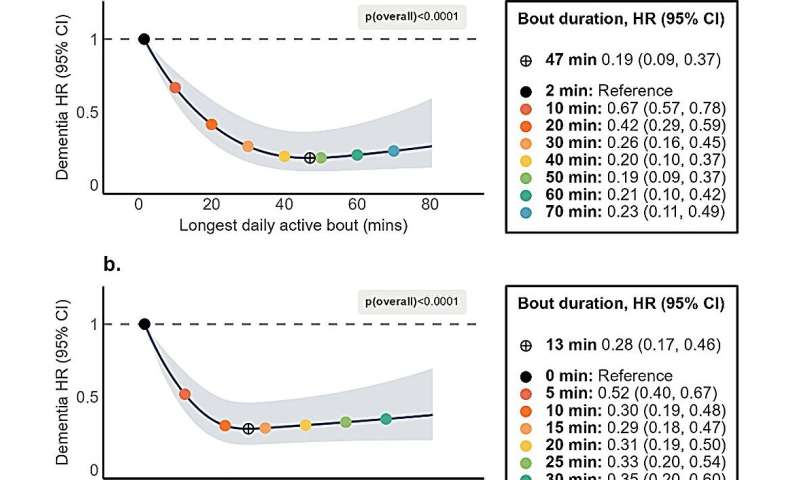
    Those who engaged in longer, uninterrupted periods of physical activity had a significantly lower risk of developing dementia, depression or anxiety later on. Doing just 13 minutes of moderate-to-vigorous physical activity (MVPA), such as a brisk walk, in one continuous session was linked to a 72% lower risk of dementia

    The way people accumulate their daily activity appears to matter for future health. People whose activity was least broken up had an 82% lower risk of dementia, a 57% lower risk of depression and a 52% lower risk of anxiety compared with those whose activity was most broken up. Such sustained activity also went hand in hand with a healthier brain, including larger left hippocampal volume, a brain region tied to memory, and fewer signs of small blood vessel damage on brain scans. These associations were seen regardless of how much total physical activity people did overall.
    One long brisk walk may protect your brain from dementia and anxiety more than short ones put together
    Associations of physical activity bout duration and fragmentation with future dementia. Credit: Translational Psychiatry (2026). DOI: 10.1038/s41398-026-04272-3

    Protective effects of long movements

    Moving more is one of the simplest ways to support a healthier brain, as it has been consistently linked to better cognitive health and a lower risk of mental health conditions. The World Health Organization recommends 150 to 300 minutes of moderate-to-vigorous physical activity each week for better brain health

    Current guidelines tell us how much exercise to aim for, but they don’t say whether it’s better to get it done in one longer session or spread it out through small bursts of movement

    Previous studies using wearable trackers have hinted that more continuous activity may be better for heart health and longevity. But whether these different movement patterns influence brain conditions such as dementia, depression or anxiety has remained largely unknown

    To get a clearer picture, researchers tracked how a large group of people moved each day, then followed their health for several years to see how those patterns affected the brain

    Everyone was between the ages of 40 and 69, with no prior diagnosis of dementia, depression or anxiety. Each wore a wrist device that captured movement 100 times per second, picking up even tiny shifts in activity

    The researchers looked for three parameters: the longest continuous stretch of general movement, MVPA bouts and activity fragmentation. They used official hospital and national health records to see who was eventually diagnosed with the conditions. For a smaller group of 13,108 participants, researchers also used MRI scans to examine brain structure

    • One long brisk walk may protect your brain from dementia and anxiety more than short ones put together
      Study overview. Credit: Translational Psychiatry (2026). DOI: 10.1038/s41398-026-04272-3
    • One long brisk walk may protect your brain from dementia and anxiety more than short ones put together
      Associations of physical activity bout duration and fragmentation with neuroimaging outcomes. Credit: Translational Psychiatry (2026). DOI: 10.1038/s41398-026-04272-3
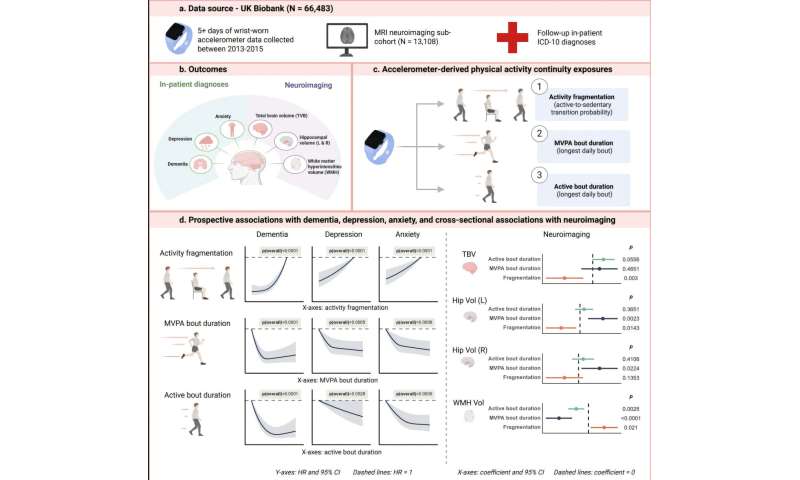

    The data revealed that the pattern and continuity of movement are just as important for brain health as the total amount of exercise. Even if recommended weekly minutes of activity were met, doing so in longer, continuous stretches provided significantly more protection than short, sporadic bursts

    To get the maximum benefit for mental health, the researchers found a sweet spot of 36 minutes of continuous brisk activity, which was linked to a 52% lower risk of depression and a 50% lower risk of anxiety. Brain scans showed that people with the most broken-up (highly fragmented) movement patterns had lower total brain volume compared with those who moved more continuously

    The researchers also wanted to see whether exercise patterns helped certain people more than others. They used blood samples to identify carriers of the APOE4 gene, a known genetic risk factor for Alzheimer’s

    For people without the APOE4 gene, longer stretches of uninterrupted activity lowered dementia risk, but only up to a point, after which the benefit plateaued. For carriers, however, dementia risk kept dropping as their activity became more continuous, with no sign of leveling off

    Dementia, depression and anxiety are among the most serious public health concerns, and this study’s findings point to a low-cost, accessible way to reduce the risk of developing these conditions

    Health campaigns could change their message to match the results. Instead of just telling people to hit a weekly activity target, they could encourage those who can to fit one sustained brisk walk, bike ride or similar continuous activity into their exercise regimen

    Follow us on Google NewsAdd as preferred source

    Science X news — your Follow us on Google News for updates, or set sciencex.com as your preferred

    brisk long protect Walk Your
    healthylife7
    • Website

    Related Posts

    The No. 1 Sign Your Stress Is Turning Into a Chronic Condition, Per an Internal Medicine Doctor

    July 29, 2026

    STRONG Pilates Accelerates U.S. Expansion with New Studios Across Nine States, Eyes 2027 Growth

    July 29, 2026

    Quote of the day by Gavin Newsom, ‘You need to let go of your fear and anxiety of being judged by others’ reveals psychology about letting go of judgment can transform life, teaches timeless lesson that real freedom begins when we stop living for the expectations of others which leads to stronger relationships, mental wellbeing, achievements, fulfillment

    July 29, 2026
    Leave A Reply Cancel Reply

    Health
    Wellness Tips

    Novo ordered to face CagriSema fraud claims from shareholders: New Jersey court

    By healthylife7July 29, 20260

    Novo Nordisk will need to answer allegations that it potentially defrauded shareholders over the next-generation weight loss therapy CagriSema

    Scripture engagement linked to greater wellbeing, study finds – Premier Christian News | Headlines, Breaking News, Comment & Analysis

    July 29, 2026

    The No. 1 Sign Your Stress Is Turning Into a Chronic Condition, Per an Internal Medicine Doctor

    July 29, 2026

    Psychology says people who constantly look for signs from the universe are just trying to make sense of the uncertain world

    July 29, 2026
    Stay In Touch
    • Facebook
    • Twitter
    • Pinterest
    • Instagram
    • YouTube
    • Vimeo
    Fitness

    Opinion: The FDA must put biotech at its center or continue to cede early research to China

    July 6, 2026

    Inside Elevance’s digital chronic disease management strategy

    July 6, 2026

    Best, Worst States For Well

    July 6, 2026

    What do the Middle Ages tell us about mental health then and now? VCU historian Leigh Ann Craig has answers

    July 6, 2026

    Subscribe to Updates

    Get the latest creative news from SmartMag about art & design.

    About Us

    Welcome to HealthyLife7.com, your trusted source for reliable health, wellness, fitness, and lifestyle information. Our mission is to help people make informed decisions about their health by providing clear, practical, and easy-to-understand content.

    At HealthyLife7.com, we believe that good health starts with the right knowledge. Whether you're looking for healthy eating tips, fitness advice, mental wellness strategies, weight management guidance, or information about common health conditions, our goal is to deliver valuable content that supports a healthier lifestyle.

    Fitness

    Novo ordered to face CagriSema fraud claims from shareholders: New Jersey court

    July 29, 2026

    Scripture engagement linked to greater wellbeing, study finds – Premier Christian News | Headlines, Breaking News, Comment & Analysis

    July 29, 2026

    The No. 1 Sign Your Stress Is Turning Into a Chronic Condition, Per an Internal Medicine Doctor

    July 29, 2026
    Health

    Opinion: The FDA must put biotech at its center or continue to cede early research to China

    July 6, 2026

    Inside Elevance’s digital chronic disease management strategy

    July 6, 2026

    Best, Worst States For Well

    July 6, 2026
    Facebook X (Twitter) Instagram Pinterest
    • About Us
    • Contact us
    • Disclaimer
    • Privacy Policy
    • Terms and Conditions
    © 2026 healthylife7.com. Designed by Pro.

    Type above and press Enter to search. Press Esc to cancel.