


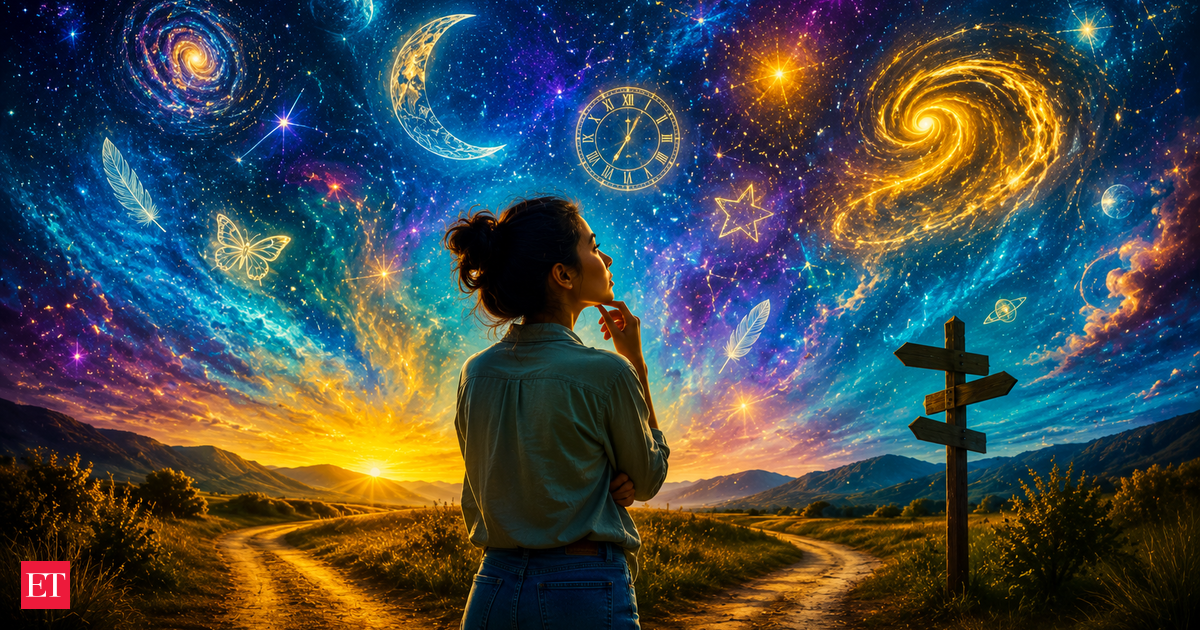
Have you ever thought about someone only for them to call a few minutes later? Or noticed the same number appearing repeatedly and wondered whether the universe was trying to tell you something? Many people describe these experiences as “signs from the universe.” Whether it’s repeatedly seeing angel numbers, hearing the same song at the perfect moment or interpreting a chance encounter as destiny, these experiences often feel deeply meaningful. Psychology does not confirm that the universe sends personal messages, but it does explain why the human mind is remarkably skilled at finding patterns, creating meaning and connecting unrelated events. Researchers say these mental processes are a normal part of how our brains make sense of an uncertain world.
The brain is naturally designed to find patterns
One of the strongest explanations comes from pattern recognition, a basic function of the human brain. Throughout evolution, recognizing patterns helped humans survive by identifying food sources, dangerous animals and changing weather conditions.Sometimes, however, this ability causes us to connect events that may not actually be related. Psychologists refer to this tendency as apophenia, a term introduced by psychiatrist Klaus Conrad. Apophenia describes seeing meaningful connections in random or unrelated information.For example, someone might notice the number 111 appearing on a clock several times in one week and begin believing it has special significance, even though similar repetitions occur naturally.
Confirmation bias reinforces these beliefs
Another important explanation is confirmation bias, one of the best-known concepts in cognitive psychology. People naturally pay more attention to information that supports existing beliefs while overlooking evidence that contradicts them.You Might Also Like:

Psychology says people who wait until the last minute to finish work aren’t lazy, they may thrive under pressure
Imagine someone believes butterflies are signs of good luck. Each time a butterfly appears before a positive event, they remember it vividly. The many occasions when butterflies appear without anything significant happening are far more likely to be forgotten.Over time, this selective attention strengthens the belief that butterflies are meaningful signs, even though the evidence may simply reflect coincidence.
People naturally search for meaning during uncertainty
Psychologists have found that uncertainty increases our desire to make sense of the world. According to Meaning-Making Theory, developed by psychologist Crystal Park, people actively search for explanations when life feels confusing, stressful or emotionally challenging.After a breakup, job loss or major life transition, individuals often become more aware of events that seem meaningful because they are trying to restore a sense of order and purpose.You Might Also Like:

Psychology says hardworking women often use these 8 phrases that are unfairly labeled as ‘rude’
For example, someone who unexpectedly receives encouraging advice from a stranger during a difficult period may interpret the encounter as a meaningful sign because it helps them understand their situation emotionally.
Coincidences can feel deeply significant
Swiss psychiatrist Carl Jung introduced the concept of synchronicity, describing meaningful coincidences that appear connected without an obvious causal explanation.While synchronicity remains influential in psychology and psychotherapy, it is considered a philosophical framework rather than an empirically established scientific theory. Modern psychologists generally explain these experiences through cognitive processes such as attention, memory and pattern recognition.For example, thinking about an old friend just before receiving a message from them can feel extraordinary. Yet psychology suggests our brains naturally remember unusual coincidences while forgetting the countless thoughts that are never followed by similar events.
The mind often creates stories to understand experience
Human beings are natural storytellers. Cognitive psychologists explain that the brain constantly organizes events into narratives that help explain what is happening. This process relates to Narrative Identity Theory, developed by psychologist Dan McAdams, which suggests people build personal stories that give their lives coherence and meaning.When someone believes a particular coincidence represents guidance, that interpretation may become part of their broader life story, helping them feel more hopeful, resilient or purposeful.For instance, receiving an unexpected opportunity shortly after making a difficult decision may be remembered as confirmation they were “on the right path,” even if many practical factors also contributed to the outcome.
Believing in signs can sometimes provide comfort
Psychologists emphasize that finding personal meaning is not necessarily harmful. Research on positive psychology shows that meaning and optimism often contribute to resilience during stressful times.However, psychologists also encourage balancing intuition with critical thinking. Making important life decisions solely because of perceived signs may lead people to ignore practical evidence, expert advice or objective information.The healthiest approach is often to see meaningful experiences as opportunities for reflection rather than definitive proof that the universe is directing every event. Whether someone interprets those experiences spiritually, philosophically or psychologically depends on their individual beliefs. What psychology makes clear is that the human mind is remarkably skilled at transforming ordinary events into meaningful stories that help us navigate life’s uncertainties.
Does psychology believe the universe sends signs?
Psychology does not provide evidence that the universe objectively sends personal signs. Instead, it explains why people naturally notice patterns, coincidences and meaningful events.
Why do coincidences sometimes feel so meaningful?
Because the brain is designed to recognize patterns, create narratives and search for meaning, especially during uncertain or emotionally significant periods.Add 
as a Reliable and Trusted News Source

Add Now!
(You can now subscribe to our Economic Times WhatsApp channel)
Read More News on
signs from the universepsychology of coincidencespattern recognition psychologyconfirmation biascognitive psychology
(Catch all the US News, UK News, Canada News, International Breaking News Events, and Latest News Updates on The Economic Times.)
Download The Economic Times News App to get Daily International News Updates
…moreless
(You can now subscribe to our Economic Times WhatsApp channel)
Read More News on
signs from the universepsychology of coincidencespattern recognition psychologyconfirmation biascognitive psychology
(Catch all the US News, UK News, Canada News, International Breaking News Events, and Latest News Updates on The Economic Times.)
Download The Economic Times News App to get Daily International News Updates
…moreless
