


Franklin County Health Department investigating several Legionnaires’ disease cases in Franklin County
Published 7:26 pm Thursday, July 30, 2026
The Franklin County Health Department (FCHD) announced Wednesday that it is investigating several cases of Legionnaires’ disease in Franklin County
“Although the number of cases remains low FCHD’s Environmental and Epidemiology teams are working closely with the Kentucky Department for Public Health and community partners to determine whether there are any common exposures oras been identified.”
Frankfort Plant Board announced Thursday in a press release that is aware of the reported cases of Legionnaires’ disease in Franklin County and is coordinating with the FCHD as it investigates the cases
“At this time, there is no indication that FPB’s public water system has been identified as the is committed to providing safe, high-quality drinking water and will continue to work closely with the Franklin County Health Department while monitoring our water system. We will share additional information as it becomes available.”
The Farmdale Water District also released a statement indicating that the district is aware of the Legionnaires’ disease cases in Franklin County
“Farmdale Water District complies with all Kentucky Division of Water testing requirements,” according the a press release. “At this time, there are no indications that Farmdale Water District’s water distribution system is the
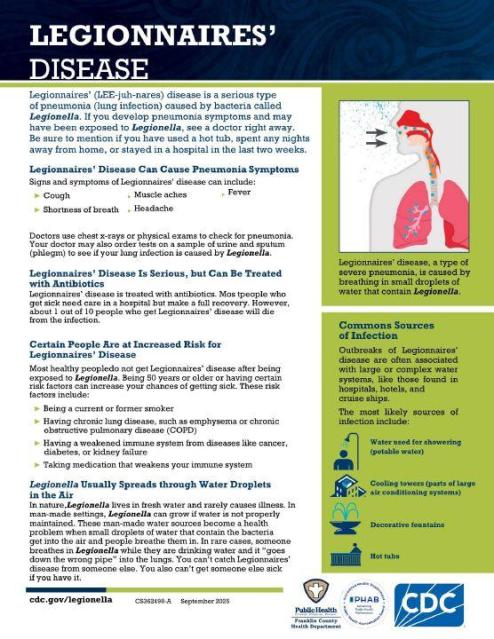
The risk of Legionnaires’ disease to the public is low, according to the FCHD. Legionnaires’ disease is not contagious and is not known to spread from person to person. This illness is caused by exposure to Legionella bacteria. Most people who are exposed to Legionella bacteria do not get sick. Those who develop Legionnaires’ disease usually recover after taking antibiotics as prescribed
Legionella bacteria occur naturally in water and can be found in both natural water sources, such as streams and groundwater, and man-made water systems. Any system or device containing nonsterile water has the potential to support Legionella growth. The bacteria thrive in large, complex water systems, particularly those with extensive plumbing networks, water heaters, storage tanks, stagnant water or inconsistent maintenance. These conditions are more commonly found in large buildings with complex plumbing systems.
People can develop Legionnaires’ disease, a serious form of pneumonia, or Pontiac Fever, a milder respiratory illness, after breathing in small water droplets (mist) containing Legionella bacteria
Common
•Showerheads and sink faucets
•Hot tubs
•Decorative fountains and water features
•Large, complex plumbing systems
•Buildings under construction
•Cooling towers
•Water main breaks
•Windshield wiper fluid reservoirs in vehicles
•Recent (within the last two weeks) overnight stays at hotels, resorts, cruise ships or hospitals
People at increased risk for Legionnaires’ disease include:
•Adults age 50 and older
•Current and former smokers
•People with chronic lung disease (e.g., COPD, emphysema)
•People with weakened immune systems due to conditions such as diabetes, cancer, or cancer treatment
•People with certain underlying medical conditions, including kidney or liver disease
Symptoms of Legionnaires’ disease include:
•Fever
•Cough
•Shortness of breath
•Muscle aches
•Headache
•Pneumonia, which often requires hospitalization
•Less commonly, diarrhea, nausea or confusion
Anyone experiencing these symptoms should contact their healthcare provider for evaluation and possible testing. People without symptoms do not need to be tested
Steps you can take to reduce your risk:
•Regularly clean and disinfect household devices that produce water mist, such as showerheads, misters, humidifiers and hot tubs
•Flush faucets and showerheads that have not been used for a week or longer, or after noticing a significant drop in water pressure, before using them again
•Set your water heaters to 140˚ F and regularly flush them according to manufacturer’s recommendations. To reduce the risk of scalding, take precautions to mix cold and hot water
•Clean and maintain devices that use water, including CPAP equipment, tubing, neti pots and nasal rinse devices, according to manufacturer’s instructions
For more information about Legionnaires’ disease, visit the Franklin County Health Department or the Centers for Disease Control and Prevention (CDC) at https://www.cdc.gov/legionella/index.html
