


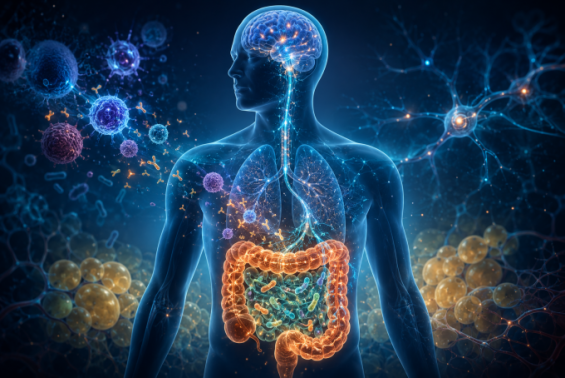
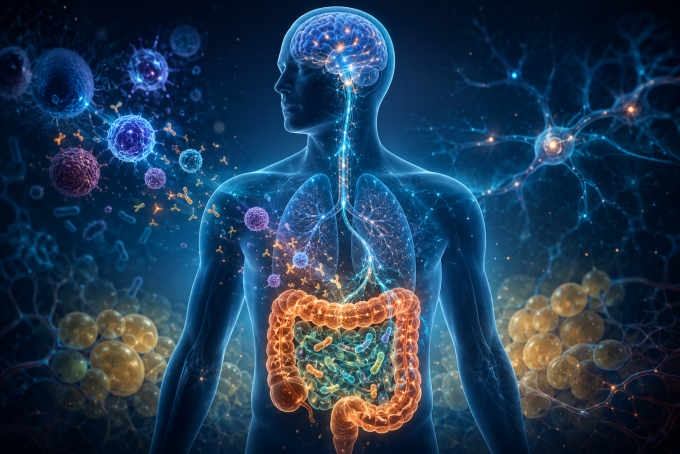
An illustration of the gut–brain–immune axis showing how the gut microbiome affects metabolism, immune responses, and brain function. Generated by generative AI.
Countless microorganisms gather in our gut and form an ecosystem. They not only help digest food, but also influence metabolism, immune responses, and brain function. In recent years, researchers have been trying to treat conditions ranging from obesity and cancer to depression by altering the composition of the gut microbiome
● Can it reduce obesity and boost anticancer drug efficacy?
A representative therapy using the gut microbiome is fecal microbiota transplantation (FMT), in which microbes are isolated from the stool of healthy donors and introduced into a patient’s gut. The area where the therapeutic benefit is currently clearest is certain intestinal diseases, such as Clostridioides difficile infection that repeatedly recurs even after antibiotic treatment. The principle is to transplant a healthy microbial ecosystem and restore a gut environment dominated by harmful bacteria to something close to normal.
Researchers are also working to expand this therapeutic field to obesity. A joint team from Anhui Medical University in China and Tokyo Metropolitan University in Japan transplanted gut microbes from musk shrews, which are resistant to obesity, into mice that had been made obese by a high-fat diet.
Mice that received the microbiota transplant showed changes in their gut microbial ecosystem and tended to have lower body weight than controls. The study results were published on November 22, 2023, in the international journal PLOS ONE
However, findings from human studies have not been consistent. In some obese adolescents, abdominal fat decreased, but body mass index (BMI) did not change significantly, and clinical trials in obese adults did not show a meaningful weight-loss effect. In other <a href="https://healthylife7.com/a-word-on-the-word-praying-with-real-words-abs/” title=”A Word on the Word: Praying with real words | ABS”>words, microbiota transplantation is unlikely to replace anti-obesity drugs anytime soon
In cancer treatment, FMT has been proposed as a strategy to enhance the effectiveness of immune checkpoint inhibitors. A team led by Professor Park Sook-ryeon at Asan Medical Center in Seoul and Professor Park Han-su at Gwangju Institute of Science and Technology (GIST) transplanted gut microbiota from patients who had responded well to immune checkpoint inhibitors into 13 patients with gastric, esophageal, or liver cancer who had developed resistance to these drugs
As a result, one patient showed partial remission with tumor shrinkage, and five patients maintained stable disease, with no further tumor progression. The researchers also identified a gut bacterium, Prevotella merdae immunoactivis, that appears to promote antitumor immune responses. This study was published on July 25, 2024, in the international journal Cell Host & Microbe
That said, this was an early-stage study with only 13 participants, and treatment outcomes varied depending on the stool donor. The findings should be interpreted as evidence that gut microbes may serve as an adjunct that revives the effects of immune checkpoint inhibitors in some patients, rather than directly eliminating cancer
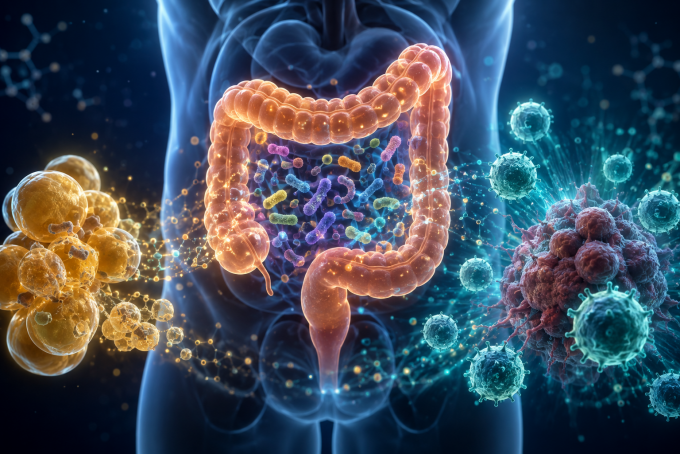
An illustration of how changes in the gut microbiome influence lipid metabolism and the antitumor responses of immune cells. Generated by generative AI.
● The gut microbiome also affects the brain
Research is also underway on treating depression by harnessing the gut–brain axis, through which the gut and brain influence each other
A team led by Senior Researcher Jeong Hye-jong at the Korea Basic Science Institute (KBSI) found that the bacteria Intestinimonas butyriciproducens and Parabacteroides merdae were reduced in mice exhibiting severe depression-like behavior. When the team fed these two microbes to mice, depression-like behaviors decreased, and expression of brain-derived neurotrophic factor (BDNF), which is involved in neuronal survival and growth, was restored. The results were published online on May 28, 2026, in the international journal Pharmacological Research.
The study proposed a mechanism by which specific gut microbes influence the brain by modulating oxidative stress and mitochondrial function, but it remains a preclinical study using mice and cells. Its effectiveness in treating depression in humans has not yet been demonstrated
The biggest challenge in gut microbiome therapy is that each individual has a different microbial composition. Even when the same microbes are transplanted, effects can vary depending on diet, genetic traits, and concomitant medications. There is also a risk of transmitting pathogens or antibiotic-resistant bacteria through stool, so donor screening and standardization of manufacturing and administration procedures are essential
At present, gut microbiome therapies remain largely in the stage of testing possibilities, except for a few intestinal diseases. Going forward, researchers will need to accurately identify microbes and metabolites that exert therapeutic effects for each disease, and verify efficacy and safety through large-scale clinical trials.
The gut microbiome is more likely to become a new therapeutic tool that complements the limitations of existing treatments than a panacea that cures every disease
※ Reference
doi.org/10.1371/journal.pone.0293213
doi.org/10.1016/j.chom.2024.06.010
doi.org/10.1016/j.phrs.2026.108269
Copyright ⓒ DongA Science. All rights reserved.
