


Download PDF
Abstract
Background
Hospitals worldwide face workforce shortages, making an understanding of early-career health dynamics central to addressing recruitment and retention challenges. This study examines whether early-career health trajectories among hospital-employed nurses and midwives differ from those of workers in other industries
Methods
Using Danish nationwide register data, we conduct a longitudinal cohort study of newly educated individuals entering the labour market between 2010 and 2015. To reduce selection bias, we emulate a target trial by constructing an inception cohort with limited prior labour market exposure and no prior history of the outcomes of interest. Matching is applied to construct the final study population of 8,752 graduates. Health trajectories are analysed over six years using fixed-effects event study models. Secondary analyses examine trajectories around exit from hospital employment.
Results
We show that hospital-employed nurses and midwives develop fewer recorded mental health conditions (up to 1.3 percentage points lower annual risk), more back disorders (up to 0.6 percentage points higher annual risk), and higher levels of long-term sick leave (up to 2.8 percentage points higher annual risk) than matched workers in other industries. Excess back disorders and long-term sick leave attenuate after four years. Secondary analyses suggest health-related selection into exit, as health improve following exit from hospital.
Conclusions
Hospital-employed nurses and midwives experience worse early-career health trajectories than comparable workers in other industries. Lower recorded mental health conditions should be interpreted cautiously, as elevated sick leave may capture early or unrecognised distress. Overall, the findings have implications for building a sustainable hospital workforce
View this article’s peer review reports
Subjects
- Health care
- Health occupations
- Risk factors
Introduction
There is a growing staffing crisis in the hospital sector worldwide. In high-income countries, the crisis is primarily related to recruitment and retention1,2,3. In the UK, this phenomenon is referred to as the ‘Great Resignation’4. This development raises concerns about whether employment in the hospital sector has become less attractive relative to other industries, potentially reflecting the underlying working conditions and occupational exposures that characterise hospital work
Hospital work is characterised by high emotional demands, heavy workloads and substantial physical strain—stressors that have been linked to adverse health outcomes and reduced well-being5,6,7,8,9,10,11,12,13,14. These associations can be understood through several central work-environment mechanisms. First, high emotional demands, arising from continuous exposure to patient suffering or dying, have been linked to increased risks of sickness absence and depression6,15,16. Second, physically demanding tasks, such as patient handling and repetitive strain, are associated with back disorders, which may further affect labour market participation12,17. Third, working time arrangements, such as long hours, shift work, and night work, have been shown to adversely affect sleep, mental health, and sickness absence18,19. Finally, hospital work is embedded in a predominantly female workforce, and evidence suggests that female-dominated occupations are associated with higher rates of sickness absence, partly reflecting differences in working conditions and occupational structures20,21.
Between 2007 and 2018, the Danish hospital sector was subject to a financial regulation which punished hospitals that did not reach a 2% annual increase in productivity as measured against the preceding year. One of the objectives of this policy was to reduce waiting times, and the productivity of Danish hospitals increased substantially and waiting times were reduced during this period22. This period may have been subject to increased work intensity, although we are not aware of any studies that have assessed this hypothesis22. However, Danish survey data from 2012 to 2018 suggest that the simultaneous exposure to high emotional demands and high workload and time pressure is highest in the hospital sector − 58% of hospital-employed respondents to the survey report high emotional demands as well as high workload and time pressure23. This type of work intensity is associated with greater risks of depressive symptoms (hazard ratio 2.44 (2.02; 2.96)) and long-term sick leave (hazard ratio 1.5 (1.33; 1.70)) per self-reported health status23. These working conditions may lead to deteriorating health and reduced labour market attachment, thereby contributing to workforce shortages in the hospital sector.
Previous research has examined health outcomes among healthcare workers, including mental health, sickness absence, and mortality. For example, studies have documented differences in mental health trajectories14,24 and sickness absence across occupations13. Evidence on mortality further suggests that healthcare work, relative to non-healthcare work, is associated with lower hazards of death from cardiovascular diseases and lung cancer, but higher hazards of death from external causes25
However, evidence on how health trajectories differ across industries remains limited in important respects. Concerns about reverse causality and selection into occupation complicate causal interpretation, as health status may influence both occupational choice and subsequent employment trajectories, for instance, leading to exit among less healthy workers and continued employment among healthier workers, the well-known “healthy worker effect” (HWE)10,26
Analysing health trajectories in a young, early-career cohort is therefore critical. Early exposure to hospital work may influence both subsequent health and retention, and even modest increases in early exit can translate into substantial losses of workforce person-years. Understanding these early-career dynamics is therefore central to addressing ongoing recruitment and retention challenges in the hospital sector
In this longitudinal register-based cohort study, we address this gap by comparing the health trajectories of newly qualified nurses and midwives employed in hospitals with a control group of individuals entering other industries. To reduce selection bias, we adopt a target trial emulation (TTE) framework27. First, we construct a young inception cohort of individuals with minimal prior labour market exposure and no recorded health outcomes in the two years before labour market entry. This design reduces bias from HWE by reducing historical exposure. Second, matching on key observable characteristics is used to define the control group to reduce selection. Third, we apply fixed-effects event study models to account for time-invariant unobserved differences between individuals and to assess dynamic effects over the early career.
Our results show that newly educated hospital-employed nurses and midwives develop fewer recorded mental health conditions, more back disorders, and a higher occurrence of long-term sick leave compared with a matched control group of employees in other industries. The excess incidence of back disorders and sick leave tends to diminish after four years of follow-up. Secondary analyses of health trajectories around exit from hospital work suggest that this pattern is partly driven by health-related selection into exit, as health outcomes appear to improve following departure from hospital employment. While recorded mental health conditions appear lower, this finding should be interpreted with caution, as elevated levels of sick leave may capture early or unrecognised distress.
Methods
Setting
The study is conducted in Denmark, which has a tax-funded healthcare system with universal coverage. Danish hospitals are publicly administered and employ healthcare workers under nationally negotiated contracts with no or limited regional variation22. Public hospitals alone account for around 4% of the total Danish workforce28. The hospital workforce consists of employees from heterogeneous professions with varying levels of education, who are subject to different working conditions and contractual arrangements. In 2019, Danish hospitals employed approximately 35,200 nurses, 6000 nurse assistants, and 1700 midwives, along with 17,500 physicians and other healthcare staff who serve a population of around 5.8 million people29. Nurses and midwives are the only professions with the same level of education and comparable conditions. They both require a bachelor’s degree in their respective field. The two trade unions were part of the same negotiation and cooperation community until 2020, for which reason the two professions were included in the same working time agreement and were subject to quite comparable contracts and working conditions when employed in hospitals30,31.
Our study is subject to several potentialality, the HWE, and health-related attrition from employment. We address these through a combination of design and analytical strategies
First, we construct an inception cohort of newly educated individuals with the same length of education entering the labour market within 180 days of graduation. We apply a two-year look-back period and exclude individuals with prior outcomes or recent hospital employment. This approach reduces baseline selection, the risk of reverse causality, and pre-existing healthy worker bias. For details on the construction of the inception cohort, see the Study population section
Second, to reduce selection and occupation choice, we apply coarsened exact matching (CEM) on key observables, ensuring comparability between treatment and control groups (see the Matching section). In addition, we employ individual fixed-effects event study models to account for time-invariant unobserved characteristics and personality traits, further reducing bias related to occupational choice (see the Main analysis section)
Finally, by defining exposure at labour market entry and following individuals irrespective of subsequent job mobility, we avoid conditioning on post-baseline employment and thereby limit bias related to the HWE. We further explore health trajectories around exit from hospital employment to assess potential bias from health-related attrition (see the Secondary analysis section)
Study population
We identify an inception cohort of individuals at the very beginning of their labour market exposure, i.e. individuals who graduate from an undergraduate programme and enter the labour market within 180 days of graduation. This is done to mitigate healthy worker bias while allowing us to observe its emergence during the follow-up
Next, we split the cohort into a treatment group of nurses and midwives entering their first hospital job and a control group of individuals with the same educational level entering other industries. Focusing on newly educated individuals establishes a common ‘time-zero’ at labour market entry. The cohort includes undergraduate graduates from 2010 to 2015 observed over an eight-year period (two years pre-baseline and six years post-baseline)
In line with the suggestions in the TTE literature27, we exclude individuals with any recorded outcome prior to baseline. We use a two-year look-back period. We also exclude individuals above the age of 30 at the time of employment after graduation to reduce potential effects of prior labour market exposure. Individuals in the control group who have been employed in the hospital industry within two years before the baseline are also excluded
Physicians and other healthcare workers are not included, as differences in educational length and timing of labour market entry would require separate matching strategies and study populations. To preserve comparability within the target trial emulation framework, the analysis is restricted to nurses and midwives with similar educational length and comparable employment conditions
Data sources
This study is based on longitudinal data from Danish registers covering the period 2008–2020. All residents in Denmark have a social security number, which enables us to identify and follow individuals through the Danish registers. The Danish Working Hour Database (DAD), based on data from the Danish Regions’ payroll systems32,33, allows us to identify hospital employees. The Danish Education Register contributes with the educational level, including the date of graduation34, while the Danish Register for Evaluation of Marginalization (DREAM) contributes with the week of employment in a certain industry.
Outcome variables
Danish nationwide registers provide comprehensive and comparable measures of health outcomes. Universal healthcare access and general practitioner (GP) gatekeeping reduce variation in healthcare utilisation across population groups, supporting the use of register-based diagnoses and healthcare contacts as proxies for underlying health
As we are interested in the health trajectories of health outcomes related to occupational exposure, we use various measures of mental and physical health. While hospital employment may involve a wide range of occupational hazards, our study focuses on health conditions that are long-term, clinically recorded, and potentially consequential for continued labour market participation. Moreover, restricting analyses to outcomes measurable independently of workplace reporting systems improves comparability between hospital employees and workers in other industries. Since some types of work-related health deterioration may not involve healthcare utilisation, we also include sick leave as a broad health outcome. To assess the robustness of our results on the different outcomes, we apply several measures of mental health and two measures of long-term sick leave.
Mental health
As an outcome for mental health deterioration we use a compound measure, which has previously been used in a Danish study35. To assess the robustness of the measure of mental health, our mental health outcome is divided into three categories that reflect minor, moderate, and severe mental health conditions35. The outcomes are measured by mental health diagnosis and use of mental healthcare services, which are based on psychiatric admissions, ICD-10 diagnoses and outpatient contacts identified in the Danish National Patient Register (DNPR)36, the use of medications drawn from the Danish National Prescription Registry37,38, services at a GP and contacts with private psychologists using the Danish National Health Service Register (HSR)39. The detailed algorithms used to define the three categories of mental health conditions are shown in Table 1.
Back disorders
Our physical health outcome only reflects diagnosed back disorders and is based on the ICD-10 diagnoses identified in the DNPR36. The type and date of hospital diagnosis are identified in DNPR using the primary diagnoses of ICD-10, including back disorders affecting the entire back (DM42*, DM43*, DM47*, DM48*, DM495, DM50*, DM51*, DM53*, DM54*, DM809C, DM96*, DM99* and DS13*). The outcome is dichotomised and equals 1 when meeting the criterion of having at least one of the ICD-10 diagnoses listed above in a given year. Since we only include diagnosed back disorders, this outcome reflects severe back disorder.
Long-term sick leave
Long-term sick leave is defined as more than four weeks of absence. Weekly data on long-term sick leave are obtained from DREAM, comprising all transfer incomes and labour market affiliations of Danish residents since 199140. Individuals receiving compensation for sick leave as a transfer income appear in this register. In Denmark, employers can apply to receive sick leave compensation from the municipalities. The refund is possible after employees have experienced sickness absence for a given minimum period (since 2012 > 30 days)41. Employees in Denmark with chronic diseases or medical conditions that may lead to increased sick leave may be subject to specific legal provisions. Under this rule, employers have a statutory right to receive sick leave compensation from the first day of absence. Long-term sick leave can result from various factors, including environmental exposure in the workplace. Both physical and psychosocial stressors contribute to sickness absence, with women experiencing sickness absence due to mental health conditions more frequently than men42. One recent Danish study highlights a strong association between employment in occupations with higher emotional demands and sickness absence among women43. In addition, uncomfortable work positions, as well as tasks that involve carrying, pushing, or pulling heavy loads, have been found to increase the risk of long-term sick leave onset44. Hence, incorporating long-term sick leave as an outcome measure provides an important advantage when relying on register data. Sick leave can capture less severe health symptoms that do not necessarily require the use of healthcare services. This is particularly relevant for mental health conditions, for which stigma can discourage individuals from seeking healthcare through conventional pathways. Moreover, sick leave may account for undiagnosed health conditions resulting from an unfavourable physical work environment.
Confounding variables
We use several covariates to assess confounding in our methodological approach. The Population Register, which draws on the Danish Civil Registration System45 provides information on the demographic covariates: age, sex, ethnicity, marital status, number of children and municipality of residence. The information on disposable income is sourced from the Income Statistics Register46. Health capital is approximated by the GP-related costs and costs related to other healthcare providers in the primary sector (sourced from the Danish National Health Service Register), pharmaceutical costs (identified through the Danish National Prescription Registry), and hospital-related costs based on the sum of diagnosis-related group costs (DRG) related to hospital contacts (sourced from DNPR). The DRG system is employed in healthcare financing, including inter-regional settlements, proximity financing schemes and municipal co-financing. It comprises two fundamental components: grouping logic and DRG tariffs 47.
Statistical analyses
A descriptive comparison of health outcomes and sick leave trajectories between all hospital employees and workers in other industries would be biased by the healthy worker effect (HWE) and selection related to occupational choice. Our analytical strategy therefore aims to reduce these biases
The empirical approach follows a two-step strategy. First, the inception cohort and matching procedure are used to improve comparability between groups. Second, we apply fixed effect models to further control for time-invariant unobserved heterogeneity related to occupational selection10,11,48
Matching
We use coarsened exact matching on relevant observables, as occupational choice may reflect systematic personality traits that may be associated with future health trajectories. As the treatment group consists of more than 90% female employees, matching on sex is paramount. Previous studies have found that the impact of different working conditions on mental health differs by age and sex48,49,50,51, which is why we also match exact on age
Occupational choice may also be related to systematic variation in lifestyle and leisure activities. In Denmark, lifestyle factors vary highly among Danish municipalities. The share of physically inactive inhabitants, for example, varies from 11% in the most active municipality to 26% in the least active municipality52,53. Matching on municipality of residence is therefore used as a proxy to control for important lifestyle-related confounding. Finally, some studies report that family structures that involve marital status and parenthood are associated with our outcome of interest54. We therefore also control for marital status and the number of children.
In addition, we match on GP-related healthcare costs prior to baseline, implemented using coarsened bins. This variable serves as a proxy for underlying health status and healthcare utilisation patterns, thereby capturing differences in primary care use across individuals. We assume that matching on GP-related costs improves balance on other healthcare measures, such as hospital-related costs and pharmaceutical expenditures. We therefore do not match on these variables directly, as doing so would substantially reduce the study sample size.
Income is a well-established socioeconomic indicator associated with disease incidence55. However, our study population is still enrolled in education prior to index, and most individuals receive the Danish student grant (SU) during this period. As a result, baseline income provides limited information about underlying socioeconomic position and would not meaningfully improve comparability. For this reason, we do not match on income
Based on the arguments above, we match on age, sex, non-Danish ethnicity, marital status, number of children, municipality of residence, the year of employment and GP-related healthcare costs, and assess post-matching balance in both the matched and additional mentioned variables
Continuous variables are not categorised, with the exception of GP-related costs, which are coarsened into bands as part of the coarsened exact matching procedure
Main analysis: fixed effect event study model
We define a fixed effect event study model that allows the effects of hospital employment to vary over the six follow-up periods. The model is defined as:
$${Y}_{im}={alpha }_{i}+{sum }_{m=1}^{6}({delta }_{m}HOS{P}_{i}cdot POS{T}_{m})+POS{T}_{m}+{varepsilon }_{im}$$
(1)
Where Yim is the outcome for individual i in follow-up period m (m = 0, …, 6), with m = 0 denoting the baseline observation. αi captures individual fixed effects. HOSPi is an indicator for hospital employment, and POSTm denotes follow-up periods
The interaction term HOSPi ⋅ POSTm captures the differential evolution of outcomes for hospital-employed individuals relative to the control group over time, with δm representing the effect m years after labour market entry
As baseline outcomes are zero for all individuals by construction, post-employment outcomes are interpreted relative to a common zero baseline
Robustness analysis: homogeneous comparison group
As a robustness check, we re-estimate the analyses using an alternative control group consisting of employees in the education and social care sectors (Industry codes 85*, 87*, and 88*), covering teaching, residential care, and non-residential social services. This group represents female-dominated public-sector occupations with relatively high emotional and physical demands and shift work, providing a more homogeneous comparison group in terms of gender composition and working conditions
This specification allows us to assess whether the main findings are driven by broader sectoral characteristics, such as emotional labour or workforce composition, rather than hospital employment per se. If the results remain consistent, this would strengthen the interpretation that early-career hospital employment is associated with distinct health trajectories. Conversely, if the estimates attenuate, this would suggest that the observed differences partly reflect more general sectoral or occupational characteristics rather than hospital-specific factors.
Secondary analysis: health trajectories around exit from hospital employment
To assess whether potential bias from health-related attrition could contribute to the observed dynamics, we conduct a secondary analysis restricted to hospital-employed nurses and midwives, as information on exit from the initial industry is not available for the control group
In this analysis, exit from hospital employment is treated as the event of interest. Individuals who leave hospital employment during follow-up are compared to those who remain continuously employed in hospitals. We estimate differences in health trajectories over time using a staggered difference-in-differences design with multiple time periods, applying the estimator proposed by ref. 56. This approach compares pre-exit and post-exit changes in outcomes between those who leave hospital employment (treated) and those who remain employed (controls of never treated). The outcomes correspond to the same health measures used in the main analysis. As exit from hospital employment is not an exogenous intervention but may be influenced by prior health, the results should be interpreted descriptively as differences in health trajectories around the timing of exit rather than as causal effects of leaving hospital employment.
Ethics approval and consent to participate
The analyses are based on administrative register data. In Denmark, studies relying exclusively on register information are exempt from formal ethical review. Data access was granted by Statistics Denmark and handled under their secure data access procedures. As no identifiable individual information was involved, informed consent was not required
Results
Study population
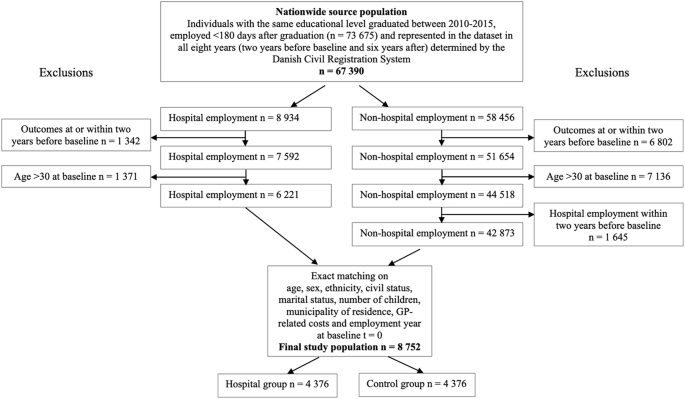
Figure 1 illustrates the cohort construction. The initial population comprises 67,390 individuals, of whom 8934 are hospital-employed, and 58,456 are employed outside hospitals. After applying the exclusion criteria, 6221 hospital-employed and 42,873 non-hospital-employed individuals remain. Following matching on age, sex, non-Danish ethnicity, marital status, number of children, municipality of residence, year of employment, and baseline GP-related healthcare costs, the final analytical sample comprises 8752 individuals.
Flow diagram of cohort construction, inclusion and exclusion criteria, and the matching procedure
The cohort construction process is illustrated in Fig. 1
Descriptives
Table 2 shows differences in baseline characteristics, both matching variables and other potential confounders, between the hospital group and the control group before and after matching. Before matching, the most notable difference is that 96% of the hospital-employed group is female, compared with 54% of the control group. The hospital group is also more likely to be married, of Danish ethnicity, and to have higher income, more children, and higher healthcare costs. After matching, differences in these variables are removed, and balance is improved across other important potential confounders, such as family income, healthcare costs, and pharmaceutical costs, which may serve as indicators of individuals’ overall health capital. In Table 2, these measures are expressed as annual costs related to the primary sector (GP and other services), the secondary sector (hospital care), and pharmaceuticals.
To ensure that the control group represents a wide variety of other job exposures, it is important that the group covers a broad range of other industries. Thirty-six different industries are represented in the matched control group. The heterogeneity of the occupational exposures is thus considerable, and they are therefore representative of the occupations and industrial employment on the specific educational level. The five most frequently reported occupations in the control group are social institutions (approximately 16% of the control population), teaching (16%), trade (9%), healthcare system (7%), and public administration, defence and police (7%).
Main analysis: fixed effect event study model
Figure 2 shows the results of the fixed event study model (Eq. (1)). The event study graphs for minor, moderate and severe mental health conditions reveal that newly educated hospital-employed nurses and midwives seem to have fewer minor mental health conditions at 1, 4 and 5 years of follow-up, fewer moderate mental health conditions in year 5 and 6 and fewer severe mental health conditions in year 5. The event study graphs for back disorders clearly indicate that hospital-employed nurses and midwives develop more back disorders with statistically significant effects in the 2nd, 3rd and 4th years of follow-up. The magnitude of the significant effects is around half a percentage point higher annual risk of back disorders for the hospital-employed group. Finally, the graphs for long-term sick leave show significantly higher occurrences of long-term sick leave in the first four years of follow-up. This holds for both 4 and 6 weeks of leave. The magnitude of these effects is around 1 and 2.5 percentage points – i.e., larger than the occurrences of back disorders. This indicates that some of the sick leave relates to other health states. For the exact estimates, see Suppl. Table 1.
Estimates reflect the annual difference in probability (percentage points) of each health outcome among hospital-employed nurses and midwives relative to a matched control group of workers in other industries, over six years following labour market entry. The study population is an inception cohort of individuals who graduated from an undergraduate programme and entered the labour market within 180 days of graduation. Each panel presents results for a distinct health outcome: (A): Minor mental health condition. (B): Moderate mental health condition. (C): Severe mental health condition. (D): Back disorder. Panel (E): Long-term sick leave > 4 weeks. (F): Long-term sick leave > 6 weeks. Estimates are based on n = 8752 biologically independent individuals with 60,997 observations. Data are presented as mean estimates with error bars indicating 95% confidence intervals. Significance at α = 0.05 is indicated based on two-sided t-tests with standard errors clustered at the individual level. The control group was matched on age, sex, ethnicity, marital status, number of children, municipality of residence, year of labour market entry, and baseline GP-related healthcare costs. All observations are derived from Danish nationwide administrative registers.
Robustness analysis: homogeneous comparison group
Supplementary Table 2, presents baseline characteristics before and after matching. After matching, the final sample consists of 3203 hospital-employed individuals and 3203 controls from the education and social care sectors. Matching achieves balance across all matching variables and substantially improves comparability in baseline characteristics
Re-estimating the models using a more comparable control group from education and social care sectors shows qualitatively similar estimates across all outcomes, with slightly attenuated effect sizes (Suppl. Fig. 1 and Suppl. Table 3)
Secondary analysis: health trajectories around exit from hospital employment
Over the six-year follow-up period, around 13% of newly educated nurses and midwives leave hospital employment (Suppl. Fig. 2). Figure 3 shows event-study estimates comparing hospital employees exiting hospital employment to those remaining in hospital employment show no statistically significant post-exit changes in minor or severe mental health conditions, or back disorders. Moderate mental health conditions increase in the year prior to exit and decrease significantly in the first two years after exit. Long-term sick leave (> 4 and > 6 weeks) increases prior to exit followed by a statistically significant decline during the first three years after exit.
Hospital employees who leave comprise nurses and midwives who at some point during the six years of follow-up leave the hospital workforce (treated). The group of hospital employees who remain represents the nurses and midwives who were hospital-employed throughout the six years of follow-up (never treated). Estimates are based on a staggered difference-in-differences model using the Callaway and Sant’Anna estimator to identify the average treatment effect on the treated (ATT). Data are presented as mean estimates with error bars indicating 95% confidence intervals. Significance at α = 0.05 is indicated based on two-sided tests with standard errors clustered at the individual level. Estimates are based on n = 4376 biologically independent individuals. All observations are derived from Danish nationwide administrative registers.
Discussion
This study evaluates health trajectories during the first six years following graduation using highly validated data from the Danish Working Hour Database and national registers. The use of register data eliminates selection into participation, reduces reporting bias, and ensures consistent follow-up without attrition, even when individuals change employment or leave the workforce
The research design deliberately prioritises internal validity by constructing an inception cohort of newly educated individuals with limited prior labour market exposure and no history of the outcomes of interest. This reduces baseline selection and the initial healthy worker effect, while addressing reverse causality, allowing us to examine how health trajectories evolve from labour market entry. However, this design entails a trade-off with external validity, with implications for policy interpretation. As health consequences may accumulate over longer careers, the findings should be interpreted as reflecting early-career effects and are not directly generalisable to the broader hospital workforce. Moreover, the institutional context of the Danish healthcare system, including working conditions, employment protections, and welfare arrangements, may influence both health trajectories and labour market responses, warranting caution when generalising to other settings.
The results of the secondary analysis show worsening health prior to exit and improvements thereafter, particularly for moderate mental health conditions and long-term sick leave. This pattern is consistent with health-related selection into exit, whereby individuals in poorer health are more likely to leave hospital employment and subsequently experience improvements in observed outcomes. Similar patterns have been documented in a recent Danish study, showing declining well-being in the years preceding exit from public frontline occupations, followed by improvements in health and lower levels of sickness absence after exit57. These findings suggest that the attenuation of effects observed in later follow-up periods may partly reflect selective attrition rather than improvements attributable to continued exposure. Accordingly, early follow-up estimates (years 1–3) are most informative about the health consequences of entering hospital employment, whereas longer-run estimates should be interpreted with caution due to increasing selection.
The robustness analysis using a more homogeneous control group from education and social care sectors shows qualitatively similar results across all outcomes, although with slightly attenuated effect sizes. As these sectors share several institutional characteristics with hospital employment, including public-sector employment structures, high emotional demands, and comparable absence regulations, this finding suggests that the observed health trajectories are unlikely to be driven solely by differences in workplace norms, job protection, or institutional rules58, but instead reflect the overall exposure to the hospital work environment as a whole.
The interpretation of register-based health outcomes requires consideration of behavioural and informational mechanisms. Healthcare professionals may differ from other workers in health literacy, access to informal advice, and responsiveness to early symptoms, which can influence both healthcare utilisation and the timing of diagnosis. While we mitigate such bias through improved balance in baseline healthcare utilisation and pharmaceutical consumption, residual differences may still shape observed health trajectories.
The observed pattern of fewer recorded mental health conditions among hospital-employed nurses and midwives, alongside higher rates of long-term sick leave and back disorders, may therefore reflect differences in how early symptoms are recognised and managed rather than differences in underlying mental health alone. Elevated levels of long-term sick leave in the first years of follow-up may capture early responses to distress not yet reflected in clinical diagnoses, indicating a temporal dimension in the measurement of mental health. This interpretation is consistent with evidence that healthcare workers experience lower mortality from conditions where early detection and timely intervention are important25, suggesting that higher health literacy and earlier behavioural responses may influence both disease progression, use of mental health-related services and the likelihood of clinical diagnosis, potentially contributing to lower recorded rates of mental health conditions in register-based data.
Our findings are broadly consistent with existing evidence. The absence of worse mental health outcomes aligns with findings from the UK showing no higher levels of depressive or anxiety symptoms among healthcare and public service workers compared with non-keyworkers24. At the same time, survey-based studies linking job stressors to poorer mental health among healthcare workers14 typically rely on selected samples of individuals who remain in employment, making them prone to healthy worker survivor bias. In contrast, our design captures individuals irrespective of continued exposure and, together with evidence on health-related exit, suggests that improvements after leaving hospital employment may partly explain the absence of worse mental health trajectories. Finally, the observed higher levels of long-term sick leave are consistent with evidence of elevated sickness absence in care occupations compared with other sectors13, supporting our interpretation that hospital work is associated with higher short-term health burdens, even if longer-run outcomes are shaped by selection dynamics.
In conclusion, hospital-employed nurses and midwives experience worse early-career health trajectories than comparable workers in other industries, reflected in higher rates of back disorders and long-term sick leave. These differences attenuate over time, and secondary analyses suggest that this pattern is partly driven by health-related selection into exit rather than improvements attributable to continued exposure. While recorded mental health conditions appear lower, this finding should be interpreted with caution, as elevated sick leave may capture early or unrecognised distress. Although the design reduces selection bias, time-varying selection into occupation cannot be fully ruled out. Differences in evolving individual traits, including personality, health literacy, and health behaviours, may still contribute to the observed differences in health trajectories. Overall, the findings highlight the importance of early-career dynamics and health-related exit for understanding workforce health, with implications for recruitment and retention in hospitals. Future research should assess whether these patterns persist over longer careers and across institutional contexts.
Data availability
The study is based on individual-level administrative register data from Statistics Denmark, including linked information on employment, healthcare utilisation, and demographic characteristics, as well as working time data from the Danish Working Hour Database (DAD). All data are accessed and stored within the secure research environment at Statistics Denmark. Due to Danish data protection legislation and the General Data Protection Regulation (GDPR), the raw data cannot be shared publicly or transferred outside the secure research environment. Access to Danish register data requires approval from Statistics Denmark and must be conducted through collaboration with a Danish research institution. Further information on access procedures is available at: https://www.dst.dk/en/TilSalg/data-til-forskning. Access to the Danish Working Hour Database (DAD) is subject to separate approval through the National Research Centre for the Working Environment and requires application to the DAD Steering Committee. More information on access conditions is available at: https://nfa.dk/arbejdsmiljoedata/nfas-forskningsdata/dad-danish-working-hour-database. No new individual-level data were generated in this study. Aggregated outputs underlying all figures are provided in the Source Data file accompanying this article. The dataset underlying all analyses cannot be made available due to the legal and regulatory restrictions described above.
Code availability
Data management was conducted in R. All statistical analyses, including generation of tables and figures, were conducted in Stata 18.5 and the code is publicly available at: https://github.com/DaCHE-SDU/nurse-health-trajectories. The repository also includes a list and description of all variables used in the analyses
References
OECD/ILO. Equipping Health Workers with the Right Skills: Skills Anticipation in the Health Workforce. Getting Skills Right (OECD Publishing, Paris, 2022) https://doi.org/10.1787/9b83282e-en
World Health Organisation. Health and care workforce in Europe: time to act. https://www.who.int/europe (2022)
Zapata, T., Azzopardi-Muscat, N., McKee, M. & Kluge, H. Fixing the health workforce crisis in Europe: retention must be the priority (2023)
Moscelli, G., Sayli, M. & Mello, M. Staff engagement, job complementarity and labour supply: evidence from the English NHS hospital workforce. IZA Discussion Paper, No 15126 (2022)
Theorell, T. et al. A systematic review including meta-analysis of work environment and depressive symptoms. BMC Public Health15, 1–14 (2015)
Madsen, I. E. et al. Job strain as a risk factor for clinical depression: systematic review and meta-analysis with additional individual participant data. Psychol. Med.47, 1342–1356 (2017)
Green, F., Felstead, A., Gallie, D. & Henseke, G. Working still harder. ILR Rev.75, 458–487 (2022)
Svane-Petersen, A. C. et al. Psychosocial working conditions and depressive disorder: disentangling effects of job control from socioeconomic status using a life-course approach. Soc. Psychiatry Psychiatr. Epidemiol.55, 217–228 (2020)
Cohidon, C., Santin, G., Chastang, J.-F., Imbernon, E. & Niedhammer, I. Psychosocial exposures at work and mental health: potential utility of a job-exposure matrix. J. Occup. Environ. Med.54, 184–191 (2012)
Ravesteijn, B., Kippersluis, H. V. & Doorslaer, E. V. The wear and tear on health: what is the role of occupation? Health Econ.27, e69–e86 (2018)
Belloni, M., Carrino, L. & Meschi, E. The impact of working conditions on mental health: Novel evidence from the UK. Labour Econ.76, 102176 (2022)
Wiben, A., Skovsgaard, C. V., Schiøttz-Christensen, B. & Olsen, K. R. Back disorder incidence and occupation in Denmark: a cross-sectional register-based study. Eur. Spine J.29, 1860–1869 (2020)
Marklund, S., Gustafsson, K., Aronsson, G., Leineweber, C. & Helgesson, M. Working conditions and compensated sickness absence among nurses and care assistants in Sweden during two decades: a cross-sectional biennial survey study. BMJ Open9, e030096 (2019)
Milner, A., King, T. L. & Kavanagh, A. The mental health impacts of health and human service work: Longitudinal evidence about differential exposure and susceptibility using 16 waves of cohort data. Preventive Med. Rep.14, 100826 (2019)
Andersen, L. L. et al. Combined psychosocial work factors and risk of long-term sickness absence in the general working population: prospective cohort with register follow-up among 69 371 workers. Scand. J. Work, Environ. Health48, 549 (2022)
Framke, E. et al. Emotional demands and all-cause and diagnosis-specific long-term sickness absence: a prospective cohort study in Sweden. Eur. J. Public Health33, 435–441 (2023)
Wiben, A., Skovsgaard, C., Søgaard, K., Schiøttz-Christensen, B. & Olsen, K. R. Tip of the iceberg: unveiling the impact on back disorders from cumulative physical job exposure and evaluating bias from the healthy worker effect using a nationwide longitudinal cohort study. Eur. Spine J.33, 2395–2404 (2024)
Santana, I. R. et al. The impact of extending nurse working hours on staff sickness absence: Evidence from a large mental health hospital in England. Int. J. Nurs. Stud.112, 103611 (2020)
Brown, J. P. et al. Mental health consequences of shift work: an updated review. Curr. Psychiatry Rep.22, 7 (2020)
Laaksonen, M. et al. Gender differences in sickness absence-the contribution of occupation and workplace. Scand. J. Work, Environ. Health.36, 394–403 (2010)
Mastekaasa, A. Sickness absence in female-and male-dominated occupations and workplaces. Soc. Sci. Med.60, 2261–2272 (2005)
Kristensen, S. R. & Olsen, K. R. Sustainable health care and health care reforms in Denmark 2000–2020. in The Sustainability of Health Care Systems in Europe. Emerald Publishing.295, 103–116 (2021)
Clausen, T., Karlsen, I., Dalsager, L., Sørensen, J. K. & Kristiansen, J. Sammenhænge mellem kombinationer af faktorer i det psykosociale arbejdsmiljø og helbredsrelaterede udfald blandt arbejdstagere i Danmark (2022)
Bu, F., Mak, H. W., Fancourt, D. & Paul, E. Comparing the mental health trajectories of four different types of keyworkers with non-keyworkers: 12-month follow-up observational study of 21,874 adults in England during the COVID-19 pandemic. Br. J. Psychiatry220, 287–294 (2022)
Olfson, M., Cosgrove, C. M., Wall, M. M. & Blanco, C. Mortality risks of US healthcare workers. Am. J. Preventive Med.68, 1080–1090 (2025)
Barnay, T. Health, work and working conditions: a review of the European economic literature. Eur. J. Health Econ.17, 693–709 (2016)
Hernán, M. A., Wang, W. & Leaf, D. E. Target trial emulation: A framework for causal inference from observational data. JAMA328, 2446–2447 (2022)
Danmarks Statistik. Statistikbanken (2025). https://www.statistikbanken.dk/statbank5a/default.asp?w=1440. Accessed: 11 February 2025
eSundhed. Ansatte på offentlige sygehuse (2024). https://www.esundhed.dk/Emner/Beskaeftigede-i-sundhedsvaesnet/Ansatte-paa-offentlige-sygehuse#tabpanel5317EEF5FDB940CF84B5C00AA60BB884. Accessed: 2024-07-08
OK-18. Arbejdstidsaftale (okportal.dk: REGIONERNES LØNNINGS- OG TAKSTNÆVN, 2018)
OK Portal. Overenskomster og aftaler m.v. pÅ det regionale omrÅde (2023). https://okportal.dk. Accessed 01.08.2023
Garde, A. H. et al. Payroll data based description of working hours in the Danish regions. Chronobiol. Int35, 795–800 (2018)
NFA.DK. Dansk arbejdstidsdatabase (dad). https://nfa.dk/da/Arbejdsmiljoedata/Arbejdsmiljo-i-Danmark/Andre-datasaet/Dansk-ArbejdstidsDatabase-DAD (2021). [Accessed 01.01.2022]
Jensen, V. M. & Rasmussen, A. W. Danish education registers. Scand. J. Public Health39, 91–94 (2011)
Christesen, A. M. S., Knudsen, C. K., Fonager, K., Johansen, M. N. & Heuckendorff, S. Prevalence of parental mental health conditions among children aged 0-16 years in Denmark: A nationwide register-based cross-sectional study. Scand. J. Public Health50, 1124–1132 (2022)
Schmidt, M. et al. The Danish national patient registry: a review of content, data quality, and research potential. Clin. Epidemiol.7, 449–90 (2015)
Wallach Kildemoes, H., Toft Sørensen, H. & Hallas, J. The Danish national prescription registry. Scand. J. Public Health39, 38–41 (2011)
Pottegård, A. et al. Data reEpidemiol.46, 798–798f (2017)
Andersen, J. S., Olivarius Nde, F. & Krasnik, A. The Danish national health service register. Scand. J. Public Health39, 34–7 (2011)
Hjollund, N. H., Larsen, F. B. & Andersen, J. H. Register-based follow-up of social benefits and other transfer payments: Accuracy and degree of completeness in a Danish interdepartmental administrative database compared with a population-based survey. Scand. J. Public Health35, 497–502 (2007)
Burr, H., Pedersen, J. & Hansen, J. V. Work environment as predictor of long-term sickness absence: linkage of self-reported DWECS data with the dream register. Scand. J. Public Health39, 147–152 (2011)
Borg, V., Nexø, M. A., Kolte, I. V. & Andersen, M. F. Hvidbog om mentalt helbred, sygefravær og tilbagevenden til arbejde. Det Nationale Forskningscenter for Arbejdsmiljø København, Arbejdstilsynet (2010)
Sørensen, J. K. et al. Psychosocial working conditions and sickness absence among younger employees in Denmark: a register-based cohort study using job exposure matrices. Scand. J. Work Environ. Health49, 249–258 (2023)
Lund, T., Labriola, M., Christensen, K. B., Bültmann, U. & Villadsen, E. Physical work environment risk factors for long-term sickness absence: prospective findings among a cohort of 5357 employees in Denmark. BMJ332, 449–452 (2006)
Pedersen, C. B. The Danish civil registration system. Scand. J. Public Health39, 22–25 (2011)
Baadsgaard, M. & Quitzau, J. Danish registers on personal income and transfer payments. Scand. J. Public Health39, 103–105 (2011)
Sundhedsdatastyrelsen. DRG-gruppering (2025). https://sundhedsdatastyrelsen.dk/data-og-registre/sundhedsoekonomi/drg-gruppering. Accessed: 11 February 2025
Fletcher, J. M., Sindelar, J. L. & Yamaguchi, S. Cumulative effects of job characteristics on health. Health Econ.20, 553–570 (2011)
La Torre, G. et al. Association between work related stress and health related quality of life: the impact of socio-demographic variables. a cross sectional study in a region of central Italy. Int. J. Environ. Res. Public Health15, 159 (2018)
Shields, M. et al. How do employment conditions and psychosocial workplace exposures impact the mental health of young workers? A systematic review. Soc. Psychiatry Psychiatr. Epidemiol.56, 1147–1160 (2021)
Leijten, F. R. et al. Associations of work-related factors and work engagement with mental and physical health: a 1-year follow-up study among older workers. J. Occup. Rehab.25, 86–95 (2015)
Jensen, H. A. R. et al. Hvordan har du det? Trivsel, sundhed og sygdom blandt voksne I Region Syddanmark 2021. Region Syddanmark (2022)
Christensen, S. B. L., Valentin, G., Jensen, M. M. & Brødløs, J. S. Hvordan har du det? Sundhedsprofil for Nordjylland 2021. Region Nordjylland. 1-100 (2022). https://rn.dk/-/media/Rn_dk/Til-sundhedsfaglige/Folkesundhed/Sundhedsprofil/2021/Rapporter/Sundhedsprofil_web.pdf
Lund, T. & Labriola, M. Sickness absence in Denmark–research, results, and reflections. SJWEH Supplements 5–14 (2009)
Pallesen, A. V. J., Mierau, J. O., Christensen, F. K. & Mortensen, L. H. Educational and income inequalities across diseases in Denmark: a register-based cohort study. Lancet Public Health9, e916–e924 (2024)
Callaway, B. & Sant’Anna, P. H. Difference-in-differences with multiple time periods. J. Econ.225, 200–230 (2021)
Arendt, J. N. Working conditions and job mobility for public frontline workers. Tech. Rep. Study Paper No. 274, Rockwool Foundation Research Unit (2026). https://rockwoolfonden.s3.eu-central-1.amazonaws.com/wp-content/uploads/2026/02/RFF_Study-paper_274_Working-Conditions-and-Job-Mobility-for-Public-Frontline-Workers_Feb2026.pdf. Accessed 30 April 2026
Böckerman, P., Bryson, A. & Ilmakunnas, P. Does high involvement management improve worker wellbeing? J. Econ. Behav. Organ.84, 660–680 (2012)
Funding
The study was funded by Helsefonden (grant number 22-B-0468) and the Lån & Spar Fond (project number: 3171785)
Author information
Authors and Affiliations
Danish Centre for Health Economics, University of Southern Denmark, Odense, Denmark
Louise Schubert Paaske, Nicolai Simonsen Damslund & Kim Rose Olsen
National Research Centre for the Working Environment, Copenhagen, Denmark
Anne Helene Gaarde & Ann Dyreborg Larsen
Authors
- Louise Schubert PaaskeView author publications
Search author on:PubMed Google Scholar
- Nicolai Simonsen DamslundView author publications
Search author on:PubMed Google Scholar
- Anne Helene GaardeView author publications
Search author on:PubMed Google Scholar
- Ann Dyreborg LarsenView author publications
Search author on:PubMed Google Scholar
- Kim Rose OlsenView author publications
Search author on:PubMed Google Scholar
Contributions
L.S.P.: Funding acquisition, project administration, conceptualisation, methodology, data curation, statistical analyses, writing, review, editing, and submission. N.S.D.: Data curation and statistical analyses. AHG: Conceptualisation, contribution of expert knowledge on the DAD database, interpretation of results, and review. A.D.L.: Data insight into the DAD database and contribution to data cleaning, conceptualisation, interpretation, and review. KRO: Funding acquisition, conceptualisation, methodology, statistical analyses, interpretation, review, editing, and overall supervision. All authors critically revised the manuscript for important intellectual content, approved the final version, and agree to be accountable for all aspects of the work.
Ethics declarations
Competing interests
The authors declare no competing interests
Additional information
Publisher’s note Springer Nature remains neutral with regard to jurisdictional claims in published maps and institutional affiliations
Supplementary information
Supplementary Information (download PDF )
Source data
Source Data (download XLSX )
Rights and permissions
Open Access This article is licensed under a Creative Commons Attribution-NonCommercial-NoDerivatives 4.0 International License, which permits any non-commercial use, sharing, distribution and reproduction in any medium or format, as long as you give appropriate credit to the original author(s) and the source, provide a link to the Creative Commons licence, and indicate if you modified the licensed material. You do not have permission under this licence to share adapted material derived from this article or parts of it. The images or other third party material in this article are included in the article’s Creative Commons licence, unless indicated otherwise in a credit line to the material. If material is not included in the article’s Creative Commons licence and your intended use is not permitted by statutory regulation or exceeds the permitted use, you will need to obtain permission directly from the copyright holder. To view a copy of this licence, visit http://creativecommons.org/licenses/by-nc-nd/4.0/.
About this article
Cite this article
Schubert Paaske, L., Simonsen Damslund, N., Gaarde, A.H. et al. Health trajectories of early career hospital nurses and midwives compared to other graduates in Denmark.
Commun. Health1, 20 (2026). https://doi.org/10.1038/s44528-026-00023-4
Received:08 December 2025
Accepted:02 July 2026
Published:13 August 2026
Version of record:13 August 2026
DOI
:https://doi.org/10.1038/s44528-026-00023-4
