


Healthcare Freefall: Longer drives, fewer options for maternity care in Colorado
By
Thelma Grimes08/21/2026 | updated 6 hours ago
Editor’s Note: Colorado’s healthcare system is entering a period of accelerating instability — a “tsunami,” as multiple leaders describe it — driven by collapsing hospital finances, shrinking Medicaid reimbursements, disappearing services and a political fight over who is responsible for this unraveling. Healthcare Freefall is a multipart series examining how Colorado arrived at this moment, what H.R. 1 will do next and why communities across the state are bracing for deeper shocks
Across rural Colorado, hospitals are making choices that once seemed unimaginable — closing labor and delivery units, scaling back core services and questioning whether they can continue offering care their communities have depended on for generations
The decisions stem from a worsening financial crisis in rural healthcare, where shrinking margins, aging populations, difficulty in recruiting a workforce and increasingly unfavorable payer mixes are forcing health leaders to weigh survival against service
Delta Health in Delta County illustrates that shift
The hospital closed its labor and delivery unit last November, eliminating the only birthing center for a region of 32,000 people. The unit had delivered about 120 babies a year — “one every three days,” CEO Nick Colleran said — but it was losing more than a million dollars annually
The hospital ended 2024 with a negative 9% margin
“Those are hard decisions you have to make when you’re living off negative margins,” Colleran said
Staffing pressures compound the financial strain. Essey Yirdaw, vice president of data programs and health outcomes at the Colorado Hospital Association, said rural hospitals face unique challenges keeping obstetric units open
“Labor and delivery is a 24/7 service,” she said. “You cannot close your OB department on weekends. You need surgeons, anesthesiologists, nurse midwives — and it’s hard to recruit and retain them in rural communities.”
Many rural hospitals, she said, take pride in offering local maternity care
“They really have a sense of pride in knowing that they can give birth locally and that their family medicine physicians know them,” she said
But, she added, declining birth volumes make it harder to maintain clinical competency
The growing distance to care — literally
Pregnant women in much of Colorado travel long distances for maternity services
Yirdaw said roughly half the state now qualifies as an obstetric “desert.” Many patients, she said, are driving more than an hour or 60 miles to reach care
Her team built a statewide maternal health dashboard to track severe maternal morbidity and travel patterns. The goal, she said, is to give communities a clearer picture of what happens after childbirth and to share the data the association has collected
The trend is perplexing: As more rural hospitals close their labor and delivery units, travel times rise
“I don’t anticipate the average going down,” she said. “If anything, it will go up.”
That pattern is already visible in Delta County, where women now drive 35 minutes to Montrose or more than an hour from the county’s rural areas to reach the nearest hospital offering obstetric care
Delta Health is not an outlier
Rural hospitals across Colorado are cutting maternity services because of low birth volumes, high staffing costs and the challenge of maintaining required nurse and physician coverage
“Just because we had 120 births, we still have to have two nurses on,” Colleran said. “You don’t have those economies of scale.”
State Sen. Dylan Roberts said closures are becoming routine across District 8, which spans parts of Clear Creek, Eagle, Garfield, Gilpin, Grand, Jackson, Moffat, Rio Blanco, Routt and Summit counties
“The hospital in Craig had to close their maternal care services,” he said. “Now, if you’re pregnant, you have to go to Steamboat or Grand Junction.”
Other regions are seeing similar losses
La Junta has shut down its maternity unit, adding to the number of Colorado communities without local obstetric care — a measure where the state already falls short of national averages
The national picture, however, reflects the same trajectory
In 2022, as worries about labor and delivery access intensified, the March of Dimes released “Nowhere to Go: Maternity Care Deserts,” documenting the nationwide decline in maternity services and providing both national and state level analyses
With an estimated 3.5 million births annually, the organization estimates that more than two million women of childbearing age live in maternity care deserts — areas without birthing facilities or maternity care providers
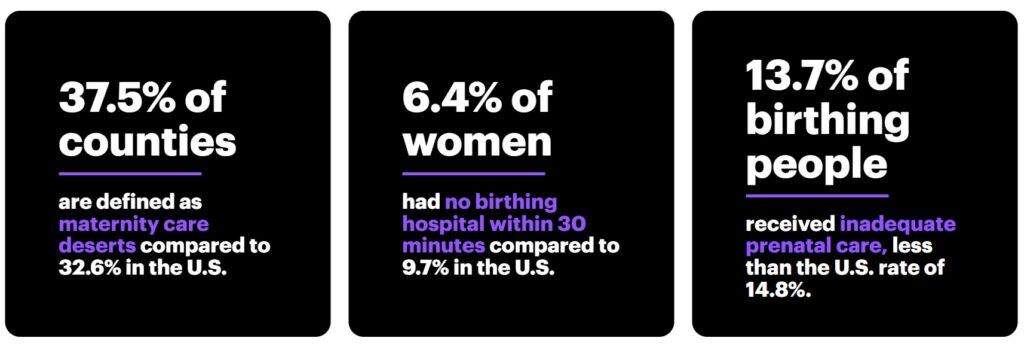
Colorado ranks 21st in the nation in the most recent 2024 March of Dimes data: About 37.5% of the state’s 64 counties are considered maternity care deserts, compared with the national average of 32.6%
The report also found that 6.5% of Colorado women had no birthing hospital within 30 minutes, slightly better than the national figure of 9.7%. Also, in Colorado, 13.7% of women giving birth received no or inadequate prenatal care, compared with 14.8% nationally
Public health pressures deepen strain
Tom Rennell, senior vice president of financial policy at the Colorado Hospital Association, said rural hospital finances are deteriorating quickly
“Eighty‑four percent now have an unsustainable margin,” he said
He pointed to a payer mix that leaves rural facilities at a disadvantage. Public programs, such as Medicare and Medicaid, make up a larger share of reimbursement in rural areas, yet neither covers the full cost of care. At the same time, many patients carry high‑deductible commercial plans that leave them functionally paying out of pocket
“You can have a lot more concentration of public payers,” he said. “And many people technically have insurance, but they have high‑deductible plans, which functionally makes them a self‑pay patient.”
For obstetric units, the math is even harder
Yirdaw of the Colorado Hospital Association said Medicaid underreimbursement is especially damaging because nearly half of rural OB patients rely on Medicaid. Maintaining 24/7 staffing — nurses, physicians and on‑call coverage — becomes difficult to sustain when reimbursement falls short
In 2024, Medicaid paid for 34.9% of Colorado live births, according to the March of Dimes. Hospitals now receive about 67 cents for every dollar spent caring for Medicaid patients, down from 80 cents five years ago and 85 cents a decade ago
Medicaid coverage is at the front of Colorado’s — and the country’s — healthcare debate. Many view it as a necessary safety net, providing care to low-income residents who otherwise cannot get insurance in the private marketplace. Without Medicaid, the argument goes, they will end up in emergency rooms, costing more, not to mention the fiscal, mental and physical toll of not affording routine care
Others argue that the program is bloated, covering many adult, able-bodied residents who should be working and getting their coveragectually care for the most vulnerable residents, such as people with disabilities, who the program was intended to serve to begin with. In Colorado, Medicaid is the single biggest driver of the increases in state spending
Colorado does not track charitable birth cases specifically, but the Common Sense Institute estimated that about 10.1% of reproductive‑age women in the state lack health insurance, leaving some to rely on emergency services or hospital discount programs
The Common Sense Institute said hospitals provide hundreds of millions of dollars in charity care each year under Colorado’s Discounted Care framework for patients earning under 250% of the federal poverty level, though they do not publish per‑procedure estimates for birth‑related charity write‑offs
“In a state as economically healthy as Colorado, it’s not acceptable that we have these maternal care deserts. But I don’t fault these hospitals. That’s what they have to do to not completely close their doors.”
Colorado Sen. Dylan Roberts
Yirdaw said rural hospitals are trying to innovate through collaboration
“Smaller hospitals are establishing relationships with larger hospitals to share information and clinical expertise,” she said. “They want to keep care local whenever possible.”
But she said the system is fragile
“Access, affordability and the ability to see your doctor in the right setting — that’s what it all boils down to,” she said. “And right now, all of those are at risk.”
For rural hospitals, the combination of Medicaid cuts, insurer denials, staffing shortages and service closures is creating a crisis that compounds each year
“In a state as economically healthy as Colorado, it’s not acceptable that we have these maternal care deserts,” Roberts said. “But I don’t fault these hospitals. That’s what they have to do to not completely close their doors.”
Once built on federal investment, rural hospitals today fight to survive
Subsidy cuts, insurance gaps reshape how Coloradans will seek care
Finger‑pointing intensifies as Colorado’s healthcare system strains under rising costs, shrinking coverage
Tags:localcolorado hospital associationdylan robertsEssey YirdawHealthcare FreefallLabor And Delivery UnitsnewsPrenatal CareTom Rennell
