


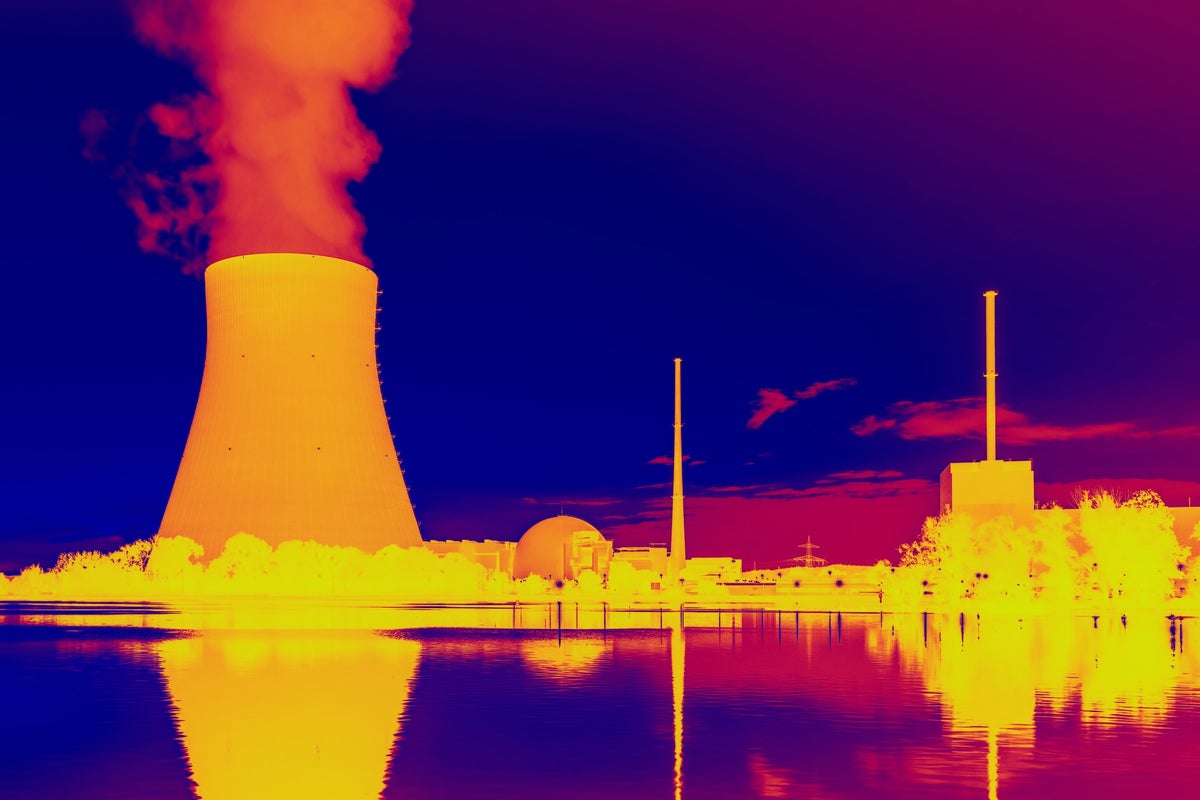
A proposed rule from the Nuclear Regulatory Commission (NRC) would ease the standard for low-dose radiation exposure. The NRC argues the change will bring more clarity to the nuclear industry, but the health effects of this rule on the public are not so clear. And if the change takes effect, then people living near nuclear facilities could be exposed to higher doses of radiation than they are currently
The change would do away with a principle called ALARA, which stands for “as low as reasonably achievable.” Under ALARA, there are maximum doses of radiation exposure that workers and the public must stay below. But beyond those thresholds, nuclear operators are also required to continuously try and push doses downward—to as low as is “reasonably” achievable
ALARA is based on a scientific model called linear no-threshold, or LNT. At high doses, ionizing radiation damages DNA and causes cancer. But at low doses, such as doses less than a few hundreds of millirems (mrem), it’s far harder to untangle whether cancers are caused by the radiation or something else
On supporting science journalism
If you’re enjoying this article, consider supporting our award-winning journalism bysubscribing. By purchasing a subscription you are helping to ensure the future of impactful stories about the discoveries and ideas shaping our world today
The LNT model holds that despite the difficulty of detecting whether a cancer has been caused by low-dose radiation amid the sea of cancer diagnoses, there is no threshold at which radiation is safe. And the risk, according to the model, rises linearly: even a tiny amount of radiation, such as the 3.5 mrem a person is exposed to on a flight from the U.S. East Coast to the West Coast, would raise lifetime cancer risk. (The average person in the U.S. gets an annual radiation dose from natural and human-made sources of about 620 mrem per year.)
In an executive order issued in May 2025, the Trump administration called the LNT model “flawed” and ordered the NRC to consider specific radiation limits instead. Ultimately, the NRC declined to drop the model, stating in its rule proposal that “no consensus-supported, regulation ready alternative model to the LNT model exists at this time.” Indeed, recent large-scale studies on nuclear workers suggest that low doses of radiation under 100 mrem increase the risk of cancer
Instead the NRC has turned its attention to ALARA. In place of that principle, the proposed rule calls for a graded approach using dose limits that already exist. Currently, the maximum dose limit for the public is 100 mrem above background radiation per year. Under the proposed graded system, operators would not have to take any action to try to further lower a dose that was already under 25 mrem per year. They could also perform a cost-benefit analysis to determine if reducing a dose below 100 mrem (but above 25 mrem) would be worth it. Exposing the public to more than 100 mrem a year would still be forbidden under the new rule.
To some experts, the proposed changes seem fair. While ALARA was aimed at considering costs and benefits with the phrase “reasonably achievable,” that hasn’t exactly panned out: “In practice, what happened is that people just drove doses as low as possible,” says Emily Caffrey, an assistant professor of health physics at the University of Alabama at Birmingham. “The ‘reasonable’ part got lost.”
People living near nuclear facilities could bear the brunt of the rule change, experts say. “The ALARA levels that are currently employed are quite a bit lower than that 25 mrem a year for public exposures, so it’s not necessarily apparent to me that they will continue to stay low without that regulatory pressure,” says Amir Bahadori, director of the nuclear engineering program at Kansas State University
“Weakening the standards by abandoning some of these principles like the LNT and ALARA is just going to create more harm to these already vulnerable communities” near nuclear plants, says Libby McClure, an occupation epidemiologist at the University of North Carolina at Chapel Hill, who works with the Union of Concerned Scientists on a project exploring the health effects of the Hanford nuclear site in Washington State
One example is the release of wastewater from nuclear power plants. This wastewater can contain small amounts of radioactive tritium, and the current ALARA objective is to keep the radiation exposure from this wastewater to 3 mrem per year or less. The rule change would do away with this objective and instead require action only if the exposure rose to 25 mrem in a year. That’s the equivalent of about eight coast-to-coast flights per year instead of one
In the proposed rule, the NRC calculated that a dose of 100 mrem per year would result in raising the lifetime risk of dying of cancer from 20 percent to 20.35 percent. But researchers such as McClure argue that the effects of public exposure are understudied and underestimated
For workers, the proposed NRC limits would put nuclear employees at a higher risk of cancer than that tolerated by other occupations, says David Richardson, a radiation epidemiologist at the University of California, Irvine. The NRC rule would allow these workers to receive 5,000 mrem of radiation per year over their careers, he says, which would raise their lifetime cancer risk by 20 percent if they actually received that dose annually, according to the linear model. (Though 5,000 mrem is the current occupational exposure limit in the U.S., limits vary by agency; the Department of Energy uses a lower limit of 2,000 mrem.) The National Institute for Occupational Safety and Health (NIOSH) guidance calls for reducing exposures to carcinogens that add more than one cancer per 10,000 workers, while the Occupational Safety and Health Administration (OSHA) considers exposures leading to one death per 1,000 workers a significant risk.
“Values as high as 20 percent excess absolute lifetime cancer risk far exceed what is typically deemed acceptable for guidance for occupational carcinogens,” Richardson says
One thing the new rule is not likely to do is to spur new nuclear development. The NRC estimates the change will save the industry $9.53 million a year—a drop in the bucket in an industry in which the cost of a plant can exceed $30 billion. Advocates of new nuclear facilities, such as small modular nuclear reactors, often cite radiation protection regulation as slowing the pace of such facilities coming online in the U.S., Caffrey says, but the NRC numbers show that is “comical.”
“There is just no way that $10 million is what is stopping nuclear power plants from being built in the U.S.,” she says
It’s Time to Stand Up for Science
If you enjoyed this article, I’d like to ask for your support.Scientific American has served as an advocate for science and industry for 180 years, and right now may be the most critical moment in that two-century history
I’ve been a Scientific Americansubscriber since I was 12 years old, and it helped shape the way I look at the world.SciAmalways educates and delights me, and inspires a sense of awe for our vast, beautiful universe. I hope it does that for you, too
If yousubscribe toScientific American, you help ensure that our coverage is centered on meaningful research and discovery; that we have the re.S.; and that we support both budding and working scientists at a time when the value of science itself too often goes unrecognized
In return, you get essential news,captivating podcasts, brilliant infographics,can’t-miss newsletters, must-watch videos,challenging games, and the science world’s best writing and reporting. You can evengift someone a subscription
There has never been a more important time for us to stand up and show why science matters. I hope you’ll support us in that mission
