


Download PDF
Abstract
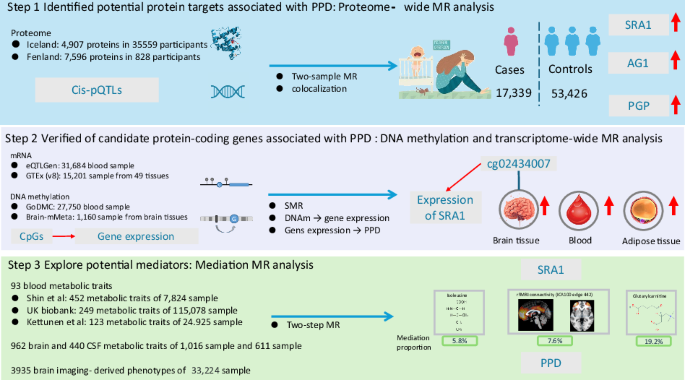
Postpartum depression (PPD) is among the most common complications of childbirth, and identifying novel treatments is vital. We aimed to identify potential drug targets for PPD by integrating the plasma proteome, transcriptome and epigenome. We designed a comprehensive analysis pipeline involving two-sample Mendelian randomisation (MR) (for proteins), colocalisation (for coding genes), and summary-based MR (SMR) (for mRNA and DNA methylation) to identify potential therapeutic targets for PPD. Genetic data on the plasma proteome were obtained from 4907 aptamers in 35,559 Icelanders and 7596 proteins in 828 FinnGen participants. The PPD genome-wide association study data were sourced from the Psychiatric Genomics Consortium (PGC) (Ncase = 17,339, Ncontrol = 53,426). A two-step MR approach was used to assess whether brain imaging-derived phenotypes (IDPs) and metabolites from blood, brain and cerebrospinal fluid mediated the observed effects. Across the two proteome datasets, the genetically predicted levels of 18 plasma proteins were nominally significantly associated with PPD, and the expression of steroid receptor RNA activator 1 (SRA1), a regulator of steroid hormone signalling, was significantly associated with PPD. SRA1, angiotensinogen (AGT, a key mediator of the renin-angiotensin and stress-response system), and glycerol-3-phosphate phosphatase (PGP, involved in lipid metabolism and cellular stress) showed increased colocalisation. The methylation of SRA1 at cg02434007 in the brain was associated with increased expression of SRA1 and a high risk of PPD, which aligns with the positive effect of SRA1 gene expression on PPD risk. Isoleucine (mediation proportion: 5.8%, p = 0.042) from blood metabolites and the IDP ICA100 edge 442 (mediation proportion: 7.6%, p = 0.044) may play mediating roles. This study reveals that SRA1 is a novel therapeutic target for PPD, which enhances the understanding of its molecular aetiology and the development of therapeutic strategies.
Subjects
Acknowledgements
We would like to express our gratitude to Weipeng Zhang for drawing the mechanism diagram and the experimental design diagram during the revision process
Author notes
These authors contributed equally: Ming Chen, Qinling Wei, Haowen Li
Authors and Affiliations
Guangdong <a href="https://healthylife7.com/northern-kentucky-health-assessment-seeks-input-on-access-to-care-mental-health-needs/” title=”Northern Kentucky health assessment seeks input on access to care, mental health needs”>Mental Health Center, Guangdong Provincial People’s Hospital (Guangdong Academy of Medical Sciences), Southern Medical University, Guangzhou, China
Ming Chen, Linyan Fu & Cailan Hou
Department of Psychiatry, The Third Affiliated Hospital of Sun Yat-sen University, Guangzhou, China
Qinling Wei, Junxiao Ma & Xiaowei Xia
Department of Obstetrics, Guangdong Provincial People’s Hospital (Guangdong Academy of Medical Sciences), Southern Medical University, Guangzhou, China
Haowen Li
Department of Cardiology, Guangdong Provincial People’s Hospital (Guangdong Academy of Medical Sciences), Southern Medical University, Guangzhou, China
Huangtao Ruan & Haozhang Huang
Department of Psychiatry, Beijing Huilongguan Hospital, Beijing, China
Junxiao Ma
The Second School of Clinical Medicine, Southern Medical University, Guangzhou, China
Yanting Liao
Authors
- Ming ChenView author publications
Search author on:PubMed Google Scholar
- Qinling WeiView author publications
Search author on:PubMed Google Scholar
- Haowen LiView author publications
Search author on:PubMed Google Scholar
- Huangtao RuanView author publications
Search author on:PubMed Google Scholar
- Linyan FuView author publications
Search author on:PubMed Google Scholar
- Junxiao MaView author publications
Search author on:PubMed Google Scholar
- Xiaowei XiaView author publications
Search author on:PubMed Google Scholar
- Yanting LiaoView author publications
Search author on:PubMed Google Scholar
- Cailan HouView author publications
Search author on:PubMed Google Scholar
- Haozhang HuangView author publications
Search author on:PubMed Google Scholar
Ethics declarations
Competing interests
The authors declare no competing interests
Additional information
Publisher’s note Springer Nature remains neutral with regard to jurisdictional claims in published maps and institutional affiliations
Supplementary information
Supplementary information (download DOCX )
Supplementary Data (download XLSX )
Rights and permissions
Open Access This article is licensed under a Creative Commons Attribution-NonCommercial-NoDerivatives 4.0 International License, which permits any non-commercial use, sharing, distribution and reproduction in any medium or format, as long as you give appropriate credit to the original author(s) and the source, provide a link to the Creative Commons licence, and indicate if you modified the licensed material. You do not have permission under this licence to share adapted material derived from this article or parts of it. The images or other third party material in this article are included in the article’s Creative Commons licence, unless indicated otherwise in a credit line to the material. If material is not included in the article’s Creative Commons licence and your intended use is not permitted by statutory regulation or exceeds the permitted use, you will need to obtain permission directly from the copyright holder. To view a copy of this licence, visit http://creativecommons.org/licenses/by-nc-nd/4.0/.
About this article
Cite this article
Chen, M., Wei, Q., Li, H. et al. Integrated proteomic, transcriptomic, and epigenomic profiling identifies SRA1 as a novel therapeutic target for postpartum depression.
npj Mental Health Res (2026). https://doi.org/10.1038/s44184-026-00232-3
Received:15 December 2025
Accepted:13 July 2026
Published:15 August 2026
DOI
:https://doi.org/10.1038/s44184-026-00232-3
