


Abstract
Background
Obesity is a serious multifactorial disease that involves epigenetic mechanisms like DNA methylation. Tyrosine kinase inhibitors (TKIs), originally synthesized and approved for cancer therapy, have recently been linked to the regulation of obesity. We evaluated whether LPM4870108, a small-molecule TKI with antitumor efficacy, contributes to obesity
Methods
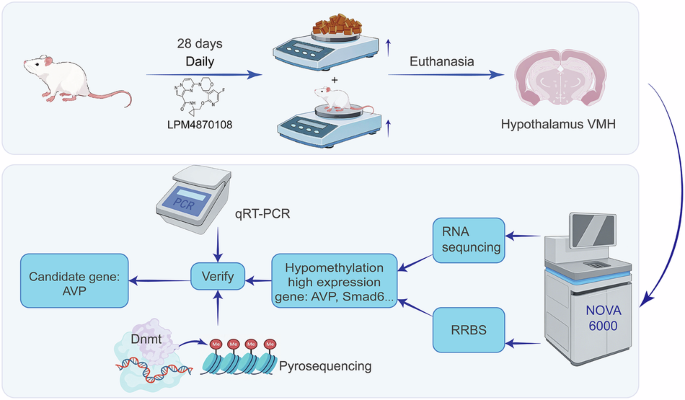
LPM4870108 (TKI) was administered orally to rats at 0, 1.25, 2.5, or 5.0 mg/kg (for 28 days, twice daily). Body weights (BWs) and food intake were recorded daily. After 28 days of administration, ventromedial hypothalamus (VMH) tissues were collected for whole-genome transcriptomic and methylation sequencing to identify candidate genes. The mRNA expression and promoter methylation of candidate genes were analyzed by real-time RT-PCR and pyrosequencing, respectively. Protein levels of DNA methyltransferases (DNMTs) were determined by Western blot.
Results
LPM4870108 treatment substantially increased food intake and BW. Whole-genome transcriptomic and methylation profiling identified 415 differentially expressed genes (DEGs) and 124,935 differentially methylated regions (DMRs) within the VMH of LPM4870108-treated rats. The transcriptomic results were combined with whole-genome methylation sequencing data, followed by further verification via RT-PCR and pyrosequencing, through which the obesity-related candidate gene arginine vasopressin (AVP) was identified. Among all DEGs, AVP showed the most prominent change, with a negative association between its promoter methylation and mRNA expression level. Reduced protein expression of DNA methyltransferase 3A (DNMT3A) in the VMH was also detected in LPM4870108-treated rats.
Conclusions
These findings indicate that LPM4870108-stimulated hyperphagia and weight gain were associated with DNA hypomethylation and concomitant upregulation of the AVP gene
LPM4870108, tyrosine kinase inhibitors; VMH, ventromedial hypothalamus; RRBS, reduced representation bisulfite sequencing; AVP, arginine vasopressin; DNMT, DNA methyltransferases
Access through your institution
Buy or subscribe
This is a preview of subscription content, access
Access options
Access through your institution
- Purchase on SpringerLink
- Instant access to the full article PDF.
39,95 €
Prices may be subject to local taxes which are calculated during checkout
Data availability
The dataset(s) supporting the conclusions of this article is(are) included within the article (and its Supplementary material(s))
References
Mahase E. Global cost of overweight and obesity will hit $4.32tn a year by 2035, report warns. BMJ. 2023;380:523
Perdomo CM, Cohen RV, Sumithran P, Clement K, Fruhbeck G. Contemporary medical, device, and surgical therapies for obesity in adults. Lancet. 2023;401:1116–30
Chen S, Zhang H, Gao M, Machado DB, Jin H, Scherer N, et al. Dose-Dependent Association Between Body Mass Index and Mental Health and Changes Over Time. JAMA Psychiatry. 2024;81:797–806
Del Corno M, Baldassarre A, Calura E, Conti L, Martini P, Romualdi C, et al. Transcriptome Profiles of Human Visceral Adipocytes in Obesity and Colorectal Cancer Unravel the Effects of Body Mass Index and Polyunsaturated Fatty Acids on Genes and Biological Processes Related to Tumorigenesis. Front Immunol. 2019;10:265
Ling C, Ronn T. Epigenetics in Human Obesity and Type 2 Diabetes. Cell Metab. 2019;29:1028–44
Rohde K, Keller M, la Cour Poulsen L, Bluher M, Kovacs P, Bottcher Y. Genetics and epigenetics in obesity. Metabolism. 2019;92:37–50
Amatu A, Sartore-Bianchi A, Siena S. NTRK gene fusions as novel targets of cancer therapy across multiple tumour types. ESMO Open. 2016;1:e000023
Drilon A. TRK inhibitors in TRK fusion-positive cancers. Ann Oncol. 2019;30:viii23–viii30
Cocco E, Scaltriti M, Drilon A. NTRK fusion-positive cancers and TRK inhibitor therapy. Nat Rev Clin Oncol. 2018;15:731–47
Liao MH, Liu X, Yu XT, Zhang S, Li YZ, Hu LL, et al. NAMPT regulates mitochondria and oxidative stress level for mouse early embryo development. Biol Res. 2025;58:25
Laetsch TW, DuBois SG, Mascarenhas L, Turpin B, Federman N, Albert CM, et al. Larotrectinib for paediatric solid tumours harbouring NTRK gene fusions: phase 1 results from a multicentre, open-label, phase 1/2 study. Lancet Oncol. 2018;19:705–14
Doebele RC, Drilon A, Paz-Ares L, Siena S, Shaw AT, Farago AF, et al. Entrectinib in patients with advanced or metastatic NTRK fusion-positive solid tumours: integrated analysis of three phase 1-2 trials. Lancet Oncol. 2020;21:271–82
Spaeth AM, Kanoski SE, Hayes MR, Grill HJ. TrkB receptor signaling in the nucleus tractus solitarius mediates the food intake-suppressive effects of hindbrain BDNF and leptin. Am J Physiol Endocrinol Metab. 2012;302:E1252–1260
Yeo GS, Connie Hung CC, Rochford J, Keogh J, Gray J, Sivaramakrishnan S, et al. A de novo mutation affecting human TrkB associated with severe obesity and developmental delay. Nat Neurosci. 2004;7:1187–9
Liu Z, Yu P, Dong L, Wang W, Duan S, Wang B, et al. Discovery of the Next-Generation Pan-TRK Kinase Inhibitors for the Treatment of Cancer. J Med Chem. 2021;64:10286–96
Duan S, Li C, Gao Y, Meng P, Ji S, Xu Y, et al. The tyrosine kinase inhibitor LPM4870108 impairs learning and memory and induces transcriptomic and gene‑specific DNA methylation changes in rats. Arch Toxicol. 2022;96:845–57
Zhang X, Yuan B, Li C, Wang H, Wei S, Tian J, et al. Preclinical Evaluation of the Oral Toxicity, Genotoxicity, and Safety Pharmacology of LPM4870108, a Novel Potent Tropomyosin Receptor Kinase Inhibitor. Pharm Res Perspect. 2025;13:e70153
Moiseev KY, Vishnyakova PA, Porseva VV, Masliukov AP, Spirichev AA, Emanuilov AI, et al. Changes of nNOS expression in the tuberal hypothalamic nuclei during ageing. Nitric Oxide. 2020;100:1–6
Denton NF, Eghleilib M, Al-Sharifi S, Todorcevic M, Neville MJ, Loh N, et al. Bone morphogenetic protein 2 is a depot-specific regulator of human adipogenesis. Int J Obes. 2019;43:2458–68
Hochberg Z. An Evolutionary Perspective on the Obesity Epidemic. Trends Endocrinol Metab. 2018;29:819–26
Guo W, Chung WY, Qian M, Pellegrini M, Zhang MQ. Characterizing the strand-specific distribution of non-CpG methylation in human pluripotent cells. Nucleic Acids Res. 2014;42:3009–16
Schoenfelder S, Fraser P. Long-range enhancer-promoter contacts in gene expression control. Nat Rev Genet. 2019;20:437–55
Ge ZJ, Luo SM, Lin F, Liang QX, Huang L, Wei YC, et al. DNA methylation in oocytes and liver of female mice and their offspring: effects of high-fat-diet-induced obesity. Environ Health Perspect. 2014;122:159–64
Lashley T, Gami P, Valizadeh N, Li A, Revesz T, Balazs R. Alterations in global DNA methylation and hydroxymethylation are not detected in Alzheimer’s disease. Neuropathol Appl Neurobiol. 2015;41:497–506
Rios M. BDNF and the central control of feeding: accidental bystander or essential player? Trends Neurosci. 2013;36:83–90
Vanevski F, Xu B. Molecular and neural bases underlying roles of BDNF in the control of body weight. Front Neurosci. 2013;7:37
Pelleymounter MA, Cullen MJ, Wellman CL. Characteristics of BDNF-induced weight loss. Exp Neurol. 1995;131:229–38
Kernie SG, Liebl DJ, Parada LF. BDNF regulates eating behavior and locomotor activity in mice. EMBO J. 2000;19:1290–300
Zuccato C, Cattaneo E. Brain-derived neurotrophic factor in neurodegenerative diseases. Nat Rev Neurol. 2009;5:311–22
Xu B, Goulding EH, Zang K, Cepoi D, Cone RD, Jones KR, et al. Brain-derived neurotrophic factor regulates energy balance downstream of melanocortin-4 receptor. Nat Neurosci. 2003;6:736–42
Li L, Yu AL, Wang ZL, Chen K, Zheng W, Zhou JJ, et al. Chaihu-Shugan-San and absorbed meranzin hydrate induce anti-atherosclerosis and behavioral improvements in high-fat diet ApoE(-/-) mice. 2019;115:108893
Ameroso D, Meng A, Chen S, Felsted J, Dulla CG, Rios M. Astrocytic BDNF signaling within the ventromedial hypothalamus regulates energy homeostasis. Nat Metab. 2022;4:627–43
Penicaud L, Larue-Achagiotis C, Le Magnen J. Endocrine basis for weight gain after fasting or VMH lesion in rats. Am J Physiol. 1983;245:E246–252
CAS
PubMed
Google ScholarFarooqi IS, O’Rahilly S. New advances in the genetics of early onset obesity. Int J Obes. 2005;29:1149–52
McAllan L, Baranasic D, Villicana S, Brown S, Zhang W, Lehne B, et al. Integrative genomic analyses in adipocytes implicate DNA methylation in human obesity and diabetes. Nat Commun. 2023;14:2784
Xu X, Su S, Barnes VA, De Miguel C, Pollock J, Ownby D, et al. A genome-wide methylation study on obesity: differential variability and differential methylation. Epigenetics. 2013;8:522–33
Ma K, Yin K, Li J, Ma L, Zhou Q, Lu X, et al. The Hypothalamic Epigenetic Landscape in Dietary Obesity. Adv Sci. 2024;11:e2306379
Ghandi M, Huang FW, Jane-Valbuena J, Kryukov GV, Lo CC, McDonald ER, et al. Next-generation characterization of the Cancer Cell Line Encyclopedia. Nature. 2019;569:503–8
Murgatroyd C, Patchev AV, Wu Y, Micale V, Bockmuhl Y, Fischer D, et al. Dynamic DNA methylation programs persistent adverse effects of early-life stress. Nat Neurosci. 2009;12:1559–66
Koshimizu TA, Nakamura K, Egashira N, Hiroyama M, Nonoguchi H, Tanoue A. Vasopressin V1a and V1b receptors: from molecules to physiological systems. Physiol Rev. 2012;92:1813–64
Smith RW. Mc CS. Alterations in food and water intake after hypothalamic lesions in the rat. Am J Physiol. 1962;203:366–70
Bundzikova J, Pirnik Z, Zelena D, Mikkelsen JD, Kiss A. Response of substances co-expressed in hypothalamic magnocellular neurons to osmotic challenges in normal and Brattleboro rats. Cell Mol Neurobiol. 2008;28:1033–47
Aoyagi T, Birumachi J, Hiroyama M, Fujiwara Y, Sanbe A, Yamauchi J, et al. Alteration of glucose homeostasis in V1a vasopressin receptor-deficient mice. Endocrinology. 2007;148:2075–84
Ding C, Magkos F. Oxytocin and Vasopressin Systems in Obesity and Metabolic Health: Mechanisms and Perspectives. Curr Obes Rep. 2019;8:301–16
Rubin RT, Rhodes ME, Czambel RK. Plasma leptin suppression by arginine vasopressin in normal women and men. Life Sci. 2003;72:1209–20
He S, Ryu J, Liu J, Luo H, Lv Y, Langlais PR, et al. LRG1 is an adipokine that mediates obesity-induced hepatosteatosis and insulin resistance. J Clin Invest. 2021;131:e148545
Morales DD, Ryu J, Wei C, Hadley JT, Smith MR, Bai J, et al. Diet-enhanced LRG1 expression promotes insulin hypersecretion and ER stress in pancreatic beta cells. Diabetologia. 2025;68:615–28
Marcelin G, Gautier EL, Clement K. Adipose Tissue Fibrosis in Obesity: Etiology and Challenges. Annu Rev Physiol. 2022;84:135–55
Lyko F. The DNA methyltransferase family: a versatile toolkit for epigenetic regulation. Nat Rev Genet. 2018;19:81–92
Lagarde CB, Kavalakatt J, Benz MC, Hawes ML, Arbogast CA, Cullen NM, et al. Obesity-associated epigenetic alterations and the obesity-breast cancer axis. Oncogene. 2024;43:763–75
Kohno D, Lee S, Harper MJ, Kim KW, Sone H, Sasaki T, et al. Dnmt3a in Sim1 neurons is necessary for normal energy homeostasis. J Neurosci. 2014;34:15288–96
Tatton-Brown K, Zachariou A, Loveday C, Renwick A, Mahamdallie S, Aksglaede L, et al. The Tatton-Brown-Rahman Syndrome: A clinical study of 55 individuals with de novo constitutive DNMT3A variants. Wellcome Open Res. 2018;3:46
Tovy A, Reyes JM, Zhang L, Huang YH, Rosas C, Daquinag AC, et al. Constitutive loss of DNMT3A causes morbid obesity through misregulation of adipogenesis. Elife. 2022;11:e72359
Mary J. Mice and Rats: Housing Temperature and Handling. Mater Methods. 2011;1:22
Tan Q, Link PA, Meridew JA, Pham TX, Caporarello N, Ligresti G, et al. Spontaneous Lung Fibrosis Resolution Reveals Novel Antifibrotic Regulators. Am J Respir Cell Mol Biol. 2021;64:453–64
Ommati MM, Jin Y, Zamiri MJ, Retana-Marquez S, Nategh Ahmadi H, Sabouri S, et al. Sex-Specific Mechanisms of Fluoride-Induced Gonadal Injury: A Multi-Omics Investigation into Reproductive Toxicity and Gut Microbiota Disruption. J Agric Food Chem. 2025;73:2527–50
Acknowledgements
The authors thank Sangon Biotech (Shanghai, China) for the support in transcriptome data analysis
Funding
This work was supported by the Natural Science Foundation of Shandong Province (No. ZR2024QH124) and the Initial Scientific Research Fund of Yantai University (Grant no. SM22B181)
Author information
Author notes
These authors contributed equally: Jingwei Tian, Sijin Duan
Authors and Affiliations
School of Pharmacy, Key Laboratory of Molecular Pharmacology and Drug Evaluation (Yantai University), Ministry of Education, Collaborative Innovation Center of Advanced Drug Delivery System and Biotech Drugs in Universities of Shandong, Yantai University, Yantai, PR China
Baiyang Yuan, Xuan Jin, Chunmei Li, Hongbo Wang, Jingwei Tian & Sijin Duan
State Key Laboratory of Advanced Drug Delivery and Release Systems, Shandong Luye Pharmaceutical Co., Ltd., Yantai, Shandong, PR China
Jingwei Tian
Authors
- Baiyang YuanView author publications
Search author on:PubMed Google Scholar
- Xuan JinView author publications
Search author on:PubMed Google Scholar
- Chunmei LiView author publications
Search author on:PubMed Google Scholar
- Hongbo WangView author publications
Search author on:PubMed Google Scholar
- Jingwei TianView author publications
Search author on:PubMed Google Scholar
- Sijin DuanView author publications
Search author on:PubMed Google Scholar
Contributions
BY: Methodology, Software, Validation, Formal analysis, Investigation, Data curation, Writing – original draft, Writing – review & editing, Visualization. XJ: Conceptualization, Methodology, Formal analysis, Investigation, Writing – review & editing, Supervision. CL: Methodology, Investigation, Data curation. HW: Formal analysis, Resources, Writing – review & editing, Supervision. JT: Resources, Project administration. SD: Conceptualization, Resources, Project administration. All authors read and approved the final manuscript.
Ethics declarations
Competing interests
The authors declare no competing interests
Ethics approval
All experimental procedures in this study were conducted in accordance with the National Institutes of Health Guidelines for Care and Use of Laboratory Animals and all animal protocols were approved by the Laboratory Animals Care and Use Committee of Yantai University (YTU20210635)
Additional information
Publisher’s note Springer Nature remains neutral with regard to jurisdictional claims in published maps and institutional affiliations
Supplementary information
Supplementary figure and table legends (download DOCX )
Supplementary Figure S1 (download TIF )
Supplementary Table S1 (download DOCX )
Supplementary Table S2 (download XLSX )
Supplementary Table S3 (download XLSX )
Supplementary Table S4 (download XLSX )
Supplementary Table S5 (download XLSX )
Supplementary Table S6 (download XLSX )
Supplementary Table S7 (download XLSX )
Supplementary Table S8 (download XLSX )
Rights and permissions
Springer Nature or its licensor (e.g. a society or other partner) holds exclusive rights to this article under a publishing agreement with the author(s) or other rightsholder(s); author self-archiving of the accepted manuscript version of this article is solely governed by the terms of such publishing agreement and applicable law
About this article
Cite this article
Yuan, B., Jin, X., Li, C. et al. Integrative multi-omics analysis of DNA methylome and transcriptome in a tyrosine kinase inhibitor LPM4870108-induced rat model of obesity.
Int J Obes (2026). https://doi.org/10.1038/s41366-026-02157-5
Received:05 December 2025
Revised:16 June 2026
Accepted:01 July 2026
Published:10 July 2026
Version of record:10 July 2026
DOI
:https://doi.org/10.1038/s41366-026-02157-5
