


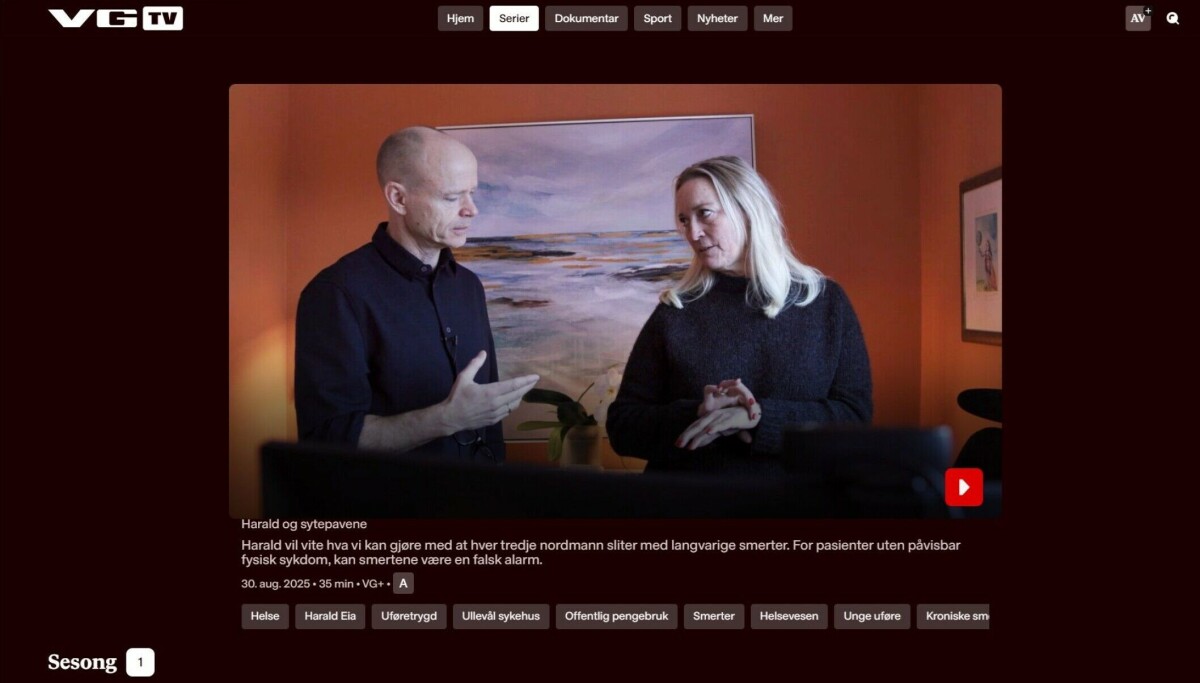
The Norwegian VGTV series Harald og sytepavene (Harald and the Whiners) is about six people with long-term chronic pain who suddenly recover. After just a few weeks of treatment aimed at reprogramming the brain’s perception of pain, all of them are either much better or completely pain-free
It seems like a miracle. One person who has experienced this kind of radical improvement is comedian and TV host Einar Tørnquist, as he told Science Norway
The potential is enormous, say psychologist Silje Endresen Reme and physician Andreas Pahle, the experts featured in the TV programme
In the wake of the series, they have experienced tremendous interest in the treatment method called Pain Reprocessing Therapy (PRT)
Patients want the treatment, and therapists want training in the method, says Reme, who is a professor of psychology at the University of Oslo
The university has now already provided PRT training to 200 therapists
Ask to have their brains reprogrammed
“We’re hearing that patients are now increasingly coming to pain clinics not to get medication, but to ask to have their brains reprogrammed,” says Reme
Others are concerned about what they see as an almost evangelical enthusiasm surrounding a treatment with limited scientific documentation
They are sceptical about the Norwegian healthcare system already changing its practices and investing more re
“There is a risk of oversimplifying extremely complex problems,” says Heidi Trydal, a pain psychologist at the Pain Center at St. Olavs Hospital’s pain centre
She and three colleagues recently wrote about this in the Journal of the Norwegian Psychological Association (link in Norwegian). They argued that there is a risk of creating unrealistic expectations among patients, healthcare professionals, and within the welfare system
One of the authors, Tormod Landmark, has himself completed additional training in PRT
What is Pain Reprocessing Therapy?
PRT is a treatment method developed by Alan Gordon at the Pain Psychology Center in Los Angeles, and introduced, among other places, in the 2021 book The Way Out
PRT is based on the theory that some cases of chronic pain are not caused by illness or physical injury, but by the brain misinterpreting the body’s sensory signals as dangerous. The pain is a false alarm
The treatment consists of information and techniques to turn off this false alarm – often described as reprogramming the brain. The therapist teaches the patient that their pain is real and physiological, but that their body is healthy. The patient then learns various techniques to explore the pain and become confident that it is not threatening. These methods may include different forms of mindfulness, hypnosis, and exposure
Nothing new
Trydal has treated pain patients for more than 20 years
She explains that chronic pain can have many different causes, and that this affects which type of pain treatment is most appropriate
In some cases, the pain is caused by tissue damage or inflammation. But in other cases, doctors cannot find any injury that explains the pain
Trydal believes it is very positive that the attention surrounding PRT has highlighted that psychotherapy can help people with chronic pain where no injury or disease can be identified. These techniques are often both safer and more effective than medication
But this is nothing new. It has long been known that pain can be caused by the brain misinterpreting signals and that various methods can counteract this
“We object to PRT being presented as something new, because there is actually very little that is new about it. These are familiar methods for those of us who have worked in the pain field for many years, but they are disguised by describing the techniques using new terminology,” she tells Science Norway
The goal is to recover completely
“It’s absolutely true that several of the techniques are already well known,” Reme tells Science Norway
She believes that the new aspect of PRT is that it is the first form of therapy based on predictive processing, a theory of how the brain functions
“PRT takes the idea that symptoms are active protective experiences created by the brain seriously, not just signals that the brain registers,” Reme says
The biggest difference for patients may be what the therapist tells them about their chances of recovery, according to the professor
“The expectation we give to patients is not just that they should learn to live with their pain, but that we will actually work towards them becoming completely free of it,” she says
This was exactly what Einar Tørnquist found so powerful when he received PRT for his chronic pain.Read his story here
“In PRT, we state much more explicitly that the pain you have is not caused by a physical injury or illness. It’s caused by a false alarm in the brain’s alarm system,” says Reme
The aim of the treatment is to get the brain to switch off this alarm. According to Reme, such ‘reprogramming’ can make a good number of patients completely healthy
Useful, but limited effects
‘We are particularly sceptical of the term ‘reprogramming the brain’,’ Trydal and her colleagues wrote in the Journal of the Norwegian Psychological Association. ‘Reprogramming the brain to produce less pain sounds logical and hopeful, but it is an oversimplification of extremely complex biological processes.’
Chronic pain can be caused by many different pain mechanisms and is shaped by a number of factors such as genetics, poor sleep, previous trauma, or difficult life circumstances, Trydal tells Science Norway
According to the pain psychologist, a substantial body of research shows that psychological therapies resembling the techniques used in PRT can be helpful for pain
“But the effects are often quite small, and none of the methods work for everyone,” she says
The researchers featured in Harald and the Whiners say that PRT is a well-documented form of therapy that can cure two out of three pain patients
“But there is only one large study on PRT. We question why the method is nevertheless described as groundbreaking and supported by solid evidence” says Trydal
Silje Endresen Reme, however, argues that research on predictive brain theory more broadly helps support the treatment
Most viewed
Archaeologists’ most exciting finds: In a box in the basement lay four girls who died in the 1300s, still wearing red mittens on their hands
How to use olive oil correctly
Archaeologists’ most exciting finds:A previously unknown medieval royal estate suddenly appeared
- museum favourite
Two condoms from 1944 washed ashore from a shipwreck in northern Norway
One in two women has experienced squirting orgasms: “Not very surprising,” says researcher
Unrealistic expectations
Trydal fears that unrealistic expectations can easily turn hope into despair
“I have worked in this field for a long time, and patients do sometimes become pain-free, but for it to happen for so many and in such a short time as shown in the TV series is unrealistic. I find it almost unethical to create those kinds of expectation,” she says
In an email to Science Norway, Tommy Gulliksen from Dox Division, the production company behind the VGTV series, writes:
“What is the basis for that claim? It is entirely legitimate to ask critical questions about the results, but to call something ‘almost unethical’ is a serious accusation that should be supported with stronger evidence than this.”
Highly motivated patients
Trydal and her colleagues believe that the participants in the series may not be representative of chronic pain patients in general
“These are probably patients with very high motivation, which is known to produce a strong placebo effect,” says Trydal
Tommy Gulliksen from Dox Division believes this is mere speculation
“This sounds like loose speculation presented as professional insight. On what basis is this person comparing the patients in our series with a representative patient group?” he writes
The programme’s host, Harald Eia, also questions this point
“The patients in the series scored similarly to all the other patients at the pain clinic. Motivation for change is, after all, central for all practitioners,” he writes to Science Norway
Disagree about the placebo effect
Eia also questions whether it is even relevant to distinguish between a placebo effect and a treatment effect
“Does it really make that much sense? When the majority of back pain patients in the 2022 study are pain-free five years later – is that a placebo effect?”
Eia disagrees that the series gives patients unrealistic expectations
“What you could see in the documentary is consistent with the experience of Pahle and Reme. And not everyone becomes pain-free – even in this documentary,” Eia writes, adding:
“But I am curious: What results can Trydal poin to? Here is a suggestion: Let’s select six patients similar to those in Harald and the Whiners and see what Trydal can achieve with her treatment approach. We’ll bring a camera! Is she in?”
Concerned about the patients
The researchers at St. Olavs Hospital’s pain centre believe it is unlikely that two out of three patients with long-term chronic pain will be cured by PRT
‘Many will probably experience little or no effect. The risk is that patients who do not achieve the desired effect from this widely praised treatment will interpret this as a personal failure,’ they wrote in the Journal of the Norwegian Psychological Association
Trydal says that some patients have come to the pain centre after not getting the desired results from this treatment
“We are very concerned that patients blame themselves – that they couldn’t even succeed at this – and then it becomes another nail in the coffin,” she says. “When patients try a lot without success, their frustration and stress often increase. We know that these are factors that can contribute to worsening pain.”
Greater harm from hopelessness
Reme, on the other hand, believes that positive expectations can be beneficial
“It’s certainly important that patients are not left feeling disappointed or like failures,” she says
“But I’m not so afraid of hype. If there’s one thing our field and our patients have had too little of, it’s hype and enthusiasm,” says Reme, adding:
“Patients with chronic pain have not been the subject of much positivity and optimism, whether from the medical community, the media or society in general. We’ve probably been too afraid of giving false hope. I think there’s a greater risk of causing harm by fuelling hopelessness.”
She believes that the sense of safety and hope of recovery itself contributes to the process of changing the brain’s perception of pain
“There were only disappointments”
The Norwegian comedian Einar Tørnquist experienced significant improvement from PRT himself. But he doesn’t think it would have been too harmful if the treatment didn’t work for him
“When I was at my lowest, there were only disappointments. I kept having hopes for a new injection, a new treatment, or a new exercise that never worked. At worst, this would simply have been one more thing that didn’t help,” says Tørnquist
“We’re not talking about surgery or medication here. You risk almost nothing by trying this. So I think it’s reasonable to give it a chance. There are stories of people who have begged for and been granted amputations because of chronic pain. You should at least be able to give them a little chat with a psychologist,” he adds
The media plays a large and important role
Reme believes the VGTV series has had a major impact
“After an important research finding is published, it typically takes between 10 and 15 years before it is put into practice,” she says
She believes the extensive media coverage has dramatically shortened that timeline in Norway
“I used to think it was enough to conduct solid research and publish it in good journals, and then the findings would automatically benefit patients and the field. Now I understand that the world doesn’t work like that. The media and broad public communication play a large and important role in getting things out quickly, and in changing healthcare practices, as we’re seeing now,” says Reme
Warns against oversimplified marketing
Tove Pettersen Heger, senior consultant at Ålesund Hospital’s pain clinic, warns against promoting PRT in an overly simplistic way as a cure for pain
‘With a private market, a low threshold for certification, and promises of effectiveness, there is a risk of oversimplification and that patients will wrongly feel responsible or ashamed when the treatment ‘doesn’t work’,’ she wrote in a column in the Journal of the Norwegian Medical Association (link in Norwegian)
“The best we have”
Reme also clarifies that PRT is not appropriate for every type of chronic pain
“Thorough assessment and careful patient selection are essential. The treatment was developed for people whose pain cannot be explained by ongoing injury or illness in the body, but whose pain system appears to have become overprotective,” she says
She also says that the response to the treatment varies from person to person
“Some become pain-free after one treatment, like Einar Tørnquist. But those are the exceptions. For some, it takes two years. Others may improve quickly, but then symptoms can return, and they need to continue working on it,” she says
Reme does not think PRT is the final answer
“It doesn’t help everyone, and of course there may be aspects of pain that we still don’t see or understand. But I think it’s the best we have so far for chronic pain patients in whom no injury or disease can be identified,” she says
“I’ve never seen anything like this”
“If the treatment works as well as you have described, will we see a big impact on future statistics for sick leave and disability?”
“I don’t want to oversell this. We simply don’t know what long-term effects it will have, not only for pain, but for getting people back to work. That’s a big question we need to investigate,” says Reme
She has often wondered why not everyone sees the same potential in the treatment as she does
“I think you have to experience it yourself. I’ve never seen anything like this. When you first meet a patient who says: ‘The pain is actually gone. I no longer have chronic pain,’ it changes you – both as a person and as a therapist,” she says
Eia and Gulliksen respond to critical voices
“Should you have included voices that are critical of the pain treatment method presented in the series?”
“This is a documentary series where we follow patients through a specific course of treatment to observe how the method is practiced and examine what happens to them. The viewer should first and foremost evaluate what they actually see and not compare one group of experts against another. It’s not a debate programme or a series that weighs the arguments for and against PRT,” writes Gulliksen from Dox Division
Eia says the goal of the series was to investigate whether there was any truth to the theory that chronic pain can be caused by a false alarm in the brain
“We could probably have had a few more critical voices from other doctors and psychologists, as you might in a television news segment,” he writes to Science Norway
“But we thought: We can’t include everything in this exploratory documentary. It would quickly become rather dutiful and superficial if we simply went through the ritual of presenting opposing viewpoints. Instead, we hoped that a more critical and professionally grounded debate would follow in the wake of the documentary.”
Translated by Nancy Bazilchuk
Read the Norwegian version of this article on forskning.no
References:
Heger, T.P. Nociplastisk smerte: Har den uforklarlige smerten fått en forklaring, og har vi funnet en kur? (PDF) (Nociplastic pain: Has unexplained pain finally been given an explanation, and have we found a cure?), Journal of the Norwegian Psychological Association, 2026.
Trydal et al. Når mål om smertefrihet møter klinisk kompleksitet (When the goal of being pain-free meets clinical complexity), Journal of the Norwegian Psychological Association, 2026.
