
K-culture is increasingly functioning less as a fandom engine and more as a pathway to routine product adoption across categories like beauty, food, fashion, and home, as outlined in Assembly’s “Beyond the wave: From K-culture phenomenon to global market dominance” report
That shift matters because it changes what “cultural marketing” is supposed to do. When the job is no longer to spark curiosity but to sustain repeat behavior, the center of gravity moves from entertainment adjacency to performance proof, creator advocacy, and localisation
Table of contents
From K-culture fandom to K-lifestyle routines
Assembly frames the current moment as an evolution from the “Korean wave” into a “K-lifestyle” era: Korean entertainment still drives awareness, but the bigger outcome is that Korean-origin products are becoming part of everyday routines rather than novelty purchases
A useful way to think about it is this: cultural attention is cheap, but behavioral adoption is expensive
The report points to scale and persistence in exposure. Global Hallyu fans surpassed 225 million by end of 2023, up from 9.26 million in 2012, and platforms like Netflix, YouTube, TikTok, and Instagram keep Korean culture continuously present in people’s digital lives. That continuous presence reduces “psychological distance,” making audiences more receptive to trying Korean-origin products across multiple categories
The behavioral signal shows up in market data cited in the report: the global K-beauty market was valued at US$14.61 billion in 2024 and projected to reach US$16.26 billion in 2025, while South Korea’s cosmetics exports rose 20.3% year-on-year to US$10.2 billion in 2024. Korean cuisine also keeps expanding in the US, with Korean restaurant locations up 10% in 2024, and South Korea’s food and agriculture exports reaching US$13.62 billion in 2025
Strategic observation: when a country’s media becomes ambient, its products stop feeling “foreign” and start competing like any other brand
Explore 50 powerful AI tools for content, SEO, email, social media, video, and more. Perfect for marketers looking to boost ROI with automation and smart insights—updated regularly.
Editorial TeamContentGrip

What the adoption ladder suggests about category strategy
Assembly categorises K-lifestyle products by maturity, and the practical implication is straightforward: one global playbook will not travel well across categories or regions
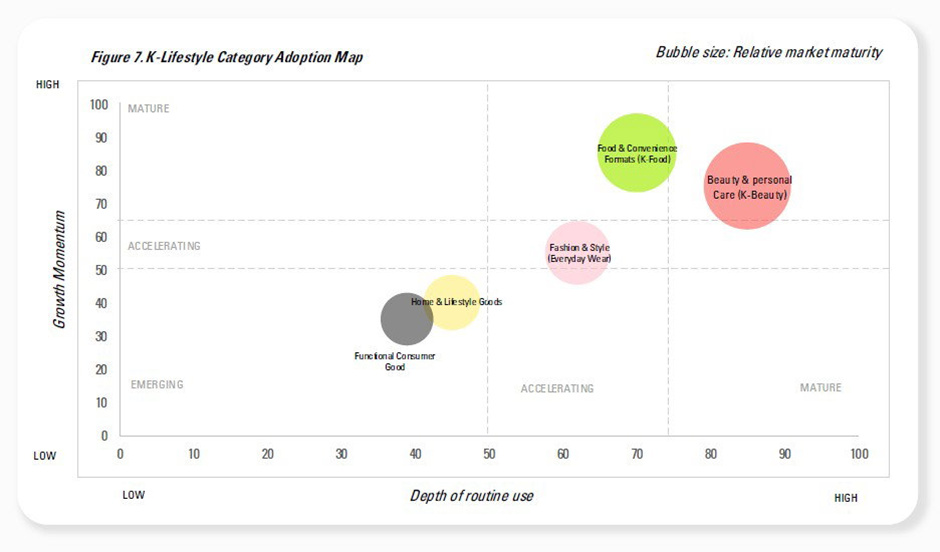
Beauty and personal care are positioned as the most mature category, supported by repeat purchasing and consumer trust. The report notes South Korea’s cosmetics exports reached US$11.43 billion in 2025, up 12.3% year-on-year, with the US overtaking China as the largest destination
Food and convenience products are accelerating, with items like instant noodles, sauces, and ready-to-eat meals increasingly moving into habitual consumption
Fashion and style sit in a transitional stage: aesthetics are mainstream, but purchasing is more seasonal and trend-driven
Home, lifestyle, and functional consumer goods remain emerging, with adoption still dependent on factors like pricing, localisation, education, regulation, and distribution. The report also flags that adoption differs by region, with Asian markets generally moving faster from familiarity to routine consumption than Western markets
Strategic observation: “K-lifestyle” is not one market, it is a stack of category clocks all ticking at different speeds
This is where many brand teams misread momentum. The common assumption is that cultural heat scales linearly across product categories. The contrasting reality is that each category has its own trust thresholds, usage frequency, and proof requirements. The strategic implication is that entertainment-led awareness needs to be paired with category-specific conversion and retention systems
Why entertainment now acts like marketing infrastructure
Assembly argues entertainment is no longer the end product, it is the infrastructure that lowers trial barriers. Dramas, films, and music provide the context that makes a brand feel familiar before the first purchase
Then social platforms do the work of translating familiarity into intent. Creator demonstrations, tutorials, reviews, and user-generated content become the connective tissue between “I like the culture” and “I know how to use this product.”
The report points to Korean skincare routines on TikTok and the global popularity of Buldak spicy noodles, amplified by the viral “Fire Noodle Challenge,” as examples of how social content can convert cultural familiarity into product demand
Strategic observation: entertainment creates the mental availability; creators create the usage narrative
But the report is explicit that curiosity is not durable growth. Trial can be culturally driven, but continued adoption depends on functional product benefits: quality, convenience, or innovation. That is where the marketing job changes. The message can begin with cultural relevance, but it must land on performance proof that fits local expectations
What this means for marketers
The deeper shift is that K-culture is becoming less of a campaign theme and more of a distribution advantage for trust and trial
- Treat culture as an entry point, not the strategyEntertainment adjacency can still open doors, but the report suggests long-term growth requires marketing that stands on product performance. That pushes teams to articulate benefits more clearly and measure repeat behavior, not just attention.
- Match messaging to category maturity, not brand ambitionMature categories like beauty require differentiation and retention thinking because familiarity is already high. Emerging categories require education and localisation because the consumer is still learning what the product is for and why it belongs in their routine.
- Build creator advocacy around real usage, not aestheticsTutorials, demos, and reviews do more than amplify reach. They reduce friction by showing “how this fits into my day,” which is the bridge from fandom to habit, especially for skincare routines and convenience foods highlighted in the report.
- Localisation is a growth constraint, not a finishing touchThe report warns against assuming international expansion is a simple extension of domestic success. Localisation must cover not just language, but the functional value consumers prioritise in each market.
- Optimise for repeat purchase signals, not cultural buzzIf K-lifestyle is the frame, the outcome marketers should monitor is routine consumption: frequency, replenishment, and trust indicators. Cultural spikes can drive trial, but habit formation is where category dominance is built.
Over time, this kind of shift tends to separate brands that are “carried by culture” from brands that are “validated by use.” Both can grow quickly, but only one tends to stay in the basket when the trend cycle moves on
The more interesting question is not whether the Korean wave is ending, but whether marketers are prepared for what comes after viral attention: the slow, measurable work of earning a default place in everyday life
When entertainment becomes infrastructure, the competitive edge is not who rides the moment best. It is who turns that moment into a repeatable adoption engine across markets, categories, and creator ecosystems
This article is created by humans with AI assistance, powered by ContentGrow. Ready to automate your content marketing?Book a discovery call today.
Thanks for booking a call with ContentGrow. We provide scalable and tailored content creation services for B2B brands and publishers worldwide.Let’s chat a bit about your content needs and see if ContentGrow is the right solution for you!IMPORTANT: To confirm a meeting, we need you to provide your

Calendly