


Journal News
Loss of a metabolic gene protects against fatty liver disease
By Hannah Pletcher
July 22, 2026
More than one-third of the global population has metabolic dysfunction-associated steatotic liver disease, or MASLD, a condition in which fat accumulates in the liver. MASLD can progress to more severe diseases like metabolic dysfunction-associated steatohepatitis, cirrhosis and hepatocellular carcinoma. Treatment options are limited and focus on weight loss through lifestyle changes and the use of a couple of medications, while liver transplantation is reserved for advanced disease
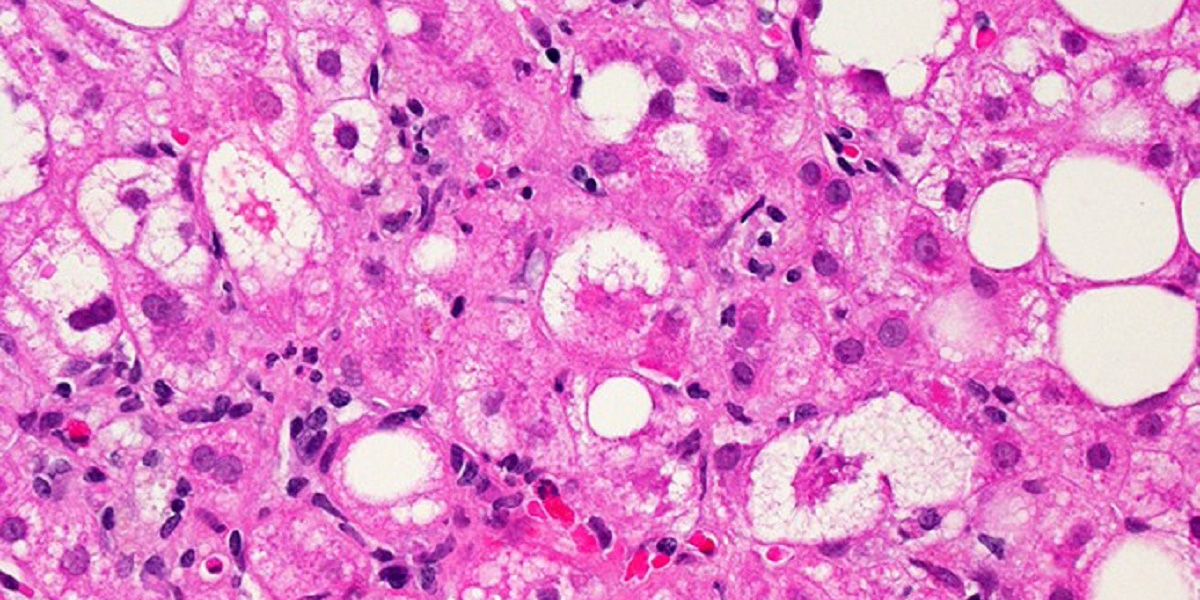
David Kleiner, National Cancer Institute, National Institutes of Health, via NIH Flickr
Light microscopy image of a nonalcoholic fatty liver disease patient’s liver tissue.
With few effective treatment options available, researchers at the University of Michigan are using genetics to identify mechanisms underlying MASLD and potential therapeutic targets. A recent study published in the Journal of Lipid Research revealed that rare loss-of-function mutations in lysophospholipase-like 1, or LYPLAL1, protect women against MASLD
Genetic variants near LYPLAL1 have been associated with MASLD, and previous research from the same laboratory has shown that female mice lacking Lyplal1 are protected against diet-induced obesity. However, how LYPLAL1 contributes to human MASLD remains unclear
“There have been some contradictory results as to how important the protein is in terms of its effects on MASLD,” Rawdat Hussain, research specialist and first author of the study, said
To investigate LYPLAL1’s role in MASLD, the researchers analyzed UK Biobank genetic sequencing data to identify people carrying predicted loss-of-function variants in the gene and examined whether those variants were associated with disease. They found that LYPLAL1 loss-of-function variants shielded against MASLD, particularly in women
“(P)eople with loss-of-function of this protein tend to have less risk of developing MASLD,” Hussain said
To validate the human genetic findings, Hussain and his team deleted LYPLAL1 in human liver cancer cells, which resulted in decreased lipid accumulation after treatment with a fatty acid called oleic acid. The cells lacking LYPLAL1 broke down more fatty acids through a process known as beta-oxidation, potentially explaining the decreased lipid content. The researchers confirmed these results by overexpressing LYPLAL1 in liver cancer cells and observing an increase in lipid content
Together, the human genetic and cellular findings suggest that LYPLAL1 loss-of-function is associated with protection against MASLD, highlighting it as a potential therapeutic target for preventing disease development
“Seeing consistent effects of decreasing LYPLAL1 function protecting against liver steatosis in mice, human population-based genetic data and human cellular data suggest an evolutionarily conserved effect on this trait and increase our confidence that reducing gene function can be beneficial for reducing MASLD,” said Elizabeth Speliotes, professor at the University of Michigan and senior author on the study
“Additional studies will be needed to determine the best way to reduce LYPLAL1 function in humans towards building a therapeutic; having consistent effects like this, however, is the first step,” Hussain said
Enjoy reading ASBMB Today?
Become a member to receive the print edition four times a year and the digital edition monthly
Learn more
Contribute your story
Enter your email address, and we’ll send you a weekly email with recent articles, interviews and more

Interview
Studying how genomes stay intact
July 20, 2026
Patrick O’Brien discusses DNA repair, enzyme evolution, scientific publishing and mentorship, reflecting on the curiosity-driven questions that shaped his career and his approach as a JBC associate editor
Read More

Feature
Building companies for unmet needs
July 16, 2026
Charles Craik’s entrepreneurial journey shows how curiosity-driven chemistry led to multiple biotech companies, and how tools, collaboration and unmet clinical needs shape when academic discoveries move from the lab toward real-world impact
Read More
Journal News
Why Alzheimer’s models may be missing aging
July 15, 2026
Age is the strongest risk factor for Alzheimer’s, yet disease models rarely consider it. Using ultra-sensitive proteomics, researchers in Maryland develop an accelerated-aging Alzheimer’s disease model and find that aging reshapes signaling pathways
Read More

News
In orbit, viruses evolve new ways to kill bacteria
July 10, 2026
Researchers at the University of Wisconsin publish findings from studies on the International Space Station, showing how space accelerates the evolution of viruses that infect bacteria
Read More
Interview
How enzyme chemistry is reshaping peptide drugs
July 8, 2026
Peptide drugs can target complex proteins but often lack stability in the body. Vahe Bandarian discusses how Sethera Therapeutics is engineering complex peptides and translating academic discoveries into real-world applications
Read More

Journal News
How radioactive implants worsen facial nerve injury
June 30, 2026
Researchers uncover how the implantation of radioactive iodine seeds exacerbates facial nerve injury
Read More
