


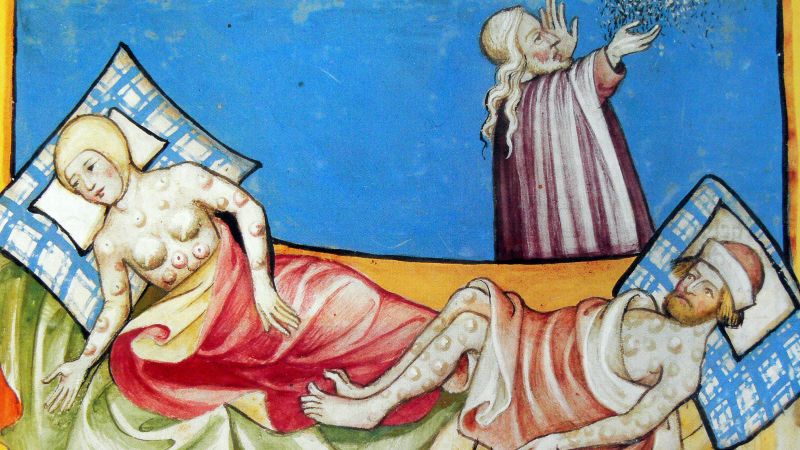
A 15th century illustration of people suffering from a plague of boils. Medical treatments from that era, such as bloodletting, aimed to balance a patient’s humors.
See all topics
In 12th-century Italy, physicians at a medical school in Salerno described the symptoms of plethora, or an excess of blood in the balance of the body’s fluids: “Plethora’s face is of a florid shade, Her eyeballs large and very glaring made; While cheeks and form with mass are overlaid.”
Fast forward to August 2025 when the US Secretary of Health and Human Services, Robert F. Kennedy Jr., said he was “looking at kids while I walk through the airports today, as I walk down the street, and I see these kids that are just overburdened with mitochondrial challenges, inflammation, you can tell it from their faces, from their body movement, and from their lack of social connection.”
The last century has brought about some of the most profound medical and technological advances humanity has ever seen — healing once-lethal bacterial infections, peering inside living bodies, flying people across the oceans and to the moon, solving the structure of DNA and the movement of continents. But the 21st century seems to have taken a turn toward the pre-rational past, with people returning to a model of wellness that can feel like one right out of the Middle Ages, an era where bloodletting, cupping and purging were commonly used to treat ailments.
A 14th century manuscript illustration told doctors which parts of the human body to bleed in order to treat specific ailments.
Today, a “body transformation” spell on Etsy promises “rapid weight loss” and a “dream body” for about $10 or slightly more if the charm is needed in a hurry. An “extreme beauty spell” is selling at a steep discount. (Returns are accepted in case results aren’t satisfactory.) Thousands have attended Energy Healing Conference events in Utah, Montana and Idaho, where breathwork practitioners, Reiki masters and herbalists gather to dispense ancient wisdom. One Reddit post on r/astrology asks about the best celestial placements for “elective surgery.”
Some of this can be attributed to a loss of trust in institutions, especially those tied to public health, thanks in part to the Covid-19 pandemic. “Covid was one of the first times that people actually saw how medical advances work, they saw the fits and starts where we have to learn things and where scientists can make mistakes,” said Roy Perlis, a professor of psychiatry at Harvard Medical School
The transparency of the scientific process mixed with the urgency of the crisis created a vacuum of confidence that wellness influencers have eagerly filled. “Everyone has questions about their health, and people have access to much more information,” Perlis said. “But so much of it isn’t correct and designed to sell them something or erode trust in an institution.”
Engagement PartyThe Year in News: Deepfakes, MAHA & AIAfter a head-spinning year in the worlds of health and technology, Audie invited Dr. Sanjay Gupta, the host of Chasing Life, and Clare Duffy from Terms of Service, to break down the stories that ended up on all their podcasts this year.
Producer: Dan Bloom
Technical Director: Dan Dzula
Executive Producer: Steve Lickteig
Jan 01, 2026 • 36 min
Americans are increasingly seeking health advice from Facebook, TikTok and AI chatbots. Millions of people subscribe to YouTube health influencers like Eric Berg, a Florida-based chiropractor who claims that colloidal silver can help with a phlegmy throat, despite no evidence it has any benefits. There is also consistent and loud messaging from President Donald Trump and RFK Jr., both of whom have spread misinformation about medical care, while working to upend decades of childhood vaccine policies. This week, Trump compared the vaccine amount given to children as equivalent to “a bottle of soda,” when in reality, vaccine doses are far smaller than a teaspoon.
<img src="https://healthylife7.com/wp-content/uploads/2026/08/ap26222726096345.jpg" alt="US Health and Human Services Secretary Robert F. Kennedy Jr. has promoted questionable theories about vaccines, antidepressants and fluoride with little medical evidence to support them.”>
US Health and Human Services Secretary Robert F. Kennedy Jr. has promoted questionable theories about vaccines, antidepressants and fluoride with little medical evidence to support them.
“The language you hear in a lot of ads now is about purging and toxins, where these residues build up in the body over time, that would feel quite familiar to medieval people,” said Meg Leja, a professor of European medieval history at Binghamton University. Websites for ayahuasca retreats highlight the emotional and spiritual benefits of the nonstop vomiting that comes from ingesting the plant mixture. Leja said the “juice cleanses” and “detoxification” protocols of today echo how people 1,000 years ago would have talked about their own health, though that was due to a lack of knowledge about how the body worked. “They had to base treatments off things they could observe, like lunar cycles or menstrual cycles,” she said. “Medieval people weren’t able to look at someone’s bloodwork.”
This is why Leja thinks comparisons between medieval and modern societies aren’t accurate. “What people are doing now doesn’t fit within our current understanding of medicine. Even if the practices seem the same, what medieval people were doing with bloodletting and enemas at least made sense within their scientific framework.”

Debunking false health claims made by RFK Jr. in a CNN interview
2:13• Source:
CNN
Debunking false health claims made by RFK Jr. in a CNN interview
2:13
Ironically, the authority of doctors was supremely important to medieval people, even if the treatments seem barbaric and ineffective now
But they also experienced a cratering of institutional faith, similar to what happened in the aftermath of Covid, in the 14th century following the Black Death, said Robin S. Reich, a history professor at Seattle University who studies the science of the Middle Ages. “European medical practitioners claimed they knew how to treat the disease when they did not. It was incurable with their medicines and they knew that,” she said
One group, though, was able to buck that trend. “The Islamic world did not have this kind of trust crisis because they had a fairly consistent public health policy,” Reich said. Medical practices throughout the world were roughly similar, but the consistency of the messaging helped engender a level of trust that went missing in other locales. “The Islamic world knew to quarantine because the memory of the previous plague pandemic was baked into the Hadith,” Reich said. “It explained the process for quarantine in simple terms and gave clear risks for ignoring it.”
The theory of humors — or the four vital bodily fluids being blood, phlegm, yellow bile and black bile — started in Ancient Greece. It was relied on by physicians for centuries afterwards in Europe, the Middle East and South Asia.
Reich said that there are other parallels between the civilizations she studies and the modern age. “We’re in a moment of medicine where people are casting around for explanations, and we don’t have a lot of faith in experts at the moment,” she said. There has been an increased interest in practices like herbalism and folk healing, which Reich considers an attempt to return to a pre-modern simplicity. “When we look to the past for these solutions, it’s because we think the life we live now is overly complicated by heartless systems,” she said. “There’s a kernel of truth in that. When we don’t acknowledge structural issues, people tend to look for other systems to fill in the gaps.”
People have been feeling frustrated by the health care system, including the high cost of prescription drugs.
Perlis knows that the health care system isn’t blameless in all of this. He said that the pharmaceutical industry has had too much power over doctors in the past, and that physicians have taken too long to identify risks. “I think being critical of people who draw the wrong conclusions is one of the major errors in public health,” Perlis said. “A parent of a sick child is desperate for an answer and if someone offers them an answer they jump at it.”
The desire for clarity about one’s body is an old one that predates the medicine that both Leja and Reich study. As people understood more about the world, they started to understand more about their bodies and how they worked. The health theories developed in the Middle Ages weren’t completely wrong, but they didn’t have a complete picture of human biology. The study of a patient’s urine was an extremely popular practice in the Middle Ages, even though doctors could tell precious little about what was ailing someone just by looking at a sample in a jar. Urine, of course, turned out to be a vital health marker, but only after modern urinalysis treatments were developed in the 19th century.
Urine analysis was one of the most popular tests used to diagnose medieval patients, even though doctors could tell very little about what was actually wrong with someone.

Modern urinalysis started in the 19th century, and allowed for a much more thorough understanding of a patient’s health.
Or consider the Miasma theory, which dates all the way back to Ancient Greece and was a popular contagious disease model throughout the Middle Ages. For centuries, people thought that “bad air” coming from rotting corpses or stagnant water was the cause of many diseases. People were observing something real and assigning conclusions based on what they saw. One odd thing about the return of medieval-style health beliefs is that there is a tension between aspects of a phenomena like the Miasma theory that were proven correct — exposure to toxic fumes clearly leads to disastrous health outcomes — and those that are still unfounded, like the idea that 5G towers and data centers emit cancer-causing radiation.
The progression in understanding came with a complementary trust and a movement away from the supernatural, one that might be reversing today. “Doctors started taking on a political and religious significance in the Middle Ages. Things weren’t just at the whim of the gods anymore,” Leja said. “There was a sense that medicine is a skill that can be learned.” It seems, then, that the modern age of wellness is a movement towards unlearning that lesson. Instead of depending on what is observable to dictate how they take care of themselves, people are increasingly told not to believe their eyes and go with their gut — or whatever else they want.
See all topics
