


Download PDF
Abstract
This study investigated factors associated with mental health outcomes in individuals who have undergone Metabolic Bariatric Surgery (MBS). A sample of 238 adults with history of MBS was assessed with the 21-item Depression and Anxiety Stress Scale (DASS-21), Difficulties in Emotion Regulation Scale (DERS-SF), and the 24-item Body Investment Scale (BIS). Regression and mediation models were employed to investigate factors associated with mental health outcomes. Higher levels of DASS-Depression (β = 2.09, p = 0.03), and DASS-Stress scores (β = 2.49, p = 0.01) were found in individual who have undergone MBS longer ago, in comparison with individuals who underwent MBS more recently. DERS-SF emotion regulation dimensions Strategies (Boot β = 0.81; 95%CI: [0.21, 1.93]; p = 0.005), and BIS dimension Body-Image (Boot β = 1.10; 95%CI: [0.48, 2.03]; p < 0.001), were found to significantly mediate the association between obesity and DASS-21 Depression. BIS-Body image also mediated the association between obesity and DASS-21 Anxiety (Boot β = 0.67; 95%CI: [0.14, 1.38]; p = 0.009) and DASS-21 Stress (Boot β = 1.97; 95%CI: [0.57, 3.86]; p < 0.002). Mental health problems might be present in individuals who have undergone MBS long time ago, despite potential treatment benefits, with presence of obesity and specific emotion regulation and body-investment difficulties being associated with greater depression, anxiety and stress symptomatology.
Subjects
Introduction
Obesity and overweight are complex multifactorial conditions encompassing elevated risk for multimorbidity, including mental health problems1,2,3. According to large-scale studies, the most prevalent comorbid psychiatric disorders in individuals with overweight or obesity are depression, anxiety, binge-eating, and personality disorders4,5,6
The potential long-term benefits of metabolic and bariatric surgery (MBS) for improving general health and quality of life in individuals with obesity are well-known7,8. The literature is, however, less consistent when providing evidence of long-term benefits of MBS for individuals’ mental health9,10. The occurrence of depression and anxiety symptomatology post-MBS has been studied in large-scale cohort studies and summarized in meta-analyses, with mixed findings regarding post-operative symptoms trajectories at medium and long-term.
A meta-analysis published in 2016 found a consistent association between MBS and post-operative reduction in depression symptomatology and severity11. The meta-analysis highlighted that depression was not associated with differences in weight outcomes in post-operative patients. A more recent meta-analysis highlighted longitudinal studies suggesting a post-operative long-term improvement (beyond 24 months post-surgery) in anxiety and depression symptomatology12. However, other longitudinal studies have shown less enthusiastic findings regarding long-term mental health improvements after MBS. A 12-year large prospective study (N = 3045) suggested that post-operative improvements in depression symptomatology did not persist after 3 years13. In a German multi-center 9-year cohort study with post-MBS patients, the 2-year follow-up improvement seen in clinical depression symptoms was not maintained at long-term, with depression symptoms increasing at 4-year and 9-year follow-up14. In another large-cohort study conducted in Taiwan, a 1.7-fold greater risk of major depressive disorder was found in patients who underwent MBS in comparison with controls (patients with severe obesity (body mass index equal or greater than 40) without history of MBS or other surgical treatment for obesity)15. Finally, a meta-analysis of randomised controlled trials highlighted that MBS was not significantly associated with an improvement in mental health related quality of life, from baseline to post-surgery16.
The aetiology of comorbid mental health problems to obesity, as well as factors explaining the prevalence of depression and anxiety post-MBS, are still not fully understood17. Factors underpinning mental health problems in individuals with obesity are deemed to be multifactorial, including factors of biological, psychological and environmental nature. Adiposity-related inflammation and dysregulation of the HPA axis have been highlighted as possible neurobiological correlates of the link obesity and depression18,19,20. Mendelian randomization studies and the genome-wide analysis of depression have suggested a possible genetic influence for the comorbidity between depression and obesity21,22.
Main psychological factors suggested to possibly explain the link between obesity and mental health include, poor body investment and body-image, difficulties associated with interpersonal effectiveness and self-esteem, and presence of binge eating17,23,24. Body investment is a concept that has its roots in clinical psychology research. The concept assumes that psychological self-representations are founded first on early life body experiences, with cognitive and affective aspects of the bodily self being mutually complementary25. It is described as containing four key dimensions of the bodily self, referring to the issue of self-preservation versus self-destruction: body-image feelings and attitudes; comfort in physical contact; body care, and; body protection. Previous research has highlighted the importance of negative body-image perceptions to explain the relationship between obesity (and overweight) and poor mental health, particularly for depression symptomatology17,23,24,26,27. Finally, emotion regulation difficulties have also been identified as a trigger for compulsive eating behaviour, both in obesity and eating disorders patients24,28,29. It has been suggested that emotion regulation difficulties can contribute to explain variability in mental health outcomes in individuals with obesity, including after MBS30, which makes these difficulties a plausible mediator for the association between obesity and mental health.
In summary, the state-of-the-art highlights mixed findings on long-term mental health outcomes after MBS. The longitudinal research suggests different post-operative medium and long-term mental health outcomes trajectories, with very limited evidence on factors explaining individual variability for these outcomes. The literature is not clear about the link between overweight / obesity and mental health after MBS, and about factors explaining and mediating that link. With the current study we want to contribute to a better understanding and new hypotheses on factors explaining different mental health outcomes (symptoms of depression, anxiety and stress) in individuals who have undergone MBS. Considering the previously highlighted possible factors underpinning the link between obesity and mental health17,23,24,26,27,28,31, we want to investigate the influence of psychological factors (body investment and emotion regulation) on mental health outcomes. Additionally, because previous research has suggested that post-MBS mental health outcomes might not be directly associated with different weight profiles, we want to investigate mediators of the relationship between overweight or obesity and symptoms of depression, anxiety, and stress in individuals who have undergone MBS. Considering previous research suggesting body investment and emotion regulation to potentially underpin the link between obesity and mental health, we hypothesize that poorer body investment and emotion regulation difficulties are associated with greater depression, anxiety and stress symptomatology. Secondarily, we also hypothesize that body investment and emotion regulation dimensions mediate the association between obesity and symptoms of depression, anxiety and stress, contributing to explain the link between obesity and mental health in individuals with history of MBS.
Methods
The current observational study examines factors potentially associated with symptoms of depression, anxiety, and stress in a sample of individuals with history of MBS and with different weight profiles (healthy weight; overweight; and obesity). The current study is a post-hoc analysis of a larger-scale research addressing the association between weight profiles and mental health32,33, because we wanted to examine factors underlying mental health problems specific to individuals who have undergone MBS. Methodological procedures in the current study followed the same protocol adopted in the primary research33.
Ethics
This study received ethical clearance by the institutional ethical review board (Instituto Superior Miguel Torga (Coimbra, Portugal), reference: CE-P06-22). All research activities were performed in accordance with relevant guidelines and regulations, and in accordance with the Declaration of Helsinki. Informed consent was obtained from all individuals who agreed to participate in this study. Written informed consent was obtained from all participants in the current study
Sample
A sample of adults with history of MBS was recruited from social media groups dedicated to topics such as MBS, obesity and weight management. Eligibility criteria included: Age of 18 or older; and having undergone MBS in the past. We recruited individuals who have undergone surgery more recently and longer ago, to get a more representative and heterogeneous sample regarding the clinical history. Considering the previous literature suggesting changes in mental health outcomes throughout the first 36 months post MBSs11,12,13,14, we categorized time post-MBS into the following subgroups: up to 12 months (recent procedure); > 12 months to 36 months; and > 36 months. No requirements were set for current participants’ BMI as we wanted to get the maximum variety possible of weight profiles, i.e. healthy, overweight, and obesity, according to the World Health Organization criteria34. Overweight was considered when the person’s BMI ranged from 25 to 29.9, and obesity when the person’s BMI was equal or greater than 30. We excluded participants with known and self-reported cognitive impairment, learning difficulties, or difficulties with the Portuguese language that would affect their ability to access and complete the questionnaire. In the original research32 408 participants responded positively to the invitation to participate in our study, 238 of whom had confirmed history of MBS and therefore were eligible for the current study. Four (n = 4) missing observations were found for the variable “time post-surgery”, making a total number of 234 complete observations.
Data collection and measures
Considering the limitations imposed by the SARS-COV-2 pandemic at the time this study was conducted (recruitment window from January to July 2022), all assessment questionnaires were delivered online after consenting to participate has been obtained. Demographical and clinical information, such as age, gender, height, current weight, self-reported chronic disease, history of mental health problems (pre-surgery), currently receiving any treatment for mental health problems, time since the MBS procedure, as well as standardized measures for psychological assessment were assessed via an online questionnaire.
For the current study, main outcome measures (dependent variables) included the assessment of symptoms of depression, anxiety and stress. Other standardized measures and demographical and clinical variables were taken as potential covariates (independent variables) in our statistical models, as described below
Symptoms of depression, anxiety and stress were assessed using the 21-item Depression and Anxiety Stress Scale (DASS-21)35,36. The DASS-21 includes 21 items with a 4-point Likert scale scoring system, organized in 3 sub-scales (with 7 items each) to assess the severity of symptoms of depression, anxiety and stress. Scores greater than 9, 7 and 14 suggest mild or more severe symptomatology of depression, anxiety and stress respectively. A good internal consistency was found both in the original version (Cronbach α: 0.91 for the depression subscale; 0.84 for the anxiety subscale; and 0.90 for the stress subscale), and the Portuguese version (Cronbach α of 0.85 for the Depression subscale, 0.74 for the anxiety subscale, and 0.81 for the stress subscale)36.
The 24-item Body Investment Scale (BIS)37,38 was used to assess Body investment dimensions. The instrument comprises four subscales to assess: feelings and attitudes toward the body; comfort with the physical touch; body care; and body protection. Each subscale includes 6 items, scored in a 5-point Likert scale. Greater scores suggest more positive feelings about, and a better investment in the own body. Good internal consistency was found in the original version (α ranging from 0.8 to 0.95), and in the Portuguese version, in which the instrument was tested with clinical (eating disorders) (from α = 0.67 to α = 0.93), and non-clinical samples (from α = 0.62 to α = 0.91).
The short version of the Difficulties in Emotion Regulation Scale (DERS-SF)39,40,41 was used to assess Emotion Regulation difficulties. The DERS-SF comprises 18 items, covering 4 dimensions of emotion regulation: acceptance of emotions; awareness and understanding of emotions; ability to engage in goal-directed behaviour and refrain from impulsive behaviour when experiencing negative emotions; and access to emotion regulation strategies perceived as effective. The instrument has six subscales: Nonacceptance of emotion responses; difficulty engaging in goal-directed behaviour; impulse control difficulties; lack of emotion awareness; limited access to emotion regulation strategies; and lack of emotion clarity. The scoring system uses a 5-point Likert scale, with higher scores suggesting greater difficulties in the corresponding emotion regulation dimension. The instrument has shown a good internal consistency, both in the original version (α = 0.93), and in the Portuguese version (α = 0.93).
Data analysis
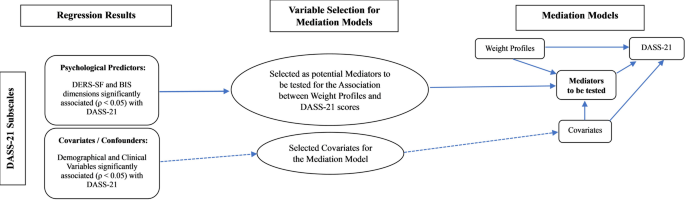
The strategy adopted for statistical analysis included regression and mediation models, to be conducted separately. Regression models have been run in the first place, to identify factors potentially associated with mental health outcomes (DASS-21 scores), including body-investment dimensions, emotion regulation dimensions (DERS-SF scores), and demographical and clinical variables that might be relevant as confounders (e.g. sex, age, education, history of mental health). Psychological dimensions (BIS and DERS-SF subscales) that have been found statistically significant (ρ < 0.05) associated with DASS-21 scores in the regression model were then selected to be included as potential mediators for each mediation model (one mediation analysis for each DASS-21 subscale). Each mediation model has been designed to test the hypothesis that weight profiles (healthy; overweight; obesity) are indirectly associated with DASS-21 scores, via the effect of psychological mediators. The variable selection process for designing mediation models is presented in Fig. 1. All regression and mediation models were performed with complete cases (N = 234), with four cases (n = 4) containing missing information for time post-surgery being excluded from the analyses.
Strategy adopted for mediation model design
Robust regression and robust mediation models have been conducted, as in both cases assumptions for classical linear regression using the ordinary least squares estimation have not been met, including normal distribution of residuals and presence of outliers and extreme observations affecting the performance of our models
All statistical analyses were undertaken with R (version 4.3.1; RStudio 2023.12.0). A-priori sample size calculations were conducted using the pwr R package for a multiple regression model, planned to investigate potential predictors of symptoms of depression, anxiety and stress in a sample of individuals with different weight profiles and medical history. The multiple regression was set for including seventeen predictors, with a medium effect size (F) = 0.15, α = 0.05, and 1-β = 0.80, resulting in a minimum required sample size of 146 individuals. Potential loss of statistical power caused by the heterogeneity of our sample was minimized by aiming to recruit at least 200 individuals with confirmed history of MBS. The power analysis for robust mediation models was set to anticipate a standardized β of 0.40 and 0.1 for the indirect paths (X – M; M – Y) and for direct effects (X – C) respectively (see Figure A in supplementary materials), following previous literature33. Power analysis for robust mediation models was performed with Monte Carlo simulation with bootstrap (with α = 0.05), using the WebPower R package. Power analysis simulation results suggest a minimum of 100 observations for an 80% statistical power (see Figure B in supplementary materials).
Regression models
The SMDM-estimator was adopted as the robust regression method for our regression models42,43. The SMDM is an extension of the standard MM-estimate with two additional steps, added to deal with issues such as the bias in the S-scale estimate, and loss of efficiency of the estimated parameters42,43. In this method, the MM-estimation is followed by the calculation of the Design Adaptive Scale Estimate, and then the regression parameters are re-estimated on a new scale, using the MM-estimate as the initial estimate43. The acronym SMDM, therefore, stands for the combination of estimates used in each method step: S-estimation, followed by an M-step, a D-estimation of scale, and another M-step at the end. In simulation studies comparing different robust regression methods, the SMDM showed better performance and lower levels of bias in comparison with other robust regression approaches, when the number of observations n is less than 5 times the number of parameters p to be estimated42,43, which is the case of our models. All robust regression models met key statistical assumptions for linear regression, including normal distribution of residuals, no multicollinearity (all VIF < 2), and homoscedasticity (Breusch-Pagan Test with p > 0.05).
In the attempt to minimize the potential bias coming from the cross-sectional design of our study, which entails the inability to establish a temporal order regarding the association between the independent variable and the outcome of interest, our regression models were adjusted for all potential confounders, including: sex; age; education level; history of mental health problems (whether the mental health problems have been previously diagnosed); history of chronic disease (as multimorbidity has been identified as an important risk factor for mental health problems); and different medical history regarding the elapsed time post-surgery (how long the surgery has been undergone).
Robust regression models included a set of seventeen predictors of DASS-21 scores, including all previously mentioned confounders plus: weight profile groups (healthy; overweight; obesity); time post-MBS, categorized into the following subgroups: up to 12 months; > 12 months to 36 months; and > 36 months; the six subscales of the DERS-SF scale (emotion regulation); and the four subscales of the BIS scale (body investment). All variables collected in our study (demographical, clinical and standardized measures) were included in the regression models, due the limited evidence in the topic of mental health following MBS. The robustbase R package was used to perform robust regression models44.
Mediation models
Robust mediation analysis was performed using the robust MM-estimator of regression and a fast-and-robust bootstrap methodology for robust regression estimators45. In mediation analysis models, we investigated the hypothesis that weight profiles of obesity (categorical variable: healthy; overweight; obesity) are indirectly associated with mental health outcomes (symptoms of depression, anxiety and stress), via specific psychological mediators. One mediation model was run for each mental health outcome (DASS-21 scores). The psychological variables previously found to be significantly associated with each mental health outcome in the multiple regression models were selected as the theoretical mediators to be included in each mediation model. For each mental health outcome, we designed a parallel mediation model, with several potential mediators, adjusting for age (in the model for depression) and for chronic disease and history of mental health (in models for anxiety and stress), according to which factors had been found significant in the corresponding regression models. The theoretical mediation model is presented in Figure A (Supplementary Materials). Considering the lack of normality for the residuals’ distribution and other statistical assumptions for the classical linear regression, a robust mediation analysis was adopted. The robmed R package was used to perform the robust mediation analysis models46.
Results
Two-hundred thirty-eight individuals (N = 238) were included in our study. Sample characteristics are presented in Table 1. Our sample was mostly composed of female individuals, with the secondary school complete or above, and currently employed. 33% (N = 79) of our sample reported a current chronic disease, with asthma, hypothyroidism, and diabetes being the most reported chronic diseases. Gastric bypass (N = 134; 56%) and Gastric sleeve (N = 91; 38%) were the most common surgical techniques used. Other surgical techniques include Mini-Gastric bypass, Gastric band, Endoscopic gastroplasty, Endoscopic Sleeve, Gastric Balloon, cholecystectomy, other mixed-surgical treatments (e.g. Sleeve + Mini-Gastric Bypass). Scores in DASS21 subscales were heterogeneous, showing large variation across individuals, with mean scores for depression, anxiety and stress being within the normal symptomatology range (Table 1). Based on DASS-21 scores, 23% of our sample (n = 56) showed moderate to severe depression symptomatology, 25% (n = 60) showed moderate to severe anxiety and stress symptomatology.
Symptoms of depression, anxiety, and stress
Regression models for symptoms of depression, anxiety and stress (DASS-21 scores) are presented in Table 2, with model variance ranging from 33% to 51%. Age (being younger), having undergone MBS longer ago (linear positive association) (Fig. 2), greater scores (poorer outcomes) in DERS-SF Nonacceptance and Strategies subscales, lower scores (poorer outcomes) on BIS Protection, Body-image subscales, and higher scores (better outcomes) on BIS-Touch subscale, were significantly associated with greater scores on DASS-Depression. Presence of chronic disease, greater scores in the DERS-SF Nonacceptance subscale, lower scores (poorer outcomes) on BIS Protection, and Body-image, and higher scores (better outcomes) on BIS-Touch subscales, were significantly associated with greater scores on DASS-Anxiety. Age (being younger), having history of mental health problems, having undergone MBS longer ago (linear positive association), greater scores (poorer outcomes) in the DERS-SF Impulse, Nonacceptance, and Strategies subscales, lower scores (poorer outcomes) in the BIS Body-image and higher scores (better outcomes) on BIS-Touch subscales, were significantly associated with greater DASS-Stress scores. None of the weight profiles (healthy; overweight; obesity) were significantly associated with DASS-21 outcomes.
Linear association between time post-surgery and symptoms of depression and stress
Mediators of the relationship between weight and mental health outcomes
The results of mediation models suggested a significant indirect effect for the relationship between weight profile groups (healthy; overweight; obesity) and mental health outcomes (DASS-21 scores for depression, anxiety and stress), via specific psychological mediators (mediation models illustrated in Figs. 3 and 4, and Fig. 5). Full statistical results for all mediation models are presented in Supplementary Materials. For symptoms of depression the results suggested significant total indirect effect between weight groups (for having obesity) and DASS-Depression scores (Boot β = 1.84; 95%CI: [0.65, 3.43]; p = 0.003), via psychological mediators DERS-SF-Strategies (Boot β = 0.81; 95%CI: [0.21, 1.93]; p = 0.005); and BIS-Body-Image (Boot β = 1.10; 95%CI: [0.48, 2.03]; p < 0.001). The pathway of these indirect effects (Fig. 1) suggested that having obesity was significantly associated with greater scores (more difficulties) in DERS-SF-Strategies, which in turn was positively associated with DASS-Depression scores. Having obesity was also significantly associated with lower scores in BIS-Body-Image, which in turn was negatively associated with DASS-Depression scores. The model for DASS-Depression included age and time post-surgery as covariates, which were not found to have any significant association with the mediators.
Mediation Model for symptoms of depression. Mediation model with significant mediators (DERS-SF Strategies and BIS-Body-Image), adjusted for age and time post-bariatric surgery (covariates), with values representing regression coefficients (β); 1Obesity is part of a categorical variable including 3 categories: healthy weight (BMI < 25); overweight (25 ≥ BMI < 30); and obesity (BMI > 30); NS: Non-significant, with ρ-value > 0.05; *ρ < 0.05; **ρ < 0.01; ***ρ < 0.001; DERS-SF: The Difficulties in Emotion Regulation Scale – Short Form; BIS: Body-investment Scale; The full mediation model included other non-significant (p > 0.05) mediators, such as DERS-SF-Nonacceptance, BIS-Protection, and BIS-Touch.
Mediation model for symptoms of anxiety. Mediation model with the significant mediator (BIS-Body-Image), adjusted for presence of chronic disease (covariate), with values representing regression coefficients (β); 1Obesity is part of a categorical variable including 3 categories: healthy weight (BMI < 25); overweight (25 ≥ BMI < 30); and obesity (BMI > 30); NS: Non-significant, with ρ-value > 0.05; *ρ < 0.05; **ρ < 0.01; ***ρ < 0.001; DERS-SF: The Difficulties in Emotion Regulation Scale – Short Form; BIS: Body-investment Scale; The full mediation model included other non-significant (p > 0.05) mediators, such as DERS-SF-Nonacceptance, BIS-Protection, and BIS-Touch.
Mediation model for symptoms of stress. Mediation model with significant mediators (DERS-SF Impulse; DERS-SF Strategies; BIS Body-Image), adjusted for age, history of mental health, and time post-bariatric surgery (covariates), with values representing regression coefficients (β); 1Obesity is part of a categorical variable including 3 categories: healthy weight (BMI < 25); overweight (25 ≥ BMI < 30); and obesity (BMI > 30); NS: Non-significant, with ρ-value > 0.05; *ρ < 0.05; **ρ < 0.01; ***ρ < 0.001; DERS-SF: The Difficulties in Emotion Regulation Scale – Short Form; BIS: Body-investment Scale; The full mediation model included other non-significant (p > 0.05) mediators, such as DERS-SF-Nonacceptance, and BIS-Touch., and a covariate, age, which was only significantly associated with DASS-Stress (β = -0.18; p = 0.004).
The mediation model for symptoms of anxiety showed a significant total indirect effect between weight groups (for having obesity), and DASS-Anxiety scores (Boot β = 0.74; 95%CI: [0.002, 1.63]; p = 0.04), via the psychological mediator BIS-Body-image (Boot β = 0.67; 95%CI: [0.14, 1.38]; p = 0.009). The pathway of these indirect effects (Fig. 2) suggests that having obesity was significantly associated with lower scores on BIS-Body-image, which in turn was negatively associated with DASS-Anxiety scores. The model for DASS-Anxiety included chronic disease as a covariate, which was not significantly associated with any mediators.
The mediation model for symptoms of stress showed a significant total indirect effect between weight groups (for having obesity), and DASS-Stress scores (Boot β = 4.43; 95%CI: [1.75, 7.46]; p = 0.002), via psychological mediators DERS-SF-Impulse (Boot β = 0.86; 95%CI: [0.05, 2.06]; p = 0.03), DERS-SF-Strategies (Boot β = 1.26; 95%CI: [0.25, 2.65]; p = 0.001), and BIS-Body-image (Boot β = 1.97; 95%CI: [0.57, 3.86]; p < 0.002). The pathway of these indirect effects (Fig. 3) suggests that having obesity was significantly associated with greater scores on DERS-SF-Impulse and on DERS-SF-Strategies, which in turn were positively associated with DASS-Stress scores and DERS-SF-Strategies. Having obesity was also significantly associated with lower scores in BIS-Body-Image, which in turn was negatively associated with DASS-Stress scores. Having pre-surgery history of mental health was positively associated with the mediators DERS-SF-Impulse and DERS-SF-Strategies.
Discussion
The current study provides new insights on the underlying factors of mental health problems in individuals with history of obesity and MBS. Findings are still preliminary and no causal-temporal associations can be assumed due to the exploratory cross-sectional study design. Our study results confirmed the hypothesis that specific emotion regulation and body investment difficulties are associated with greater symptomatology of depression, anxiety and stress in these individuals. Furthermore, a positive linear association between time post-MBS and depression and stress symptomatology was found, which suggests that mental health problems might be present (and more pronounced) in individuals who have undergone MBS longer ago (beyond 4 years), in comparison with individuals who underwent MBS more recently. The mediation analyses results are consistent with our previous hypotheses that having obesity can be indirectly associated with mental health problems, via the mediation effect of specific dimensions of emotional regulation and body investment. However, this mediation effect does not imply any temporal association between obesity and mental health, but instead a hypothetical effect that some psychological dimensions (body image; emotion regulation) might have to explain the link between obesity and symptoms of depression, anxiety and stress.
The regression models suggested that individuals who had undergone the surgery for longer showed higher levels of depression and stress symptomatology, even beyond 36 months post-MBS, in comparison with individuals who underwent surgery more recently. The previous literature on the potential benefits of MBS for mental health is, however, mixed and inconclusive, as some studies suggested a long-term post-surgery improvement in mental health9,47, whereas other studies, including meta-analyses and longitudinal studies, have suggested that those improvements are reverted three or four years post-MBS3,17. A meta-analysis of randomized controlled trials highlighted that despite effectiveness of MBS for improving physical health (e.g. managing weight loss; less comorbidities), it fails to be associated with long-term improvements in mental health quality of life16. Two meta-analyses highlighted that individuals who seek MBS are more prone to have higher baseline risk for more severe mental health problems than individuals not seeking MBS16,17, which would partially explain the persistent post-operative mental health problems. Our findings, however, should be interpreted with caution as the linear relationship between time post- surgery and mental health resulted from a cross-sectional study design, i.e., no follow-up mental health assessments were considered in this study, which would give us a more realistic picture on the link between MBS and mental health.
The comorbidity of overweight / obesity and symptoms of depression, anxiety and stress has been well documented4,6,21,48. The aetiology is described to be multifactorial and possibly triggered by factors of psychological nature1,2. In the current study, emotion regulation difficulties such as a tendency toward secondary responses to negative emotions, and / or denial of distress (measured by the DERS-SF-Strategies subscale)39,40, beliefs that there is nothing we can do to cope effectively with negative emotions after becoming upset39,40(measured by the DERS-SF Nonacceptance subscale), and impulse control difficulties revealing individuals’ struggles to control behaviour when upset (measured by the DERS-SF-Impulse subscale)39,40, were associated with poorer mental health outcomes, i.e. greater scores on the DASS-21 scale. The literature examining the association between emotion regulation difficulties and post-MBS mental health is limited, but suggests a tendency for these difficulties, together with eating pathology, to be prevalent in individuals seeking MBS30,31,32,33,34,35,36,37,38,39,40,41,42,43,44,45,46,47,48,49,50. A 3-year longitudinal study found post-operative emotion regulation difficulties to predict depression symptomatology and eating disorders51. Another longitudinal study suggested a post-MBS improvement in depressive symptoms positively associated with an improvement in emotion regulation52.
In our study, body investment difficulties were independently associated with higher levels of depression, anxiety and stress symptomatology. Previous studies have highlighted body investment and body-image difficulties to be prevalent in individuals with obesity53,54,55,56, although there is still paucity of literature effectively linking these difficulties to post-MBS mental health problems. The available literature suggested an association between body-dissatisfaction and unhealthy diet behaviours (e.g. restraint and unsustainable diets), dichotomous thinking, and recurrent binge-eating53,54. Body image concerns and body dissatisfaction are also known to increase the risk for attrition and poor adherence to weight loss programs, particularly in cases of comorbid depression55,56,57,58. Body-image concerns in individuals who underwent MBS have also been found to mediate the association between weight loss and depressive symptoms58, which is also consistent with our findings. As body image concerns and dissatisfaction are often linked to poor self-esteem55, the relationship between obesity, poor body image, and depression are expected to co-occur and might be synergistic. Unexpectedly, a positive body-investment outcome related to the individual’s comfort level with physical contact (BIS-Touch) was independently associated with poorer mental health outcomes (DASS-21 scores). This finding should be clarified in future longitudinal studies with more data, as previous research suggests that poorer body-investment and body-satisfaction is associated with depression59.
These findings contribute to explain why obesity and mental health have not always been found to be comorbid in individuals with history of MBS, as the literature is mixed in this respect9,16,17,47. Furthermore, there is no evidence that obesity and mental health problems are directly linked in individuals who have undergone MBS13,16,60,61, which suggests this relationship to be possibly mediated by other factors. Our mediation models suggest that individuals with post-MBS obesity who have specific emotion regulation and body-image concerns are more prone to have elevated depression, anxiety and stress symptomatology. This might explain why some individuals develop mental health problems after MBS and others not. Previous literature is very limited but corroborates the idea that difficulties in these psychological dimensions are likely to predict poor mental health outcomes in individuals with obesity and in individuals who underwent MBS51,52,55,56,57,58. However, not all mental health problems in our sample have their onset after surgery and might have been unrelated to MBS. Furthermore, in some individuals, mental health problems (pre and post-surgery) might have a multiple aetiology, including factors unrelated to obesity and MBS that we did not explore in our study. Future cohort studies should clarify the actual role of emotion regulation and body investment difficulties in relation to post-MBS mental health, as well as the importance of other pre and post-surgical factors (e.g. social, biological, environmental). Finally, these mediating associations should be seen as hypotheses to be confirmed in future longitudinal studies, due to the limitations of adopting a cross-section al design in the present study.
Strengths, limitations, clinical implications, and future perspectives
Main strengths of the current study include a relatively large sample size composed of individuals with different weight profiles, medical history (including pre-surgery history of mental health problems), the use of different measures for mental health outcomes (not only symptomology-based measures), and the use of robust statistical methods. Main study limitations include a cross-sectional design not allowing us to capture variations overtime for the outcomes of interest, including pre- and post-surgery outcomes, the use of self-reported measures, and the fact that our sample was mostly female with higher education level, which limits generalization of our findings. The current findings should, therefore, be seen as preliminary in relation to potential predictors of post-surgery mental health outcomes and providing plausible hypotheses that should be tested in larger-scale cohort studies. In addition, in the current study we only examined results obtained from online surveys and questionnaires which might considerably limit generalizability of findings, as there were no direct clinical observation and in-person assessment. For the current study we did not assess preoperative or lifetime maximum BMI, extent of weight loss (after surgery), any weight regain, postoperative complications, and body contouring procedures. These clinical factors could potentially influence medical outcomes and mental health. We assume that presence of obesity after MBS is likely a poor outcome, but we did not assess individual weight changes. We have now included this as part of study limitations. Another limitation is the fact that the variable “chronic disease” was self-reported and not treated separately for each condition (e.g. only for diabetes, or cardiovascular). The presence of specific comorbid medical conditions might affect the way obesity and mental health are linked. Participants were recruited through social media groups focused on bariatric surgery, obesity, and weight management, and this strategy might have oversampled individuals still experiencing psychological or weight-related difficulties. Finally, our study only tested hypotheses related to psychological variables (e.g. body-image; emotion regulation) that have been previously highlighted in the literature, but there are other possible predictors of the link between obesity and depression that might be addressed in future studies.
On the side of clinical implications, the current study highlights the potential importance of addressing specific emotion regulation and body image difficulties to assess mental health in individuals with obesity after having undergone MBS. A multidisciplinary treatment approach with a focus on these psychological dimensions might have potential to improve individuals’ well-being, mental health, and treatment outcomes
Future larger-scale longitudinal studies will be needed to confirm the actual importance of these predictors for these patients, as well as to test other predictors and mediators (e.g. biomarkers)
Conclusions
In conclusion, the current study highlights the potential importance of specific psychological dimensions related to body investment and emotion regulation, to explain the prevalence of mental health problems in individuals with history of MBS and with different weight profiles. Future large-scale cohort studies and might benefit from considering the potential role of these factors, to bring the evidence needed in this topic, which will be key to inform multidisciplinary pre- and post-operative assessment protocols.
Data availability
All data generated or analysed during this study are included in this article [and its supplementary material files]. Further enquiries can be directed to the corresponding author
References
Kivimäki, M. et al. Body-mass index and risk of obesity-related complex multimorbidity: an observational multicohort study. Lancet Diabetes Endocrinol.10https://doi.org/10.1016/S2213-8587(22)00033-X (2022)
Delpino, F. M. et al. Overweight, obesity and risk of multimorbidity: A systematic review and meta-analysis of longitudinal studies. Obes. Rev.24 (2023)
Lin, H. Y. et al. Psychiatric disorders of patients seeking obesity treatment. BMC Psychiatry. 13https://doi.org/10.1186/1471-244X-13-1 (2013)
Avila, C. et al. An overview of links between obesity and mental health. Curr. Obes. Rep. 4 (2015)
Perry, C., Guillory, T. S. & Dilks, S. S. Obesity and Psychiatric Disorders (Nursing Clinics of North America 56, 2021)
Leutner, M. et al. Obesity as pleiotropic risk state for metabolic and mental health throughout life. Transl Psychiatry. 13https://doi.org/10.1038/s41398-023-02447-w (2023)
Arterburn, D. E., Telem, D. A., Kushner, R. F. & Courcoulas, A. P. Benefits and Risks of Bariatric Surgery in Adults: A Review (JAMA – Journal of the American Medical Association 324, 2020)
Lindekilde, N. et al. The impact of bariatric surgery on quality of life: A systematic review and meta-analysis. Obes. Rev.16https://doi.org/10.1111/obr.12294 (2015)
Driscoll, S., Gregory, D. M., Fardy, J. M. & Twells, L. K. Long-term health-related quality of life in bariatric surgery patients: A systematic review and meta-analysis. Obesity24https://doi.org/10.1002/oby.21322 (2016)
Müller, A., Hase, C., Pommnitz, M. & de Zwaan, M. Depression and Suicide After Bariatric Surgery. Curr. Psychiatry Rep.21, 84. https://doi.org/10.1007/s11920-019-1069-1 (2019)
Dawes, A. J. et al. Mental Health Conditions Among Patients Seeking and Undergoing Bariatric Surgery. JAMA315, 150. https://doi.org/10.1001/jama.2015.18118 (2016)
Gill, H. et al. The long-term effect of bariatric surgery on depression and anxiety. J. Affect. Disord. 246, 886–894. https://doi.org/10.1016/j.jad.2018.12.113 (2019)
Booth, H. et al. Impact of bariatric surgery on clinical depression. Interrupted time series study with matched controls. J. Affect. Disord. 174, 644–649. https://doi.org/10.1016/j.jad.2014.12.050 (2015)
Herpertz, S. et al. Health-related quality of life and psychological functioning 9 years after restrictive surgical treatment for obesity. Surg. Obes. Relat. Dis.11, 1361–1370. https://doi.org/10.1016/j.soard.2015.04.008 (2015)
Lu, C-W. et al. Increased risk for major depressive disorder in severely obese patients after bariatric surgery — a 12-year nationwide cohort study. Ann. Med.50, 605–612. https://doi.org/10.1080/07853890.2018.1511917 (2018)
Szmulewicz, A. et al. Mental health quality of life after bariatric surgery: A systematic review and meta-analysis of randomized clinical trials. Clin. Obes. 9 (2019)
Wimmelmann, C. L., Dela, F. & Mortensen, E. L. Psychological predictors of mental health and health-related quality of life after bariatric surgery: A review of the recent research. Obes. Res. Clin. Pract. 8 (2014)
Schachter, J. et al. Effects of obesity on depression: A role for inflammation and the gut microbiota. Brain Behav. Immun.69, 1–8. https://doi.org/10.1016/j.bbi.2017.08.026 (2018)
Robles, B., Kuo, T. & Galván, A. Understanding the Neuroscience Underpinnings of Obesity and Depression: Implications for Policy Development and Public Health Practice. Front. Public. Health. 9https://doi.org/10.3389/fpubh.2021.714236 (2021)
Agustí, A. et al. Interplay Between the Gut-Brain Axis, Obesity and Cognitive Function. Front. Neurosci.12https://doi.org/10.3389/fnins.2018.00155 (2018)
Jokela, M. & Laakasuo, M. Obesity as a causal risk factor for depression: Systematic review and meta-analysis of Mendelian Randomization studies and implications for population mental health. J. Psychiatr Res.163https://doi.org/10.1016/j.jpsychires.2023.05.034 (2023)
Howard, D. M. et al. Genome-wide meta-analysis of depression identifies 102 independent variants and highlights the importance of the prefrontal brain regions. Nat. Neurosci.22https://doi.org/10.1038/s41593-018-0326-7 (2019)
Preiss, K., Brennan, L. & Clarke, D. A systematic review of variables associated with the relationship between obesity and depression. Obes. Rev.14 (2013)
Abdoli, M. et al. Body image, self-esteem, emotion regulation, and eating disorders in adults: a systematic review. neuropsychiatrie39, 118–132. https://doi.org/10.1007/s40211-025-00544-4 (2025)
Orbach, I. & Mikulincer, M. The Body Investment Scale: Construction and validation of a body experience scale. Psychol. Assess.10, 415–425. https://doi.org/10.1037/1040-3590.10.4.415 (1998)
Czepczor-Bernat, K., Modrzejewska, A., Modrzejewska, J. & Pękała, M. A preliminary study of body image and depression among adults during COVID-19: A moderation model. Arch. Psychiatr Nurs.36, 55–61. https://doi.org/10.1016/j.apnu.2021.11.001 (2022)
Jun, E. M. & Choi, S. B. Obesity, Body Image, Depression, and Weight-control Behaviour Among Female University Students in Korea. J. Cancer Prev.19, 240–246. https://doi.org/10.15430/JCP.2014.19.3.240 (2014)
Sloan, E. et al. Emotion regulation as a transdiagnostic treatment construct across anxiety, depression, substance, eating and borderline personality disorders: A systematic review. Clin. Psychol. Rev. 57 (2017)
Leehr, E. J. et al. Emotion regulation model in binge eating disorder and obesity – a systematic review. Neurosci. Biobehav Rev. 49 (2015)
Lavender, J. M. et al. Examining emotion-, personality-, and reward-related dispositional tendencies in relation to eating pathology and weight change over seven years in the Longitudinal Assessment of Bariatric Surgery (LABS) study. J. Psychiatr Res.120, 124–130. https://doi.org/10.1016/j.jpsychires.2019.10.014 (2020)
Leehr, E. J. et al. Emotion regulation model in binge eating disorder and obesity – a systematic review. Neurosci. Biobehav Rev.49, 125–134. https://doi.org/10.1016/j.neubiorev.2014.12.008 (2015)
Joana, H. A Autoimagem, Regulação Emocional, Ansiedade, Stress e Depressão em sujeitos obesos submetidos a Cirurgia Bariátrica. MSc in Clinical Psychology Thesis, ISMT (2022)
Henriques, J., Afreixo, V., Unterrainer, H. & Senra, H. Psychological Mediators of the Association between Obesity and Symptoms of Depression, Anxiety, and Stress. Neuropsychobiology84, 26–37. https://doi.org/10.1159/000542767 (2024)
World Health Organization. Moderate and severe thinness, underweight, overweight, obesity. (2026). <a href="https://apps.who.int/nutrition/landscape/help.aspx?menu=0&helpid=420″ rel=”nofollow noopener” target=”_blank”>https://apps.who.int/nutrition/landscape/help.aspx?menu=0&helpid=420
Lovibond, P. F. & Lovibond, S. H. The structure of negative emotional states: Comparison of the Depression Anxiety Stress Scales (DASS) with the Beck Depression and Anxiety Inventories. Behav. Res. Ther.33https://doi.org/10.1016/0005-7967(94)00075-U (1995)
Pais-Ribeiro, J. L., Honrado, A. & Leal, I. Contribuição Para O Estudo Da Adaptação Portuguesa Das Escalas De Ansiedade, Depressão E Stress (Eads) (2004). De 21 Itens De Lovibond E Lovibond. Psicologia, Saúde & Doenças 5:
Orbach, I. & Mikulincer, M. The body investment scale: Construction and validation of a body experience scale. Psychol. Assess.10https://doi.org/10.1037/1040-3590.10.4.415 (1998)
Vieira, A. I., Fernandes, J., Machado, P. P. P. & Gonçalves, S. The Portuguese version of the body investment scale: Psychometric properties and relationships with disordered eating and emotion dysregulation. J. Eat. Disord. 8https://doi.org/10.1186/s40337-020-00302-7 (2020)
Kaufman, E. A. et al. The Difficulties in Emotion Regulation Scale Short Form (DERS-SF): Validation and Replication in Adolescent and Adult Samples. J. Psychopathol. Behav. Assess.38https://doi.org/10.1007/s10862-015-9529-3 (2016)
Moreira, H., Gouveia, M. J. & Canavarro, M. C. A bifactor analysis of the Difficulties in Emotion Regulation Scale – Short Form (DERS-SF) in a sample of adolescents and adults. Curr. Psychol.41https://doi.org/10.1007/s12144-019-00602-5 (2022)
Veloso, M., Gouveia, J. P. & Dinis, A. Estudos de validação com a versão portuguesa da Escala de Dificuldades na Regulação Emocional (EDRE). Psychologica (2011). https://doi.org/10.14195/1647-8606_54_4
Koller, M. & Stahel, W. A. Sharpening Wald-type inference in robust regression for small samples. Comput. Stat. Data Anal.https://doi.org/10.1016/j.csda.2011.02.014 (2011). 55:
Koller, M. Simulations for Sharpening Wald-type Inference in Robust Regression for Small Samples. (2023). https://cran.r-project.org/web/packages/robustbase/vignettes/lmrob_simulation.pdf
Maechler, M. et al. robustbase: Basic Robust Statistics. R package (2015)
Alfons, A., Ateş, N. Y. & Groenen, P. J. F. A Robust Bootstrap Test for Mediation Analysis. Organ. Res. Methods. 25https://doi.org/10.1177/1094428121999096 (2022)
Alfons, A., Ateş, N. Y. & Groenen, P. J. F. Robust Mediation Analysis: The R Package robmed. J. Stat. Softw.103https://doi.org/10.18637/jss.v103.i13 (2022)
Raza, M. M., Njdeaka-Kevin, T., Polo, J. & Azimuddin, K. Long-Term Outcomes of Bariatric Surgery: A Systematic Review. Cureus. (2023). https://doi.org/10.7759/cureus.39638
Amiri, S. & Behnezhad, S. Obesity and anxiety symptoms: a systematic review and meta-analysis. Neuropsychiatrie33https://doi.org/10.1007/s40211-019-0302-9 (2019)
Ahmadkaraji, S., Farahani, H., Orfi, K. & Fathali Lavasani, F. Food addiction and binge eating disorder are linked to shared and unique deficits in emotion regulation among female seeking bariatric surgery. J. Eat. Disord. 11, 97. https://doi.org/10.1186/s40337-023-00815-x (2023)
Belloli, A. et al. Emotion dysregulation links pathological eating styles and psychopathological traits in bariatric surgery candidates. Front. Psychiatry. 15https://doi.org/10.3389/fpsyt.2024.1369720 (2024)
Schäfer, L. et al. Pre- and Postbariatric Subtypes and Their Predictive Value for Health-Related Outcomes Measured 3 Years After Surgery. Obes. Surg.29, 230–238. https://doi.org/10.1007/s11695-018-3524-1 (2019)
Efferdinger, C., König, D., Klaus, A. & Jagsch, R. Emotion regulation and mental well-being before and six months after bariatric surgery. Eating and Weight Disorders – Studies on Anorexia. Bulimia Obes.22, 353–360. https://doi.org/10.1007/s40519-017-0379-8 (2017)
Weinberger, N-A., Kersting, A., Riedel-Heller, S. G. & Luck-Sikorski, C. Body Dissatisfaction in Individuals with Obesity Compared to Normal-Weight Individuals: A Systematic Review and Meta-Analysis. Obes. Facts. 9, 424–441. https://doi.org/10.1159/000454837 (2016)
Meneguzzo, P. et al. Body Image Disturbances and Weight Bias After Obesity Surgery: Semantic and Visual Evaluation in a Controlled Study, Findings from the BodyTalk Project. Obes. Surg.31, 1625–1634. https://doi.org/10.1007/s11695-020-05166-z (2021)
Baur, J., Krohmer, K., Naumann, E. & Svaldi, J. Efficacy and mechanisms of change in exposure-based and cognitive stand-alone body image interventions in women with overweight and obesity. Behav. Res. Ther.159, 104210. https://doi.org/10.1016/j.brat.2022.104210 (2022)
Yokoyama, H. et al. Factors associated with the improvement of body image dissatisfaction of female patients with overweight and obesity during cognitive behavioral therapy. Front. Psychiatry. 13https://doi.org/10.3389/fpsyt.2022.1025946 (2022)
Buchanan, K., Sheffield, J. & Tan, W. H. Predictors of diet failure: A multifactorial cognitive and behavioural model. J. Health Psychol.24, 857–869. https://doi.org/10.1177/1359105316689605 (2019)
Monpellier, V. M. et al. Body image dissatisfaction and depression in postbariatric patients is associated with less weight loss and a desire for body contouring surgery. Surg. Obes. Relat. Dis.14, 1507–1515. https://doi.org/10.1016/j.soard.2018.04.016 (2018)
Lieselot, A., van Mierlo Mia, Scheffers Ina, Koning. The relative relation between body satisfaction body investment and depression among dutch emerging adults. J Affect Disord. 278, 252–258. https://doi.org/10.1016/j.jad.2020.09.034 (2021)
Dawes, A. J. et al. Mental health conditions among patients seeking and undergoing bariatric surgery a meta-analysis. JAMA – J. Am. Med. Association. https://doi.org/10.1001/jama.2015.18118 (2016)
Duarte-Guerra, L. S. et al. Relationship between psychiatric disorders and loss weight among patients underwent metabolic and bariatric surgery: A reassessment observational study after nine years. Clinics79, 100517. https://doi.org/10.1016/j.clinsp.2024.100517 (2024)
Author information
Authors and Affiliations
Private practice, Coimbra, Portugal
Joana Henriques
Center for Research & Development in Mathematics and Applications (CIDMA), Department of Mathematics, University of Aveiro, Aveiro, Portugal
Vera Afreixo
Faculty of Psychotherapy Science, Sigmund Freud University, Vienna, Austria
Human Unterrainer
Center for Integrative Addiction Research (CIAR) – Grüner Kreis Ltd., Vienna, Austria
Human Unterrainer
Department of Psychiatry and Psychotherapeutic Medicine, Medical University Graz, Graz, Austria
Human Unterrainer
Department of Religious Studies, University of Vienna, Vienna, Austria
Human Unterrainer
School of Health and Social Care, University of Essex, Colchester, UK
Hugo Senra
Coimbra Institute for Biomedical Imaging and Translational Research (CIBIT), ICNAS, Faculty of Medicine., University of Coimbra, Coimbra, Portugal
Hugo Senra
Authors
- Joana HenriquesView author publications
Search author on:PubMed Google Scholar
- Vera AfreixoView author publications
Search author on:PubMed Google Scholar
- Human UnterrainerView author publications
Search author on:PubMed Google Scholar
- Hugo SenraView author publications
Search author on:PubMed Google Scholar
Contributions
H.S. played a lead role in the conceptualization, data curation, methodology, and data analysis of the current work, set up the database, undertook the data analysis with input and help received from V.A., and drafted the manuscript, with input received from all authors who contributed to the final version of the manuscript. H.S. and J.H. designed the study, with input received from H.U. Participant recruitment and data collection were conducted by J.H. All authors interpreted and discussed data, critically reviewed the report for important intellectual content, approved the final submitted version, had full access to all the data in the study, and accepted responsibility to submit for publication.
Ethics declarations
Competing interests
The authors declare no competing interests
Additional information
Publisher’s note
Springer Nature remains neutral with regard to jurisdictional claims in published maps and institutional affiliations
Supplementary Information
Below is the link to the electronic supplementary material
Supplementary Material 1 (download DOCX )
Rights and permissions
Open Access This article is licensed under a Creative Commons Attribution-NonCommercial-NoDerivatives 4.0 International License, which permits any non-commercial use, sharing, distribution and reproduction in any medium or format, as long as you give appropriate credit to the original author(s) and the source, provide a link to the Creative Commons licence, and indicate if you modified the licensed material. You do not have permission under this licence to share adapted material derived from this article or parts of it. The images or other third party material in this article are included in the article’s Creative Commons licence, unless indicated otherwise in a credit line to the material. If material is not included in the article’s Creative Commons licence and your intended use is not permitted by statutory regulation or exceeds the permitted use, you will need to obtain permission directly from the copyright holder. To view a copy of this licence, visit http://creativecommons.org/licenses/by-nc-nd/4.0/.
About this article
Cite this article
Henriques, J., Afreixo, V., Unterrainer, H. et al. Mental health in individuals who have undergone metabolic bariatric surgery: a cross-sectional study using mediation analysis.
Sci Rep16, 25714 (2026). https://doi.org/10.1038/s41598-026-60999-5
Received:01 March 2026
Accepted:01 July 2026
Published:17 August 2026
Version of record:17 August 2026
DOI
:https://doi.org/10.1038/s41598-026-60999-5
