


New federal policies have prioritized the study of certain psychedelics for therapeutic purposes, and University of Miami epidemiologist Denise Vidot, whose lab for years has focused on holistic cannabis research, is capitalizing on this research window to expand the lab’s focus to better understand how hallucinogens affect health
“A lot of people are jumping into psychedelic research, but this is not new for us. We’re building off what we’ve learned from our cannabis and psilocybin work and are now incorporating other psychedelics,” said Vidot, an associate professor in the School of Nursing and Health Studies and of public health sciences at the Miller School of Medicine
Last April the U.S. Department of Health and Human Services began to explore accelerating access to treatments that include a class of perception-altering psychedelic medications for patients with serious mental illness, including devastating, complex and treatment-resistant conditions
These titanic shifts in government policies, in part, have prompted the transformation of Vidot’s lab, the Global Cannabis and Psychedelics Research Collaboratory (GCAP), into a global coalition of scientists, community members and students—all working to provide evidence on the health impacts of psychedelics and cannabis
“We’re researching how these substances are rewiring the brain and impacting the brain-heart-gut axis holistically. That systems-level perspective has always been the core tenet of my work. Expanding into psychedelics was a natural progression because studying cannabis in isolation is hard—hard in the sense that it’s missing a big piece of the real-world story if we’re only asking about one substance
“For example, sleep is only one piece of the psychedelic work we’re doing within GCAP. As an epidemiologist, I am trained to study multiple health outcomes; if someone is experiencing insomnia, and we do not ask about cannabis, psychedelic use, stress, etc., then we are doing a disservice in working to improve patient care. Clinicians cannot fully understand what may be affecting a patient if real-world exposures are ignored,” Vidot added
“I’m focused on psychedelics through the lens of cannabis,” she said. “What we’re noticing from our patient participants is that cannabis is a silent helper in the pre- and post-integration of psychedelic consumption, but usually people don’t speak about it because it’s not asked. They see cannabis as part of their normal wellness, so don’t think about the potential crosstalk between the two substances.”
Vidot highlighted the growth of her collaboratory over the past decade and is especially proud of the increased student involvement. Of the more than 60 peer-reviewed and invited presentations offered by GCAP over the summer at national and international scientific conferences, students—from undergrads to early-career faculty—have given nearly all
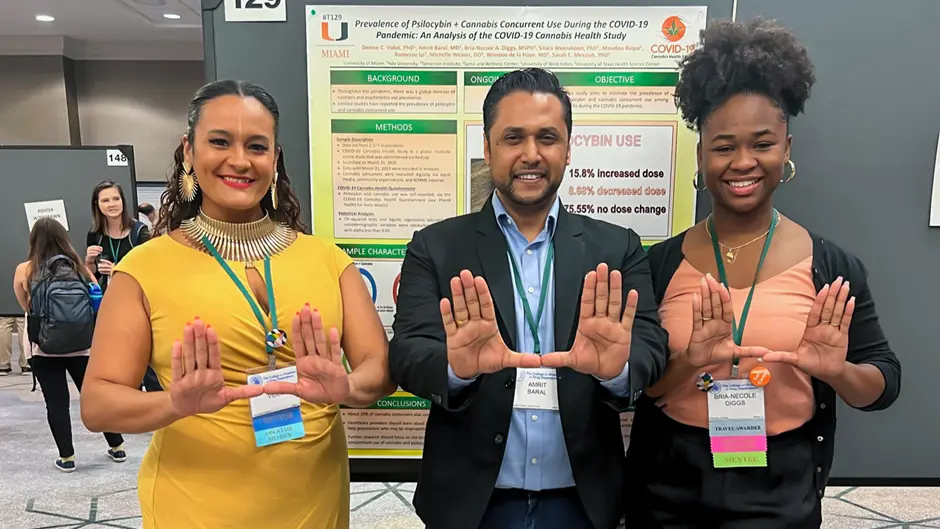
Bria-Necole A. Diggs and Amrit Baral are two key players. Both are assistant directors in the GCAP and co-authors on two recently published papers on cannabis and psychedelics
Diggs is soon to be a triple Cane. She began as an undergraduate in the collaboratory in 2019, went on to earn her B.S. in public health, then continued for a master’s degree and is now a doctoral candidate in epidemiology focused on cannabis research and innovation
Since attending her first International Cannabinoid Research Society’s Annual Meeting in 2022, Diggs has attended nearly every meeting since. This summer in France, she presented, in part, on AI-assisted research, cannabis use and sleep health research, and cannabis and psychedelic research that she’s spearheading
Originally from Liberia, West Africa, Diggs grew up in the Washington, D.C., area. While in high school, her sister’s condition with sickle cell disease motivated her to learn how medications impact the body and what it’s like to live with chronic pain. In a third-year University class with Vidot, she first learned about cannabis epidemiology and plant medicine, and a light went on.
“Oh, this is what I’ve been looking for, something holistic that can help people with chronic health conditions, especially pain,” Diggs remembered thinking
She continues to study the more than 100 different cannabinoids and their unique effects on health
“I’m really excited to explore how these impact people living with chronic conditions, see what change we can bring to their lives, and hopefully end some of this opioid and narcotic overprescribing and use plant medicine instead,” Diggs said
A practicing physician in his native Nepal before coming to the U.S. to study public health, Baral first earned a master’s degree and then a doctorate in epidemiology at the University. His dissertation explored classic psychedelics use and cancer in the U.S. population. He is now a postdoctoral fellow at Johns Hopkins University’s Bloomberg School of Public Health
Baral came to Miami originally to study HIV/AIDS, yet an interview with Vidot changed his career trajectory. He was not familiar with the endocannabinoid system integral to cannabis research
“But I was super interested, started learning more, and saw a lot of potential to do quality research of the potential benefit and also the risk or harms,” Baral said.
“Cannabis grows wild in Nepal and in many ways is part of our culture, used for traditional medicine and in rituals. But I had never looked at its therapeutic potential, only focusing instead on its adverse effects, so I started understanding its terrific potential,” he said
At the conference in France, Vidot’s team presented from its recent research on the impact of cannabis and psychedelics on sleep from the Herbal Heart Study
“Our studies are basically telling us that we can’t look at the substances in isolation. We have to see how the different types of psychedelics could be potentially talking to each other within our body,” Vidot commented
For her next stage of sleep-related research, Vidot plans to investigate dreaming, such as lucid versus sleep dreaming, and altered states of consciousness
“When you think about the dream world, psychedelics raise fascinating questions. People describe vivid immersive experiences that can feel like dreaming with your eyes open. That makes me wonder what these altered states might teach us about dreaming, insomnia and consciousness in the context of health outcomes.”
From her research, Vidot has an important takeaway message for clinicians
“This is the time, more than ever, to keep your eyes open and practice impeccable listening with your patients. If a patient trusts you enough to share about an experience with psychedelics or cannabis that they may be hesitant to disclose, honor it without judgment. What they share may be an important piece of understanding their health,” she suggested
That question of trust is now becoming a research focus of its own. Vidot recently received funding from Sylvester Comprehensive Cancer Center to study patient and provider communication about psychedelics and cannabis during cancer care
“For me, that’s where my team’s science goes next globally. It’s not enough to gather the data; we must continue collaborating with the community to translate what we learn into tools, conversations and services that reach the people who need them,” Vidot said
topics:
Health and MedicinePeople and CommunityHealth and LifestylePatient CareIn the Community
Top
