




Public Health Newswire from The Nation’s Health brings you the news you need now
Op-ed: To advance disability justice, public health should serve needs, not norms
- August 13, 2026
- Guest Author(s)
Guest author Rivers Laraque-Ho is a member of the Disability Justice Board, which advises APHA’s Center for Public Health Policy on its work on disability justice and public health. The center recently hosted a four-part webinar series that provides professional development on disability justice — a concept that centers on access, communication, dignity, trust and belonging, enabling people to fully participate in their communities and lives
Public health is a locus for hard conversations about what people need, who is responsible for meeting those needs, and how. What does it mean to be healthy? What does it look like to be sick? How do we make our lives better? And who gets to decide what other people need?
These are questions of imagination, questions of possibility and questions of practicality. They are questions that disabled people have a hard-won wealth of experience and expertise in. We cannot begin to have these conversations in earnest without disabled people. We cannot begin to have these conversations until we are ready to ask: What do you need?
Medicine uses the language of disorder to apprehend difference and correct it. Health is a powerful tool for enforcing norms: Setting standards for a healthy body, mind and life works not only to improve quality of life, but to define it — and ensure people lead the right life
Access and agency within public health are controlled by a hierarchy of knowledge that privileges “scientific expertise” over lived experience, characterizing one as subjective and the other as objective, imbued with the authority of fact. The assertion of reality is an assertion of power. By restricting access to certain treatment and services and promoting others, those in control coerce and corner patients into medical and life decisions that prioritize the ideological or financial interests of others.
Interventions that target disability or difference itself and work to remove, reduce or replace it to better approximate the norm are favored and expected in health practice. Consider the involuntary, unnecessary surgeries performed on intersex children, the “biological reality” asserted upon them. Is this what they need? People coo over videos of deaf children with cochlear implants hearing their mother’s voice for the first time, calling it a miracle, while the deaf community’s calls to expand sign language education and interpretation services go neglected.
Sign language is a miracle, too. Disabled people make miracles all the time. In a world that wasn’t made for us and doesn’t account for us, we account for ourselves; we make ourselves. When we cannot be one way, we find new ways of being. We invent new ways to talk to each other, to hear each other, to see and feel and hold each other
Institutionalization and access barriers have segregated disabled people from their communities, allowing misconceptions about disability to run rampant. There exists such terror of the disabled experience that, 20 years after being disproven, falsified research associating vaccines with autism still leads millions of parents to refuse lifesaving vaccinations for their children because they think that having a dead child is better than having an autistic child
But having an autistic child can be wonderful. Some fear the hard parts, and there are hard parts of being disabled or having a disabled child. Some think of disabled people as a burden. But we are all borne and birthed burdens. A burden can be a gift. We are none of us alone. We carry each other at the beginning and end, and every day in between. We rely upon each other to keep the lights on and the water running, to build houses and unclog sinks and make art for each other. This tethers us, our obligation. Human society is built on interdependence.
I dislike the language of “accommodations” for the same reason I dislike the language of “tolerance” — because it implies a generosity toward that which is undeserving, unnecessary or unpleasant. In truth, we are stingy. The accommodations approach addresses the needs of disabled people as an afterthought and puts the onus on disabled people to demand and prove their needs through lengthy, expensive, and humiliating processes. Accommodations become the privilege of those with a formal diagnosis, the means to litigate it — and the time to wait.
When we develop for disability and work to meet the needs of our most vulnerable, we build systems that serve everyone better — like subtitles, mainstreaming, texting! But instead of taking opportunities to transform our learning and work environments, we keep creating barriers to success and health, treating sustainable practices of care like an economy of scarcity. Stigma and bootstrap mentality further hold people back from accepting, allowing or seeking out that which might make their own lives easier. For what? Is that the world we want to create? A world of hardship? A world that is unforgiving?
Forgive yourself. If you need to sit, sit. If you need more time, take more time. You are allowed to struggle with things. You are allowed to ask for help. This is a process improvement, not a detriment
The curative approach to health positions the subject to fix the object; it renders us objects. Consider us subjects. It is time to include disabled people in our conversations and practices as agents of their own health and leaders in public health. It is time to include yourself in the conversations disabled people are already having. Come learn what we’ve learned. Come see what we’ve made. Meet us at the field of possibility where the queer imagination and crip innovation are making the world a better, kinder, cooler place. We’ll be waiting.
Stream the Center for Public Health Policy’s four-part webinar series online now, and access case studies, principles and other re
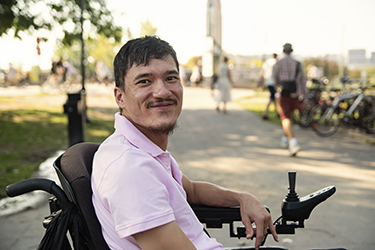
Photo by Martinedoucet, courtesy iStockphoto
Explore more topics
DisabilityEquity
