


By Katie Suleta, DHSc, MPH — Aug 14, 2026
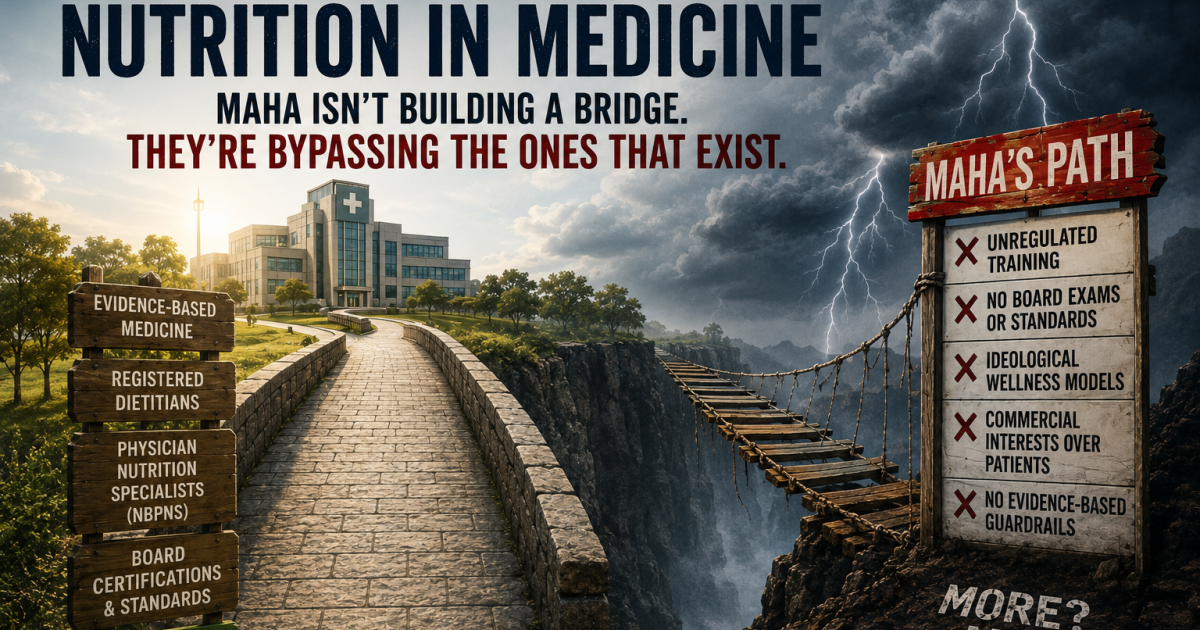
One of MAHA’s central claims, that medicine completely ignores nutrition, only holds up if you deliberately ignore the existence of registered dietitians, the National Board of Physician Nutrition Specialists, and similar organizations. MAHA isn’t building a new bridge for nutritional medicine; they’re bypassing existing infrastructure on both the physician and allied health care workers fronts.
Image by ACSH using AI
In a recent analysis, I examined how HHS’s new nutrition competencies for medical education effectively erased Registered Dietitians. By creating new framework competencies that bypass established interdisciplinary care teams, the federal initiative sidelined the 70,000+ credentialed dietitians already working in health systems. These are the very experts trained to provide clinical nutrition care. Instead of leveraging existing licensure and clinical referral pathways, they were erased in favor of policies favoring vague ‘health coaching’ models that lack standardized board exams, clinical oversight, or evidence-based practice mandates. But the erasure doesn’t stop with dietitians.
One of the central talking points of the Make America Healthy Again (MAHA) movement is that physicians receive little to no nutrition training. They frame this as a systemic void that only their new paradigm can fill. Yet this claim relies on ignoring the entire profession of registered dietitians as well as existing pathways for physicians to obtain additional training in nutrition
The National Board of Physician Nutrition Specialists (NBPNS)
The National Board of Physician Nutrition Specialists (NBPNS) was established in 1997. For nearly 30 years, physicians have had the opportunity to seek more education in nutrition through this organization.
“Physician Nutrition Specialists devote a substantial career effort to nutrition and can assume a leadership role in coordinating interdisciplinary clinical nutrition services and education …”
–About Us, National Board of Physician Nutrition Specialists
NBPNS provides training, certification, and continuing medical educationin nutrition. Their baseline eligibility requirements are far from daunting for a practicing physician;
requiring an active license to practice medicine, and “demonstrated expertise in nutrition,” which can be met numerous ways, including but not limited to mentor and peer attestation. While these requirements could always be more rigorous, at least there are requirements and an attempt at standardization. It’s far from a wellness influencer 2-hour course based purely on vibes that anyone can enroll in.
“NBPNS is also committed to supporting the achievements and advancements of our diplomats by increasing awareness as to the importance of having board certified PNSs as nutrition faculty in medical schools, as the leaders of multi-disciplinary nutrition teams, and in the community guiding both their colleagues and the public in the practice and promotion of evidence-based clinical nutrition.” —About Us, National Board of Physician Nutrition Specialists
NBPNS is not alone; there are multiple medical organizations that provide training/certification in nutrition. The National Board of Nutrition Support Certificationfocuses on enteral and parenteral nutrition and is open to most providers with a valid license. There’s also the American Board of Obesity Medicine(ABOM), which focuses on treating obesity, largely through diet and <a href="https://healthylife7.com/usar-deputy-commanding-general-visits-warrior-exercise-2026/” title=”USAR Deputy Commanding General Visits Warrior Exercise 2026″>exercise
MAHA Connection
NBPNS itself has been around for about 30 years, but there are multiple pathways for physicians to obtain more training in nutrition. It seems odd that MAHA, which is calling for more nutrition education, hasn’t leveraged existing medical organizations and bodies that focus on nutrition. If MAHA wanted to encourage more nutrition education inmedicine, one of the fastest ways to do so would be to offer incentives for physicians to become certified through NBPNS or a similar organization. But they aren’t doing that, which begs the question, “Why not?”
The answer lies in governance and control. Scaling NBPNS or empowering registered dietitians requires operating within established, evidence-based science and accredited board standards. Bypassing these bodies allows MAHA to substitute consensus-driven standardized clinical science with ideological wellness paradigms, unvalidated functional medicine certificates, and unregulated commercial interests. The goal isn’t to elevate medical standards. It is to sidestep the guardrails of evidence-based medicine entirely.
If MAHA truly wanted rapid, high-yield integration of nutrition into patient care, incentivizing fellowship training or CME through NBPNS (or similar bodies) and expanding interdisciplinary care with registered dietitians would be the fastest, safest route. That the ABOM has over 11,000 certified physicians demonstrates a thirst for and pursuit of additional nutrition training when accessible. If MAHA’s goal were simply to increase physician participation, they would look to ABOM’s success or scale NBPNS incentives. The fact that they ignore these pathways suggests their goal isn’t more, but differentphysician education.
There is a fundamental difference between identifying a gap in core training and claiming a void in the entire medical ecosystem. The expertise and infrastructure to bridge this gap already exist; they are underfunded, underutilized, and systematically sidelined. However, MAHA claims they’ve discovered an empty field. The field is far from empty, and MAHA is choosing to ignore the established, credentialed pathways already in place. That distinction matters. If their goal were truly to elevate the rigor of clinical nutrition, the safest route would be expanding access to recognized fellowship training and interdisciplinary care. Instead, MAHA’s actions suggest its goal isn’t to strengthen medical standards, but to replace science-based medicine with unregulated wellness practices and people—a system lacking the evidence-based guardrailsthat define legitimate clinical practice.
Tags:
Category
Food & Nutrition
Katie Suleta, DHSc, MPH
Katie Suleta is a regional director of research in graduate medical education for HCA Healthcare. Her background is in public health, health informatics, and infectious diseases. She has an MPH from DePaul University, an MS in Health Informatics from Boston University, and has completed her Doctorate of Health Sciences at George Washington University
Recent articles by this author:
The Manufactured Void in Medical Nutrition
Weaponizing “Gold Standard” science to undermine childhood vaccines
Wellness: a masterclass in monetization
When Aid Becomes Leverage, HIV Finds the Gaps
The Wellness Salad Bar: Why Skipping the Hard Work is a Public Health Risk
All articles by this author
