


Download PDF
Abstract
Work-related musculoskeletal disorders (WMSDs) are prevalent among physiotherapists and occupational therapists due to the physically demanding and repetitive nature of manual therapy techniques. Stretching requires therapists to exert substantial force while holding static postures for extended periods. Assistive devices may mitigate these ergonomic risks. This crossover study evaluated postural risk factors for WMSDs during lower-limb muscle stretching (targeting the hamstrings, calves, iliopsoas, quadriceps, hip adductors, hip abductors, and gluteal muscles) and compared manual with device-assisted techniques among 32 healthy practitioners (highly trained students and licensed therapists). Postural risk was evaluated using the Rapid Entire Body Assessment (REBA), and perceived comfort via a five-point Likert scale. Data were analyzed using mixed-effects regression models. Device-assisted stretching significantly improved therapists’ posture (mean REBA score: 11.35 units lower, P < 0.001) and increased the odds of belonging to a lower WMSDs risk category by 69.17-fold. Furthermore, device-assisted stretching significantly enhanced participants’ comfort for nearly all muscle groups (P < 0.010), with no period or carryover effects. These findings indicate that the assistive device can substantially reduce postural risk factors for WMSDs and improve comfort during lower-limb stretching. However, prospective clinical studies are needed to determine whether these postural improvements reduce the incidence of WMSDs.
Subjects
- Health care
- Health occupations
- Medical research
Abbre
DM:
Device-assisted first, then manual
MD:
Manual first, then device-assisted
OTs:
PTs:
Physiotherapists
REBA:
Rapid entire body assessment
TBZMED:
Tabriz University of Medical Sciences
WMSDs:
Work-related musculoskeletal disorders
Acknowledgements
This article was derived from the MSc thesis of Aliakbar Asil, student of Ergonomics at TBZMED. The authors thank all participants of this study. The authors also thank the head of the Biomechanics Laboratory, Faculty of Rehabilitation Sciences, TBZMED, for supporting this study
Funding
This study was financially supported by the Tabriz University of Medical Sciences [Grant No. 72400]
Author information
Authors and Affiliations
Department of Occupational Health Engineering, Faculty of Health, Tabriz University of Medical Sciences, Tabriz, Iran
Aliakbar Asil, Jalil Nazari & Melika Khabbazi
Health Science and Technology Park, Tabriz University of Medical Sciences, Tabriz, Iran
Aliakbar Asil
Department of Statistics and Epidemiology, Faculty of Health, Tabriz University of Medical Sciences, Tabriz, Iran
Neda Gilani
Faculty of Rehabilitation Sciences, Tabriz University of Medical Sciences, Tabriz, Iran
Ali E. Oskouei
Authors
- Aliakbar AsilView author publications
Search author on:PubMed Google Scholar
- Jalil NazariView author publications
Search author on:PubMed Google Scholar
- Neda GilaniView author publications
Search author on:PubMed Google Scholar
- Melika KhabbaziView author publications
Search author on:PubMed Google Scholar
- Ali E. OskoueiView author publications
Search author on:PubMed Google Scholar
Ethics declarations
Competing interests
The authors declare no competing interests
Ethics approval and consent to participate
This study was approved by the Ethics Committee of Tabriz University of Medical Sciences (Ref. No. IR.TBZMED.REC.1402.504) and was conducted in accordance with the Declaration of Helsinki. Informed consent was obtained from all participants prior to participation
Consent for publication
Written informed consent was obtained from all participants prior to participation in the study, including consent for photography and video recording during the performance and receipt of the stretching techniques. In addition, written informed consent for publication of the anonymized photographs presented in Figs. 1, 2, 3, 4, 5, 6 and 7 was obtained from all participants
Additional information
Publisher’s note
Springer Nature remains neutral with regard to jurisdictional claims in published maps and institutional affiliations
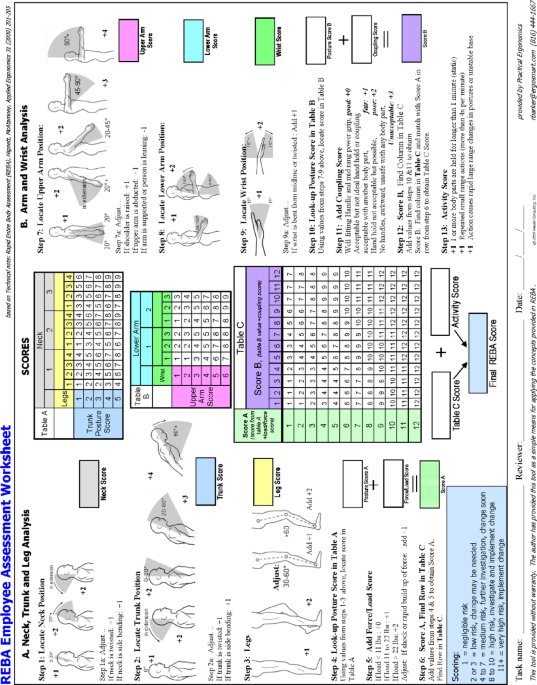
Appendix 1: Rapid entire body assessment (REBA)
Appendix 1: Rapid entire body assessment (REBA)
Rights and permissions
Open Access This article is licensed under a Creative Commons Attribution-NonCommercial-NoDerivatives 4.0 International License, which permits any non-commercial use, sharing, distribution and reproduction in any medium or format, as long as you give appropriate credit to the original author(s) and the source, provide a link to the Creative Commons licence, and indicate if you modified the licensed material. You do not have permission under this licence to share adapted material derived from this article or parts of it. The images or other third party material in this article are included in the article’s Creative Commons licence, unless indicated otherwise in a credit line to the material. If material is not included in the article’s Creative Commons licence and your intended use is not permitted by statutory regulation or exceeds the permitted use, you will need to obtain permission directly from the copyright holder. To view a copy of this licence, visit http://creativecommons.org/licenses/by-nc-nd/4.0/.
About this article
Cite this article
Asil, A., Nazari, J., Gilani, N. et al. Postural risk factors for work-related musculoskeletal disorders during manual versus device-assisted lower-limb stretching.
Sci Rep (2026). https://doi.org/10.1038/s41598-026-65644-9
Received:10 September 2025
Accepted:03 August 2026
Published:10 August 2026
DOI
:https://doi.org/10.1038/s41598-026-65644-9
